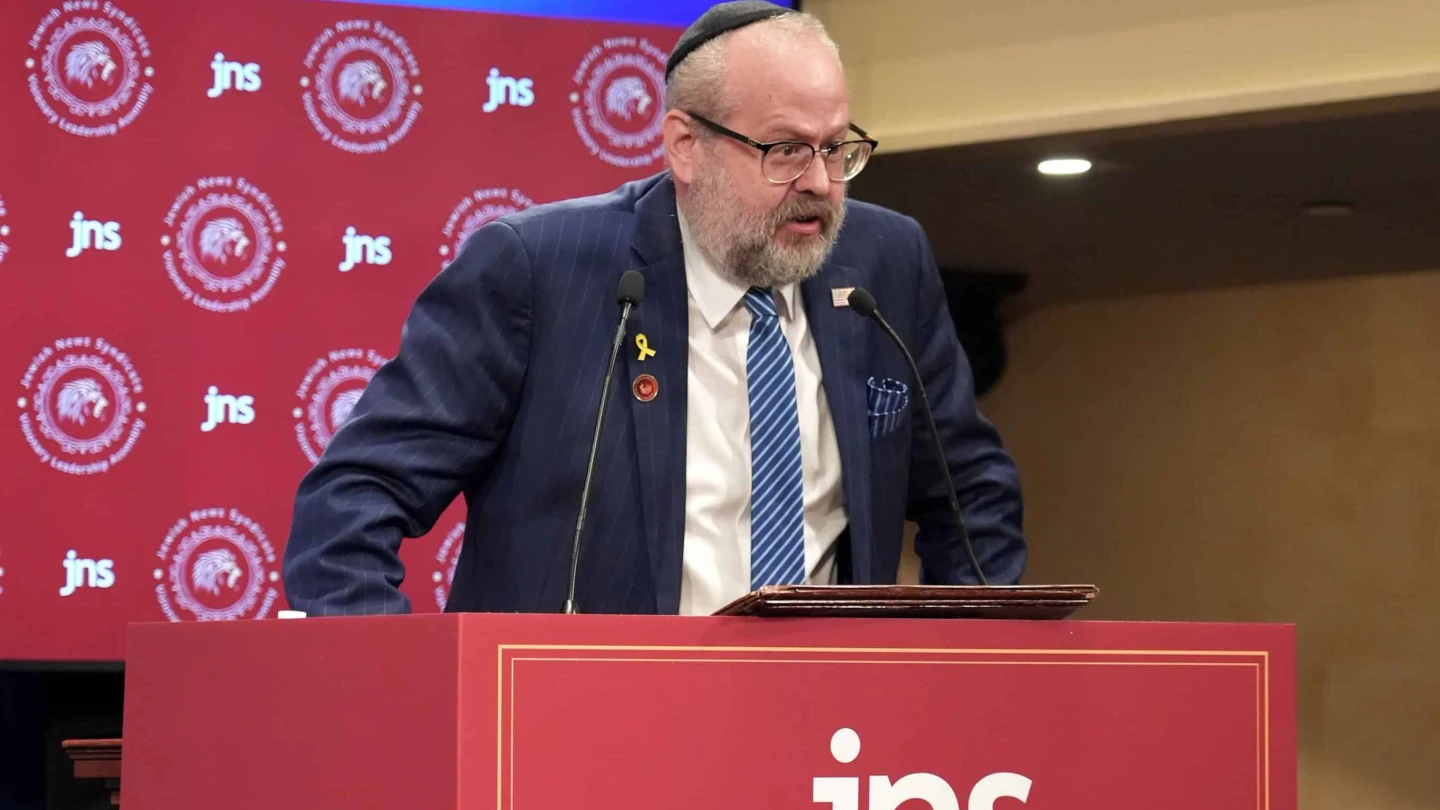
An evening with theater director, playwright and bestselling author Tuvia Tenenbom is always insightful and entertaining. His appearance at the Oz Vegaon Nature Preserve in Gush Etzion, Judea, on May 7 was no exception.
Tenenbom, 68, an Israeli-American, grew up in the ultra-Orthodox city of Bnei Brak and served in the Israel Defense Forces as a tank driver before settling in the United States, where he founded the Jewish Theater of New York, the city that currently serves as his primary residence. He travels extensively researching his topics and spends significant time in Germany and Israel.
An exceptional, fearless and outspoken journalist, he digs deeply into the issues he investigates, and while the subjects are always serious, he manages to lighten the discussion—and sharpen his point—with his trademark sense of humor.
The educational and recreational nature preserve was established by members of the nationalist Women in Green organization and residents of Judea, with the support of the Gush Etzion Regional Council, as a Zionist response to the murder of the three Israeli teens by Hamas terrorists in 2014 that triggered the IDF’s “Operation Protective Edge” in the Gaza Strip.
The event, hosted by the Sovereignty Movement (Ribonut)—an Israeli activist group founded in 2011 and co-chaired by Women in Green leaders Nadia Matar and Yehudit Katsover, advocating for the application of Israeli law and sovereignty to Judea, Samaria and the Jordan Valley—featured Tenenbom discussing his latest book, “Excuse me, is this Yours?”
“This” in the title refers to Judea and Samaria, the biblical heartland of the Jewish people. The book is based on the author’s eight-month stay in the region and his conversations with residents and leaders.
An open interview conducted by Israeli journalist and author Ifat Erlich with Tenenbom during the first half of the program, attended by about 200 people, was followed by a heated panel discussion hosted by tour guide Gabriel Asulin on the meaning of sovereignty and how to achieve it.
Tenenbom’s central argument, reflected in the title of the book, is straightforward: If Judea and Samaria belong to the Jewish people, Israel should declare sovereignty. If not, he said, Israelis should leave.
“This place is wonderful,” he said. “It’s the cradle of the Jewish people, and it makes no difference if you’re religious or not. It’s the land of the Bible. It’s the foundation of the Jewish nation. More than 80% of the stories in the Tanach [the Bible] happened here, not in Tel Aviv.”

‘Why isn’t there sovereignty?’
“So why isn’t there sovereignty?” Tenenbom asked rhetorically.
The main problem, in his view, is that Israel’s leadership does not fight hard enough for it.
For example, he questioned why Israeli Finance Minister Bezalel Smotrich, chairman of the Religious Zionism Party, and National Security Minister Itamar Ben-Gvir, chairman of the Otzma Yehudit Party, did not insist on sovereignty over Judea and Samaria as a condition for joining Prime Minister Benjamin Netanyahu’s government after the November 2022 election, when Netanyahu was struggling to form a coalition.
Tenenbom recalled hearing politicians repeatedly say: “It’s not the right time.”
“I love this region,” he continued, noting that when other countries win wars and capture territory, they generally keep it. “What’s wrong with us? I don’t understand. What are you afraid of? It’s your right.
“Is it yours? If not, get out of here. If yes, take ownership. Demand it from your leaders.”
According to Tenenbom, activists seeking sovereignty should pressure political leaders directly rather than staging demonstrations in public squares.
“Have a guy make a scene at shul, where your leaders go,” he said. “It would be over in two weeks. That was what ended Naftali Bennett’s government.”
Tenenbom argued passionately for Israeli sovereignty over Judea and Samaria, but what about the Arab population living there, many of whom are hostile to Israel?
“That’s very easy,” he told JNS. “When I wanted to get a green card in America, I had to swear allegiance to the United States of America. If you ask those Arabs, with their hands on the Koran, to swear allegiance to the Jewish State of Israel, how many of the two and a half million will do that? Maybe two and a half people.
“It’s very easy to do that. If you can do it in New York, why not in Tel Aviv?
“They cannot be Israeli citizens if they don’t swear allegiance; they are guests, like in any other country. If they want a permit to work, the government can decide.
“If the Jewish people who live in the settlements believe—or say they believe—they can convince the Palestinians to leave, they are lying to themselves and cheating themselves,” he added. “I asked the settlers and their leaders: If you really believe the Arabs are leaving, why did you spend millions and millions of dollars on special roads where only Israeli cars can drive, circumventing Palestinian areas?”

‘Sovereignty or another Oct. 7'
During the panel discussion, Rochel Sylvetsky, senior adviser for Arutz 7’'s English news site, described what she sees as the real apartheid in Israel, noting that residents of Judea and Samaria, unlike the rest of the country, are not governed by Israeli civil law.
Aside from the unfairness, she said, this shows the world that Israel does not intend to hold on to the territory.
She also pointed to significant steps taken by Smotrich to accelerate settlement expansion and dismantle legal barriers to land acquisition.
Attorney Maurice Hirsch argued that it is the Jewish presence in Judea and Samaria that creates sovereignty, noting that more than 550,000 Jews live there.
The public should demand the cancellation of the Oslo Accords and the dismantling of the Palestinian Authority, he said. “Either we prepare for sovereignty, or we prepare for another Oct. 7,” he warned.
Likewise, attorney Michael Sperber pointed to what he described as the security threat posed by Arab residents of Judea and Samaria.
“We want to move them eastward. Jordan is Palestine, and if we say this openly, it is the only thing that will guarantee our survival,” he said.
Omer Rahamim, CEO of the Yesha Council, said it is crucial ahead of the next national election, due by Oct. 27, to secure a decisive victory for a government that views Judea and Samaria as an intrinsic part of the State of Israel.
Dubi Sheffler, head of the Efrat Local Council, called on each person to contribute to advancing sovereignty, including by bringing tour groups to Judea and Samaria.
Nearly 60 years after the Six-Day War, Israel has yet to declare sovereignty over Judea and Samaria.
“But it will happen,” Katsover and Matar affirmed in their closing remarks. “Because it’s ours.”
The book is currently available in Hebrew via Sela Meir/Tzomet Sfarim. An English-language edition from Gefen Publishing House is expected in July, along with a German edition from Suhrkamp Verlag.