


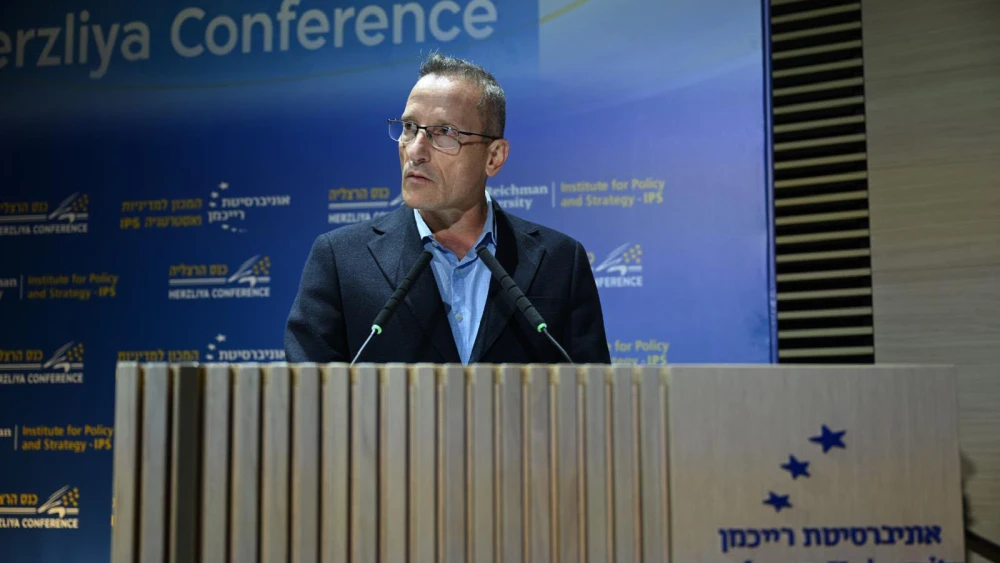
Maj. Gen. (res.) Amir Baram, director general of Israel’s Defense Ministry, said on Wednesday that Jerusalem must prepare for a “new regional architecture,” warning that emerging global agreements could funnel “hundreds of billions of dollars” to Tehran.
Speaking at the Herzliya Conference at Reichman University, Baram called for a tailored Israeli force buildup and the formation of a broader regional alliance, first and foremost with Israel’s strategic ally, the United States, stretching “from India through the UAE to Greece and Cyprus,” citing shared concerns over Iran.
“Israel’s strengths in technology, proven operational experience, and defense innovation, combined with the Gulf’s financial power, could enable a new security-economic front,” he said. “Expanding our strategic partnerships is not a substitute for our partnership with the United States, but it will allow Israel to broaden its room to maneuver and its standing on the international stage, and will allow us to diversify our strategic footing.”
Baram also addressed ongoing negotiations over a new U.S.-Israel security memorandum of understanding, emphasizing that the partnership must be grounded in both shared values and strategic interests. He noted differing priorities between Washington and Jerusalem, describing Iran as an “existential threat” for Israel but a “chronic regional challenge” for the United States, which remains focused on China and the Indo-Pacific.
“We think Tehran, they think Taiwan,” Baram said, summarizing the differing strategic priorities of Jerusalem and Washington.
“America First” policies require Israel to position itself as a stabilizing regional force, he said, adding that a strong Israel enables Washington to shift resources toward Asia.
“This is the foundation of the next Memorandum of Understanding on security cooperation now being formulated. The agreement will need to generate security, economic, and strategic benefits for both countries for years to come,” said Baram.
On defense readiness, Baram said Israel has increased production of Arrow, David’s Sling and Iron Dome interceptors through emergency measures, including expanded procurement and industrial output, though efforts are ongoing.
“Israel’s long-term force buildup is dangerously behind. If we continue to act this way as a state, the risk to Israel’s tailored security readiness will become the greatest,” he warned at the Herzliya Conference.


