For Oklahoma native Hayden Jones, antisemitism and visceral hate struck him head-on when, while walking from the House of Representatives to the Senate at the U.S. Capitol, he was spat on for wearing a yellow ribbon in solidarity with the Israeli hostages being held by Hamas in Gaza.
The 22-year-old had grown up in a strongly pro-Israel home and later studied at a private Christian university in Tulsa, and so had been largely sheltered from the surge of often violent demonstrations that swept many U.S. campuses following the Hamas massacre on Oct. 7, 2023. The incident was an eye-opener to the hatred he encountered while working in a Senate office.

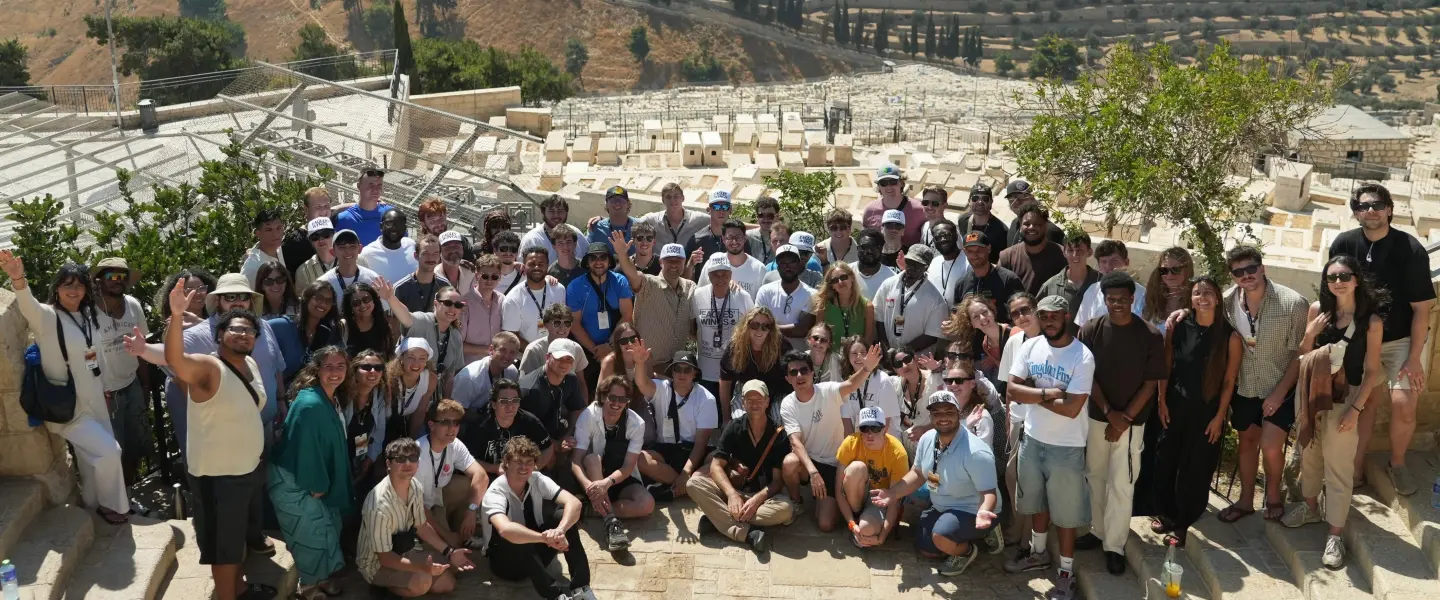
“Coming from a Republican stronghold that is known as the ‘buckle of the Bible Belt’ to Washington, D.C., to encounter openly pro-Hamas and pro-Hezbollah supporters was something of a shock to me,” Jones told JNS on Sunday at the end of a weeklong tour of Israel for scores of Christian students and young professionals, mostly from the United States, initiated and organized by the New York-based Eagles’ Wings Ministry in partnership with Israel’s Ministry of Foreign Affairs.
“It showed me that there is a loud, vocal minority and a silent majority where most people are sitting on the fence.”
The visit, which crisscrossed the country, included a Friday night dinner with Jewish families in the Jerusalem-area community of Efrat in the biblical heartland, which participants singled out as a highlight. The trip was geared toward countering declining support for Israel among young evangelicals amid the fallout from the war in Gaza, according to public opinion polls.
“This trip has made me understand that I should not stay silent,” said Pedro Martins, 24, of São Paulo, Brazil. “What scares me the most is that we should not be silent.”

Feeling at home in the Holy Land
“Coming from California, I witnessed a lot of anti-Israel activity, so I had no idea what I was coming to,” said Maisie Skiles, 23, who studied at California Baptist University and, like many of the participants, was visiting Israel for the first time.
“The most surprising thing for me in coming here was how at home I felt. In fact, I felt more connected and at home in this community than I did in my community back home for a long time.”
She cited a visit to the Western Wall as a personal highlight and noted how moved she was to see people of different faiths and attire united in prayer.
“As a Christian, I was crying next to a woman very different than me,” Skiles said. “It made it seem like a call to action for me.”
“Every time I come, I am always surprised by how far reality is from the narrative you see in the media,” said Avery Williams, 27, of Dallas, Texas, who works as an administrator with Eagles’ Wings, an international evangelical group, and was on her third trip to Israel. “To come and see the land and see the freedom and diversity that exists is so opposite of the mainstream narrative that is common on social media.”
She said that even friends back home had asked her why she would support a nation on the other side of the world, adding that she felt Christians were not familiar enough with their Bible.
Some participants said the communal reverence of a Shabbat family gathering was often lacking in their own societies, save for Christmas, and that they felt the Bible come alive in Israel.
“I felt I was stepping into the place I read about for years in my Bible,” Martins said.
As the group traveled around Israel, participants took to humming their own version of the classic 1971 song “Take Me Home, Country Roads,” replacing the refrain with the words, “Shalom, shalom, we are home.”