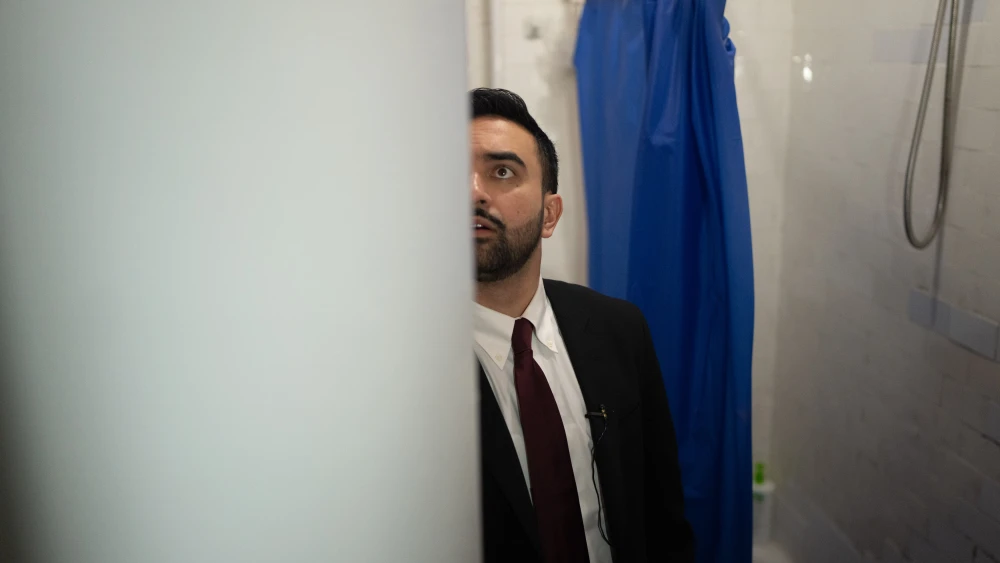
The first hearing of a case, over which Gerald Lebovits, a New York County Supreme Court judge, presided on Thursday was about whether New York City Mayor Zohran Mamdani’s administration has illegally withheld records about his revocation, on his first day on the job, of his predecessor’s executive orders protecting Jews.
It also doubled as a legal classroom for and a pitch to law students from New York University and China about how rewarding a legal career can be, in which City Hall’s lawyer, the plaintiff’s attorney and the judge gave their spiels about why they chose their profession.
“The law is a noble profession. You can do so much good in your life in the law,” Randy Mastro, an attorney and former first deputy mayor of New York City, told the students. “Law is a profession. It’s not a job.”
Mastro was on hand in the snug, high-ceilinged courtroom representing Richard Behar, a veteran investigative journalist, who alleges that Mamdani’s office has denied several of his requests under the state’s Freedom of Information Law to share documents about the anti-Israel mayor’s decision to axe executive orders of former mayor Eric Adams.
Late Wednesday, hours before the court heard oral arguments at 3:30 p.m. on Thursday, a batch of documents that Behar had requested more than eight months earlier arrived suddenly in his email inbox.
Mastro told the court on Thursday that not only had it taken more than eight months to secure the documents, but the released information contained “nothing substantive at all,” due to large swaths of redacted materials, and instead of explanations of City Hall’s reasoning, the documents were transcripts of mayoral press conferences, inquiries from reporters—including from JNS—and press releases.
Behar had sued Mamdani and the city for what he said was a “pattern of obstruction.” In court, Mastro called City Hall’s responses a “gross inadequacy.”
“I’m shocked,” Mastro told JNS in the hallway outside the courtroom after the hearing.
“A mayor, who said it’s gonna be the most transparent administration in history, is turning out to be one of the least transparent administrations in city history,” he said, “and particularly on this issue—city actions that implicate antisemitism policies.”
“We need to get to the truth,” he told JNS. “We need to know what’s really gone on.”
Among the roughly 20 people who observed the case on Thursday were members of the New York City Council and Jewish community members.
The 11th-hour city release of documents changed Thursday’s hearing from a dispute about a City Hall delay to one about whether it provided adequate documentation.
Mastro told JNS that the Mamdani administration spent months trying to “throw up barriers” by withholding documents, “claiming privilege” and “delaying for eight months, producing anything, and then having given virtually nothing.”
“Without any explanation at all. That’s outrageous,” he said. “That’s not transparent government. That’s a government more reminiscent of what you would find behind the old Iron Curtain. It’s not right.”
Behar told JNS after the hearing that the documents did little to satisfy his effort to understand how the administration reached the decisions.
“The mayor had his day one, when he issued the executive orders,” Behar said. “Today is essentially our day one.”
“We’re not going away,” he told JNS. “Whatever records exist, we’re gonna get them.”
‘Wholly inadequate’
Eric Hiatt, an attorney representing the city, argued in court that Behar could not yet ask Lebovits to order the release of material the city had redacted or withheld. Behar first has to appeal the city’s response and give the administration another chance to decide whether more records should be released, the attorney said.
“There’s a process to identify those issues and to allow the producing party, your mayor’s office, to address those,” Hiatt told the judge. “Then that administrative record is developed, and then it can properly be before the court.”
Behar took that step Friday, filing two appeals with the city over the records it had withheld and redacted. He shared the appeals with JNS.
In the first, Mastro called the city’s response “wholly inadequate.” After months of waiting, the administration produced only two items: an email attaching Mamdani’s first executive order and a press release about the signing of the orders, he wrote.
“The mayor’s office has offered no particularized justification for its withholdings. It has merely cited statutory exemptions without explaining how they apply to any specific document,” Mastro wrote in the appeal.
“It strains credulity that a seven-month search for all records relating to the mayor’s first and most significant executive order yielded only two publicly available documents,” he wrote.
The second appeal also called the city’s response “wholly inadequate.”
“It is not credible that the mayor’s office’s search yielded only a handful of press-related emails and a public transcript in response to requests covering the definition of antisemitism, BDS policy, the New York City Economic Development Corporation website removals, the NYC-Israel Economic Council and the Cornell-Technion partnership,” Mastro wrote.
“The production demonstrates that responsive documents have been improperly withheld,” he said.
In January, Behar sought records from City Hall about the rescinded executive orders, including those that had adopted the International Holocaust Remembrance Alliance’s working definition of Jew-hatred and barred city agencies from boycotting Israel.
In May, he asked for records about the disappearance of city web pages promoting business relationships with Israel and Israeli companies, the future of the New York City-Israel Economic Council and possible efforts to end the city’s collaboration with the Cornell University-Technion partnership.
Behar filed suit in June after waiting months for responses to the two FOIL requests.
In the appeals on Friday, Mastro asked the city to release additional records, explain why it was continuing to withhold others and respond within five days—the timeframe Hiatt had given Lebovits in court.
“We will go through the procedural hoops, and we will follow from where they lead us,” he told JNS on Thursday.
“As I predicted, we’ll be back here again, and we will get to the truth, because antisemitism is too important not to get to the truth,” he said.
The court also heard a related FOIL case brought by Republican City Council members Joann Ariola, who represents parts of Queens, and Inna Vernikov, who represents parts of southern Brooklyn, among other petitioners.
Their attorney, Jack Lester, is seeking records about the Mamdani administration’s policies on Jew-hatred, its approach to the IHRA definition and the city’s ties with Israel.
Mastro told JNS that Behar intends to continue pursuing the records regardless of how long the process takes.
“The extraordinary lengths to which the Mamdani administration is going to try and drag out something that it’s required to do by law—provide basic information from the government about the decisions the government makes under freedom of information,” are “shocking,” he said. “We will keep litigating until we get to the truth.”
“I’m sure the court will hear us when these procedural issues are behind us,” he told JNS.