Newsletter
Newsletter Support JNS

Swiss parliament votes against recognizing Palestinian state

The lower house in Bern followed the example of upper one last year, and rejected a motion by a large majority.

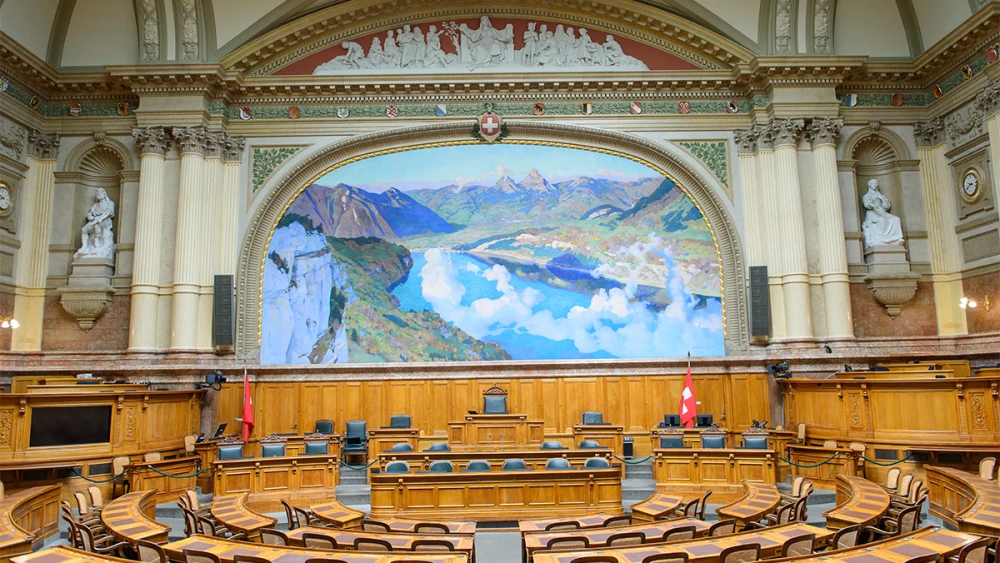
The hall of the lower house of the Swiss Parliament. Photo courtesy of the Federal Council of Switzerland.
The hall of the lower house of the Swiss Parliament. Credit: Courtesy of the Federal Council of Switzerland.

The lower house of the Swiss parliament voted on Tuesday against recognizing Palestinian statehood, following the example of the upper house last year.

In the vote at the National Council of Switzerland, 116 lawmakers out of 200 voted against recognition and 66 voted in favor, according to a bulletin by the Federal Assembly of Switzerland, the country’s bicameral parliament. Another 11 lawmakers abstained and the vote of the remaining seven lawmakers was not recorded.

The vote was on a text submitted by the Geneva Canton and, in addition to proposing Swiss recognition for Palestinian statehood, it would have affirmed that Switzerland make “every possible effort to establish a just and lasting peace between Israel and Palestine, drawing in particular on the Geneva Initiative.”

The Geneva Initiative was a plan promoted by left-wing and far-left Israelis and PLO officials in the 2000s that proposed that the Palestinian Authority take over the Old City of Jerusalem, except for the Jewish Quarter, among other concessions, en route to the establishment of a Palestinian state in Judea, Samaria and Gaza.

Jonathan Kreutner, the General Secretary of the Swiss Federation of Jewish Communities, or SIG, told JNS: “We have always said that we support the two-state solution, but that it should be achieved through negotiations and a peaceful resolution, not through unilateral declarations.”

On Sep. 9, 2025, the Council of States, the Swiss senate, rejected an initiative for Switzerland to recognize the “State of Palestine,” with 27 voting against and 17 in favor.

Canaan Lidor is an experienced journalist and international correspondent for JNS, covering Europe, Australia and global Jewish affairs.
The designations include Hezbollah-linked institutions that “threaten regional stability, international security, mutual interests and global trade,” the U.S. Treasury Department stated.
Gerard Filitti, of the Lawfare Project, told JNS that “lax immigration policy” has always been the main driver of importing “terrorist ideology” into the United States.
“The teachers we have, we don’t respect and support in the way that they deserve,” Paul Bernstein told JNS. “If we’re successful and we grow enrollment, that problem only gets bigger.”
“The message being sent is that you can get away with attacking someone in broad daylight because you disagree with their opinions, especially if it involves feelings about Israel,” Joshua Burt, of the Anti-Defamation League, told JNS.
“Not identifying Hamas as a terrorist organization is, I think, a failure, Marc Miller told the Canadian Press. “And not clearly stating that, for example, Hamas intended to kill Jews is, I think, an unfortunate error in curation and should be rectified.”
“This is life for Jews under the leadership of Mayor Zohran Mamdani,” advocacy group StopAntisemitism wrote.