Newsletter
Newsletter Support JNS

No ancient Roman racism, says Ramaswamy at Jewish spoils-funded Colosseum

“Citizenship is the distinction they drew. It wasn’t just about what you got in return, it was about your duty to your nation,” the former presidential candidate wrote.

Colosseum
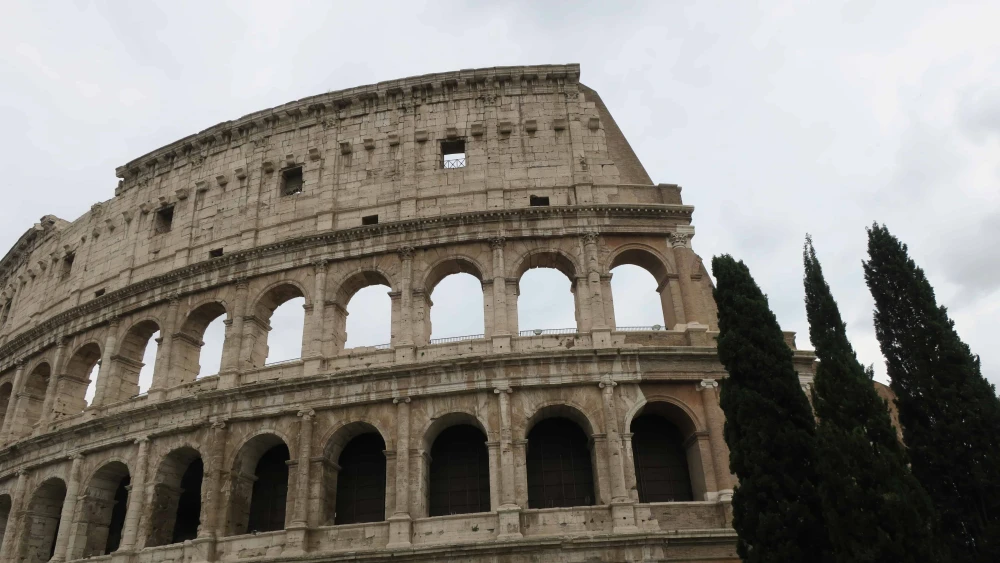
The Colosseum in Rome. Photo by Menachem Wecker.

There was no “racism” in ancient Rome, when “emperors were white, black, Arab, didn’t matter,” former presidential candidate Vivek Ramaswamy wrote on Sunday.

The entrepreneur posted photos on social media on Sunday of him and his family at the Colosseum in Rome.

“The color of your skin was like the color of your eyes. *Citizenship* is the distinction they drew,” he wrote. “It wasn’t just about what you got in return, it was about your duty to your nation.”

Ramaswamy added that Roman emperors were born in Libya and Arabia. “The fact that people think these things are so incredible as to be implausible reveals how our understanding of history has become unnecessarily racialized,” he wrote.

The Colosseum is said to have been built with the spoils of the Jewish Temple in Jerusalem, and with Jewish slave labor.

Israeli airstrikes destroyed a launcher after projectiles were fired at troops, and forces also struck a suspicious vehicle in the area, the IDF said.
A pioneering project sends desalinated water into a once-dry Galilee wadi, offering a glimpse of how Israel turned chronic scarcity into abundance.
“Without me, there would be no Israel,” U.S. President Donald Trump said at the G7 summit in France.
“It is a big problem if she is making these kinds of statements while officially representing the E.U. on the world stage,” said one E.U. diplomat.
The U.S. president told reporters that he intends to read his agreement with the Iranian regime “word by word” publicly to set the record straight.
“When you have something saying you can’t go to someone who uses divination, or a witch, or consults spirits, or a wizard, or a necromancer, that means this is something people were doing,” Eddy Portnoy, the curator, told JNS.