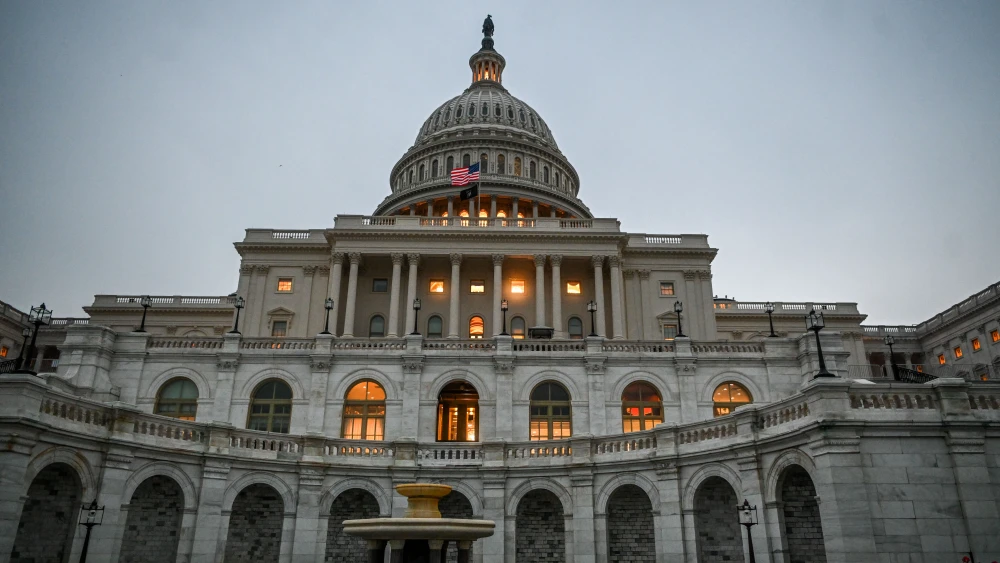

It’s easy to be cynical about congressional hearings. They often seem political and ideological. They encourage grandstanding. But hearing rooms aren’t courtrooms and they aren’t meant to be. Public hearings are forums where lawmakers are able to expose real problems in ways invaluable to American democracy.
In an era when the most pedigreed brands in journalism have abandoned their duty to report facts honestly in favor of extremist advocacy, hearings can also be an essential corrective, allowing citizens to bypass the legacy media filter and glimpse reality for themselves.
But, it turns out, if you can look past some showboating, public hearings are forums where lawmakers expose not only themselves, but real problems in ways invaluable to American democracy.
In an era when the most pedigreed brands in journalism have abandoned their duty to report facts honestly in favor of extremist advocacy, hearings can also be an essential corrective. Even performative hearings allow citizens to bypass the legacy media filter and glimpse reality for themselves.
Americans can decide whether we appreciate the behavior of the distinguished members of the House and Senate just as we can judge the value of the information being brought to light. Sunlight, Justice Louis Brandeis famously wrote, is the best disinfectant.
Sometimes, the light shed by hearings—even if it’s just a momentarily brilliant flash of lightning—shifts culture more effectively than any law because it reveals something significant that our media have chosen to misreport, underreport, or hide.
We see this with academia. For years, the normalization of antisemitism on the institutional Left was denied and minimized. Jews, the minority most targeted for hate in America, were treated across DEI-corrupted campuses as privileged oppressors, unworthy of protection.
Then came Congress’s post–Oct. 7, 2023, hearings on antisemitism at elite universities. The bloodless banal evil of university president testimony shocked millions, exposing academia’s tolerance of genocidal antisemitism and its systemic mistreatment of Jewish students. Denials collapsed. Culture began to shift. No law could have done that. Congressional hearings did.
But academia is only one front. A danger even greater in scope lies in the antisemitism that courses through our elite media — the filters that shape narrative, perception, opinion, and policy every day. Being forced to testify before Congress shone a light on the universities; it is even more necessary to expose the media.
Consider just one story by one publication on one day: The Washington Post’s massive feature on July 30 listing 18,500 names it claimed were “children” killed in Gaza by Israel. Its sole source? The so-called Gaza Health Ministry—Hamas itself.
The Post admitted it published the list “as provided,” without verification or context, in flagrant violation not only of every acceptable standard of ethical journalism, but of its own published policies and standards of fairness and accuracy.
As Jonathan Tobin, the editor-in-chief of JNS, observed, “the mainstream media acted as stenographers for Israel’s foes in much the same way they now do for Hamas’s claims about civilian casualty statistics, starvation and other supposed Israeli misconduct.”
In other words, this is not journalism. It is propaganda. And it is not just The Washington Post.
The results are horrifying. As Tobin noted, “The correlation between the shocking rise in hate crimes committed against Jews and the adoption by corporate media of these anti-Israel narratives is patently obvious.”
There is—and must be—a strong presumption in favor of a free press. But no freedom is absolute. We draw legal lines, for example, when it comes to obscenity, threats, and defamation. And under federal law, there may be another line: the felony of providing “material support” to a designated foreign terrorist organization (FTO).
Could such conduct rise to the level of “material support” for a foreign terrorist organization—a federal crime? Possibly. Congress created both the FTO designation process and the material-support statute. That means Congress has a direct interest in whether American media corporations are laundering propaganda for terrorist organizations the U.S. itself has identified.
Yet law has limits. As the Supreme Court observed in Holder v. Humanitarian Law Project (2010), independent speech—however odious—is broadly protected. Prosecutions cannot solve this problem because antisemitism is not merely a legal issue; it’s a cultural toxin that mutates across centuries. It cannot be outlawed out of existence. But maybe the light of public hearings can force it to scurry back into the sewer.
And there’s another angle Congress should consider: the Foreign Agents Registration Act (FARA). FARA does not criminalize speech; it demands transparency when entities act “at the order, request, or under the direction or control” of foreign principals while engaging in political persuasion in the U.S.
The debate over Al Jazeera is instructive: critics argued its alignment with Qatari policy warranted registration; defenders warned of endangering press freedom. The DOJ eventually required some affiliates, such as “AJ+”, to register, while sparing the core news operation.
What makes today’s situation alarming is the echo chamber effect: libelous charges against Israel—“genocide,” “child-killing,” “deliberate starvation”—originate overseas and are then laundered and amplified by U.S. outlets until they harden into conventional wisdom. Our “free press” risks becoming a megaphone for foreign principals, laundering propaganda designed to shape American opinion and policy.
Whether or not such conduct falls squarely under FARA, Congress has a duty to investigate how this works, and whether disclosure obligations should apply when content becomes unrecognizable as journalism and indistinguishable from foreign influence.
Congress can provide oversight and shed light. Hearings strip away denial, reveal complicity, and render the invisible visible. They allow decent Americans to see betrayal with their own eyes.
Famously, the corrective for disagreeable speech is more speech. Nothing can bring more awareness of the diabolical role now played by major U.S. media companies than unfiltered public hearings.
That is why hearings matter. They do not manufacture morality; they unleash it. Most Americans are good people. Most recoil from cruelty and lies when they see them. Hearings provide that moment of clarity.
We’ve studied academia. Let’s meet the press.
Hamas knows it cannot win militarily. Its battlefield is narrative. And when American outlets recycle Hamas’ lies as fact—by publishing unreliable, unverifiable lists of “dead children” or promoting lurid famine images—they are not simply failing at journalism. They are resurrecting the oldest antisemitic blood libel in modern form: Jews as child-killers.
This is exactly the kind of predicament a congressional investigation into the ties—the coordination—between Hamas, an FTO and the American media can spotlight. And it is why the question of FARA must also be on the table: whether our press has become a willing agent of foreign influence, laundering propaganda for America’s enemies.
Congressional hearings cannot end antisemitism. But they can strip away its deniability, expose its conduits, and rebalance the cultural frame.
And this isn’t only about Jews or Israel. When major American media corporations launder terrorist propaganda, the damage reverberates here at home. It fuels unrest in our cities, mobs at our embassies and schools, radicalization on our campuses, and violence in our streets. It undermines America’s foreign policy abroad and corrodes civic trust at home. It destabilizes democracy itself.
The Constitution names as the government’s first duties the securing of national defense, the preservation of domestic tranquility, and the guarantee of equal protection under law. All three are imperiled when the press—meant to be the guardian of our liberties—instead becomes the megaphone of our enemies.
Because mainstream media have become the essential platform for a foreign war waged by narrative, they now function as a domestic weapon against America’s own cohesion. That is why congressional oversight is urgently required.
Will media— and Jew-haters—gnash teeth, claiming that such hearings “chill” speech? Yes. But hearings are not censorship; they are democracy’s version of countering bad speech with more speech.
They cannot cure Jew-hatred or dissolve extremism. But they can strip respectability from those who spread it—whether on campus and in the streets, or on camera and in the headlines. That is how we defend not only the Jewish people and America’s ally Israel, but the peace, safety, and survival of America itself.