
“ … those vast impersonal forces … ” — T.S. Eliot
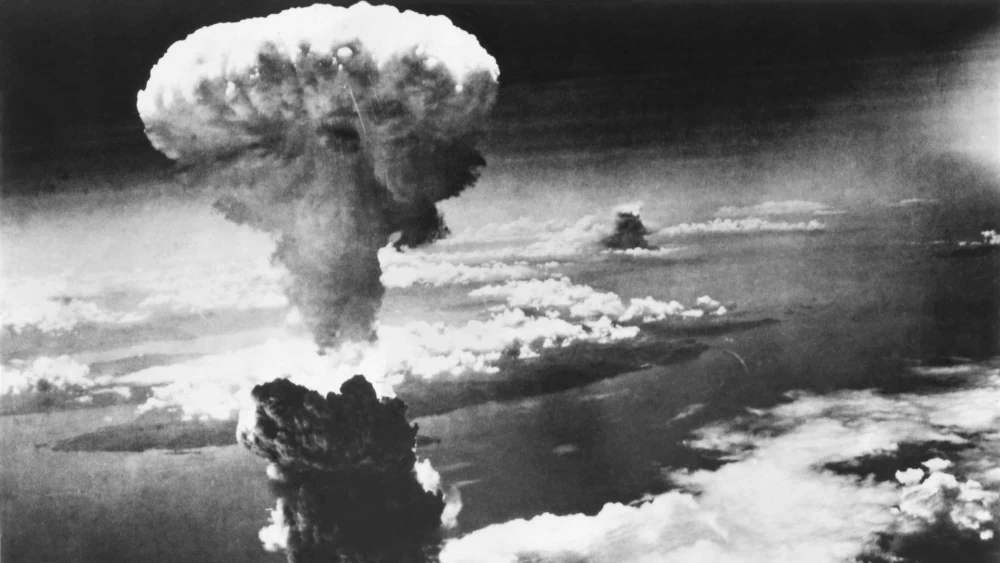
There has never been a nuclear war. Hiroshima and Nagasaki don’t really “count” because they constituted the use of nuclear weapons during an otherwise conventional war.
Before August 1945, nothing “more advanced” could have been expected. But today, 81 years later, a nuclear war is not merely possible; it is plausible. Though nothing can be predicted scientifically about such a conflict (in logic and mathematics, probabilities must be based on the frequency of pertinent past events), we needn’t be logicians or mathematicians to reach the following conclusion: All decipherable nuclear war prospects would be intolerable.
Realistically, over time, the accelerating fusion of belligerent nationalism with nuclear weapons will produce unbearable outcomes. Moreover, in comparison to what happened at Hiroshima and Nagasaki, these outcomes will be force-multiplying and effectively irreversible. They will have transformative impacts on human survival options. A nuclear war—any nuclear war—would resemble an incurable disease. All serious “therapies,” therefore, lie in prevention.
In identifying war-avoidance methodologies, gifted thinkers will need to seek science-based “cures.” To meet this incomparably grave obligation, only “deep thinkers” should be granted eleventh-hour responsibilities. Under no circumstances should a survival-centered species place its collective fate in the tied hands of political leaders.
In world politics, as in economics, good news can sometimes be bad news.
It’s high time for candor: Nuclear war is not a contrived peril. To avoid it, we must study it “impersonally” and with reference to certain primary distinctions.
The first such distinction centers on differences between an intentional nuclear war and an unintentional nuclear war. This may sound elementary, but these differences are staggeringly complex and potentially bewildering.
Inter alia, if the distinction between intentional and unintentional nuclear war is overlooked or undervalued, the United States and other major states will impair their residual capacities to survive. Whether suddenly or incrementally, such an impairment could become existential and irremediable. This is the case whether the impairment concerns a single state or several states.
There is more: For gifted strategic thinkers, self-contradictory expectations will be manifest. Here, not every oxymoron would automatically be unreasonable. In world politics, as in economics, good news can sometimes be bad news. Though humankind is obviously fortunate to have avoided nuclear war so far, such good news could also signify “something bad.”
In the United States, Israel and certain other places, “high thinkers” will need to decipher complex strategies for averting nuclear conflict and minimizing unpreventable harms. Such confounding calculations would vary according to presumed enemy intentions and supposed prospects of accident, hacking intrusion or decisional miscalculation. Linguistic precision would be imperative.
To wit, any instance of accidental nuclear war would be inadvertent, but not every inadvertent nuclear war would be the result of accident. All such examples represent interlocking elements of a single overriding security problem: preventing a nuclear “final epidemic.” This term was used as the title of an important early book dealing with the danger of nuclear war, The Final Epidemic: Physicians and Scientists on Nuclear War by Ruth Abrams and Susan Cullen (1981).
These are not matters for educated laypersons or military professionals. Nuclear war prevention and mitigation ought never to be approached by national security thinkers as a preeminently political or narrow tactical issue. Informed by serious historical understandings and consciously refined analytic capacities, U.S. strategists should continuously prepare for a large variety of intersecting factors. Even under the best workings of modern science, though this variety would be multidimensional and daunting, it ought never to be considered insoluble.
The hazards of misleading nuclear-warfare calculations can be understood only in light of the conceivable intersections between them. All such critical intersections would be more or less plausible, a conclusion based on expectations of formal logic (not actual history) and the knowledge that mutually reinforcing intersections could at some point become “synergistic.” Close attention to credible nuclear synergies—intersections in which a “whole” conflict outcome would be greater than the sum of its “parts”—would be necessary.
In dealing with nuclear war risks involving Iran, North Korea, Russia, China, India or Pakistan, no concept could prove more important than “synergy.” Unless synergistic interactions were correctly anticipated, the United States could underestimate the cumulative impact of any nuclear engagement. The flesh-and-blood consequences of such underestimations could defy “impersonal” analytic assessments and pointless post-war justifications.
One final observation: In America’s current war against Iran, even the non-nuclear belligerent could launch a dedicated cyber campaign against enemy power plants, data centers or public water installations. To cause major harm to the United States and its allies, Iran would not need its own nuclear weapons. Instead, focused on asymmetrical warfare, it could rely on certain nuclear-state allies (North Korea or Pakistan) or its own already advanced cyber-weapons.