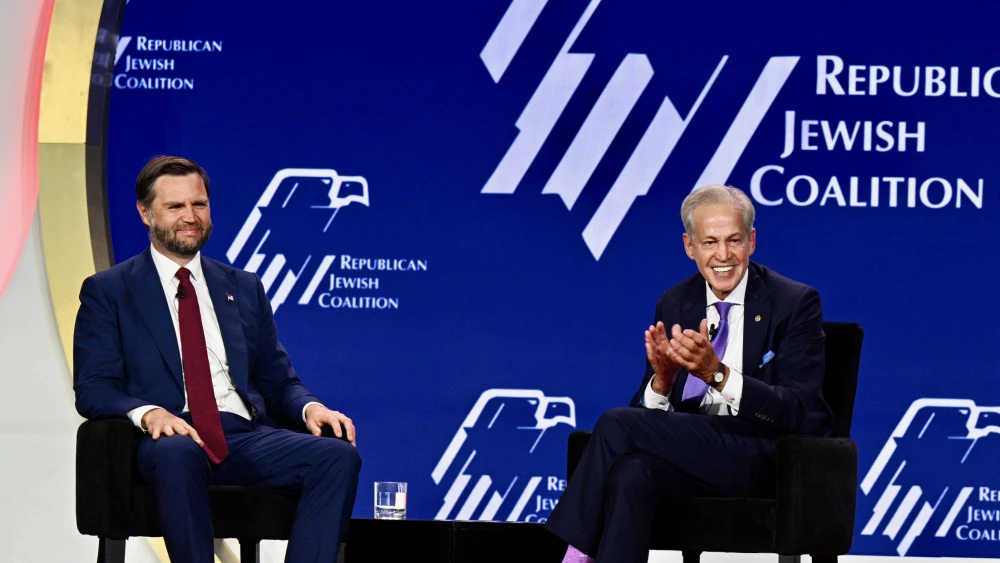
Vice President JD Vance spoke to Jewish Republicans in Las Vegas on Monday amid doubts from some pro-Israel conservatives about his feelings towards the Jewish state, his self-described “realist” foreign policy views and his relationship with Tucker Carlson.
Vance was met with applause by attendees at the Republican Jewish Coalition’s annual summit for his conversation with former senator Norm Coleman, the coalition’s national chairman. The discussion was closed to press, but a recording of Vance’s remarks was released by the Daily Wire shortly after he spoke.
The vice president said that it was “natural” that the United States and Israel have “different views on certain things,” but that it is the “most important regional alliance” of the United States and “one of our most important alliances in the world.”
“I believe there are a few countries—Israel, the U.K.—where there’s a much deeper cultural symbiosis and harmony than exists with most other countries,” Vance said. “I wouldn’t say that it’s purely transactional in the same way that I wouldn’t say that our alliance with the U.K. is purely transactional.”
Vance said that one of the “elephants in the room” is that “there is a growing suspicion among, I would call it under-40s, of the U.S.-Israel relationship.”
“My view is what we have to do is articulate why this is in the best interest of the United States of America and actually get out there and talk about the ways in which it is in the best interest of the United States of America,” he said.
“I can only speak for myself here, but I think it’s very, very important to talk about the concrete alignment of interest and to hook the relationship on that, rather than something that may have made a lot of sense, rhetorically, 30 or 40 years ago, but just doesn’t have the same purchase as it did 30 or 40 years ago,” Vance said.
U.S. President Donald Trump’s record of support for Israel was a common refrain from GOP officials at the conference, but as Vance is a likely contender for 2028, it is an open question whether he will be as enthusiastically received by pro-Israel Republicans as are other potential candidates, like Sen. Ted Cruz (R-Texas) or U.S. Secretary of State Marco Rubio.
Vance’s remarks were closed to press, but the Republican Jewish Coalition’s CEO Matt Brooks, former White House press secretary Ari Fleischer and Sen. Jim Banks (R-Ind.) answered questions from reporters about the discussion after the vice president spoke.
JNS asked if Vance’s appearance at the conference should be viewed as the first campaign event of the 2028 presidential election.
“Senator Coleman said over and over again that the Trump-Vance administration is the most pro-Israel administration we’ve ever had and that line resonated with the crowd,” Banks said. “That’s a line that I think you heard then that you’re going to hear after the midterm as we head into the presidential cycle, too.”
Fleischer, who is also on the coalition’s board of directors, said that the focus of Vance and Republicans remains the 2026 midterms but that the vice president’s talk was important engagement with American Jews.
“Today is not primary day, but I think today was progress day for JD Vance with the Jewish community,” Fleischer said. “Don’t overstate how presidential today was or was not. That’s not what it was about, but it was progress, and that’s important.”
“I think the vice president really answered a lot of questions in a way that made a Republican Jewish Coalition really comfortable,” he said.
During their talk in front of about 1,000 attendees, Coleman asked Vance about his interviews with Tucker Carlson, Joe Rogan and other podcasters who have hosted anti-Israel guests or been accused of antisemitism and how he distinguishes them from Holocaust deniers like Nick Fuentes.
“Where I really do draw the line is on people who engage in what I call this ‘blood-guilt attitude,’” Vance said. “I recognize a lot of people in this room are going to disagree with things that Tucker Carlson or Megyn Kelly or Joe Rogan have said, but just to hone in on Fuentes and Rogan, I think these are two very, very different categories of people.”
He did not explicitly condemn Carlson, whose podcast he appeared on in 2024 shortly after Yad Vashem accused Carlson of engaging in antisemitism and Holocaust denial.
“As a political matter, I think that we have got to be willing to go everywhere and bring our message anywhere and to any person,” the vice president said on Monday. “Outside of some pretty bright lines, I try to talk to as many people as I can.”
Vance said that he believes antisemitism is “corrosive for the soul” and spoke about his relationships with Jews and views on Christian-Jewish relations.
“My solution to this, and I’m hardly an expert on the Jewish faith, but I believe that Jews and Christians, one of the critical things that we agree on is this concept of Imago Dei, that we are all made in the image of God,” Vance said.
“The core of antisemitism to me is the idea of blood libel, the idea that because of your genetics, because of your blood, because of your ancestry, you are guilty of a crime that you never committed,” he said.
“I think that blood libel, which is at the root of antisemitism, is the exact opposite of the Christian gospel, and because of that, I believe the gospel is actually the solution to this,” he said.
Vance attributed some of the rise of antisemitism in America to immigration policy.
“The worst antisemitism grows up when you allow the importation of large groups of people who bring their ethnic rivalries to the United States,” he said.
Fleischer told reporters after the vice president’s remarks that Vance had made clear his “emotional connection to the Jewish people.”
“A lot of Jewish people hadn’t had a chance to hear that from the vice president yet,” Fleischer said.
At least one attendee at the conference was unimpressed with Vance’s performance.
“My honest assessment of Vice President Vance tonight? He was not strong enough on Israel,” wrote Sid Rosenberg, the WABC New York talk radio host. “I don’t think he wowed the strong Jews in the room tonight.”