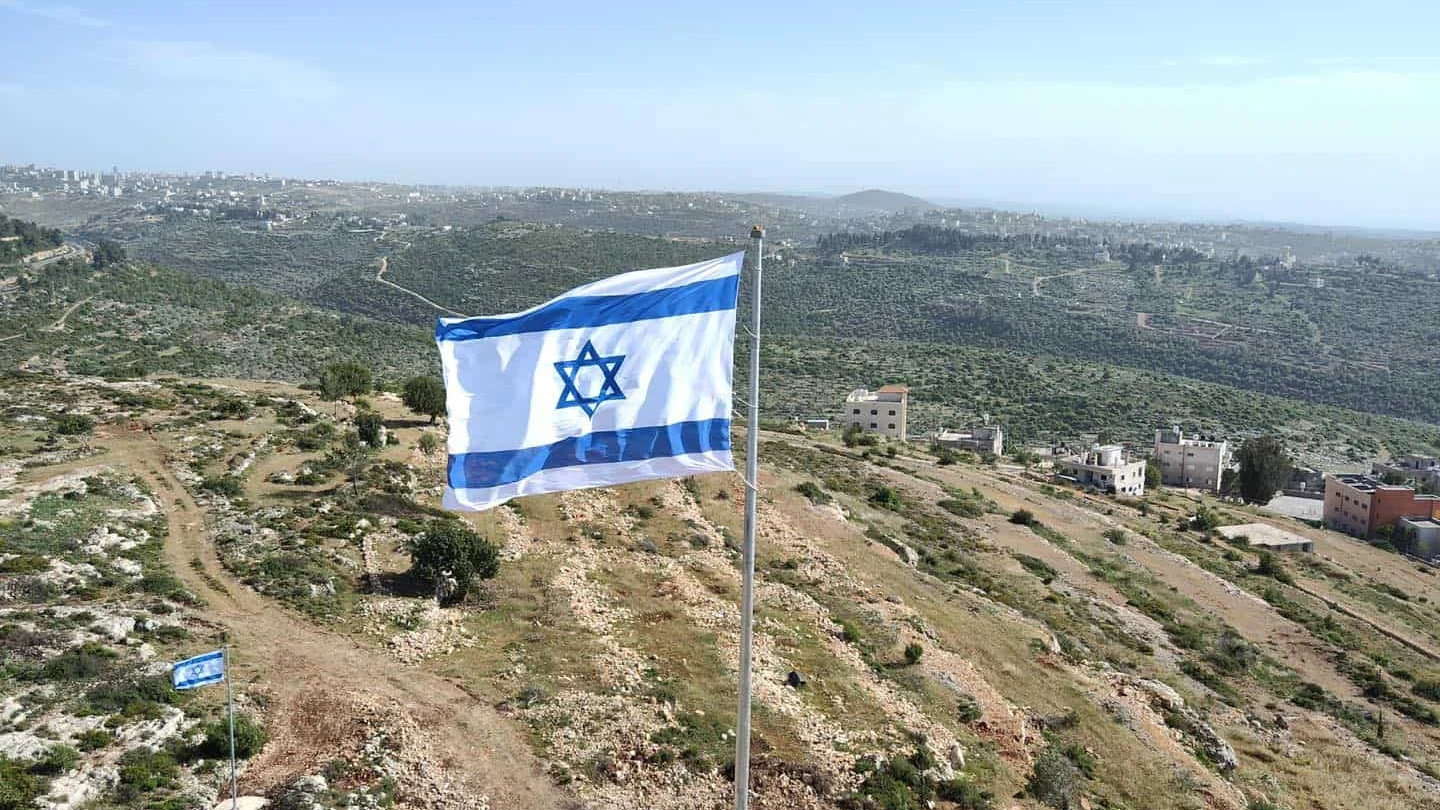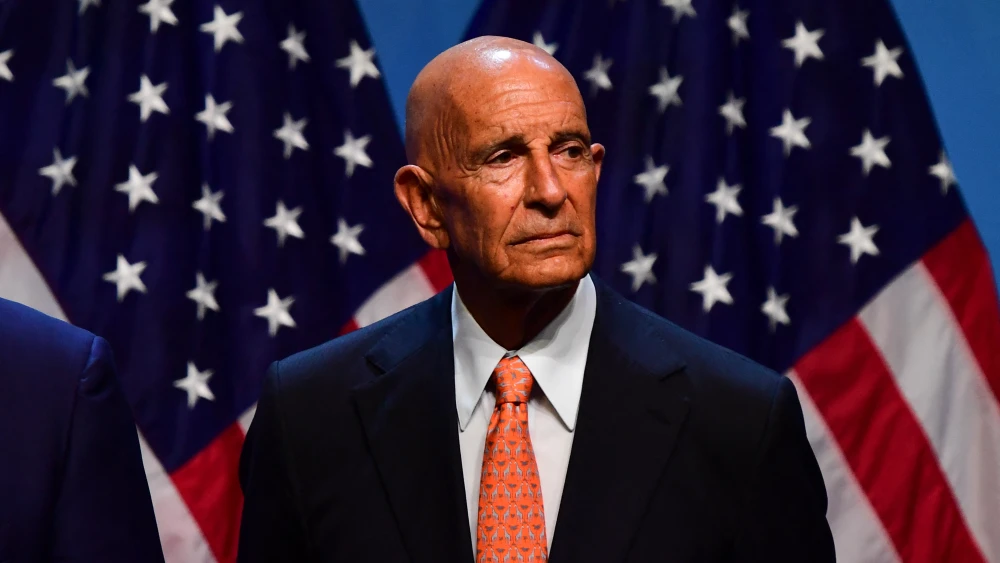

Tom Barrack, the American ambassador to Turkey and U.S. President Donald Trump’s envoy for Syria and Iraq, told an interviewer on Aug. 22 that Israel “still occupies the Golan against the U.N. resolutions, against all of the international order, which has said the Golan is Syria’s.”
Yet the president Barrack serves recognized Israeli sovereignty over the Golan by proclamation in 2019, and that recognition remains American policy.
Shortly after, Israeli Defense Minister Israel Katz called the remarks “full of inaccuracies,” and Sen. Rick Scott (R-Fla.) observed that the ambassador seemed to have forgotten his own president’s proclamation. Barrack quickly walked his statement back.
Policy on the Golan, he told the Associated Press, was set by Trump in 2019 and is unchanged. His use of the word “occupation” described historical status, not the U.S. position.
We’ve seen this cycle before. When The New York Times prints something outrageous and retracts it, it runs it in small print—late and light—drawing only a fraction of the traction of the original, which has already been quoted in 100 places by people who will never see the correction. Here, the original distortion came from a sitting ambassador, and the correction was a note to a wire service.
Barrack effectively stated that Israeli sovereignty is always provisional. This assertion was withdrawn. The frame that produced it was not.
There is an old naval expression for this: a loose cannon. A cannon that breaks loose of its tackle on a rolling deck does not aim at anything. It weighs two tons, moves with the ship and smashes whatever lies in its path.
The danger is not malice but mass without restraint. Barrack is that loose cannon on the deck of Trump’s foreign-policy frigate.
Consider another remark he retracted. Barrack said two parties were missing from the Israel-Lebanon negotiating table: Hezbollah and Iran. He said it one day after the U.S. Treasury Department specified Hezbollah as operating under the direction of Iran’s Quds Force, which has been listed by Washington as a Foreign Terrorist Organization since 1997.
Soon, Barrack was explaining that he had merely described a difficulty rather than proposed a new structure for negotiations. But an ambassador who needs a spate of criticism to see that his phrasing required a clarification is operating without the requisite instincts regarding the critical issues at hand.
Then came the part Barrack has not walked back. He floated a theory that Israel struck Syria’s Abu al-Duhur airbase to bait Turkey into a response that would help Israeli Prime Minister Benjamin Netanyahu ahead of the Oct. 27 election in Israel. He further called Ankara’s leadership “not predatory.”
Thus, an American ambassador accused an allied government of manufacturing a military confrontation for domestic advantage and then warmly vouched for Turkish President Recep Tayyip Erdoğan.
Ankara has issued arrest warrants for Netanyahu on genocide charges, moved advanced weapons into post-Assad Syria and served for years as Iran’s financial back door. Whatever description fits that record, “not predatory” isn’t it.
A cannon that breaks loose on a rolling deck smashes whatever lies in its path.
The clearest refutation came from Netanyahu’s political opponent Yair Lapid, who said on Aug. 20 that the strike on al-Duhur was justified. Lapid has every reason to portray Netanyahu as an extremist gambling with the American alliance, and Lapid is no hawk on the issue in any case.
Katz said that opposition figures first called the operation politically motivated and shifted only once it emerged that the IDF had recommended it, which makes the concession more probative rather than less. In fact, the army urged the strike repeatedly on clear intelligence about Turkish intentions, and the general staff does not make recommendations to improve Netanyahu’s polling.
Thus, Barrack’s theory is not an argument about Israeli politics but a broad-stroke slander against the Israeli army.
None of this is new.
At April’s Antalya Diplomacy Forum, Barrack publicly questioned the sincerity of Israel’s concern for the Druze people and called the Lebanon ceasefire fragile because everyone involved had been untrustworthy—placing Israel on an equal moral plane with Hezbollah. Washington responded by enlarging his portfolio.
Nor are complaints about Barrack an Israeli monopoly. Bechara Charbel, the Lebanese journalist and former editor-in-chief of Nidaa al-Watan, accused Barrack of a repeating pattern: Every time Lebanon begins pulling away from Tehran and Hezbollah, Barrack says something that drags it back.
Consider the source: A Lebanese Christian sovereigntist who has spent his career trying to pull his country out from under Hezbollah’s control, watching an American envoy with no Lebanon portfolio throw the militia a lifeline.
Barrack’s convictions were formed the way most men’s are: inside a particular set of rooms. He began as a young lawyer in Saudi Arabia in the 1970s and built the billion-dollar financial firm Colony Capital on Gulf sovereign wealth. In 2021, federal prosecutors indicted him as an unregistered agent of the United Arab Emirates, though a jury acquitted him in 2022. This is fair enough, but it does not erase four decades of formation.
Layer onto that the ordinary hazard of diplomacy, which is capture.
Erdoğan is Barrack’s host, his daily counterpart and the source of every deliverable he can carry back to Washington. An envoy who wants to win treats his host’s preferences as a center of gravity and whoever complicates them as an obstacle. Israel is a permanent obstacle, and so is a Lebanon that insists on disarming Hezbollah.
This is not a conspiracy but an incentive structure operating as such structures do. What shields Barrack is friendship. Forty years close to Trump apparently places him beyond the machinery that disciplines envoys.
Jerusalem should stop treating each Barrack pronouncement as a gaffe requiring a fresh clarification. The pattern is the message. Every time an American ambassador says “occupation” about the Golan, he hands a legal weapon to any foreign ministry or tribunal that wants one, stamped with the seal of the United States, and no swift retraction retrieves it.
The loose cannon does not need to go over the side to count as a severe hazard. Barrack’s retraction was a hand on the barrel, not a rope. Until someone lashes the loose cannon back where it belongs, everyone nearby should understand what is coming across the planking. Israel should stop pretending it cannot see it.