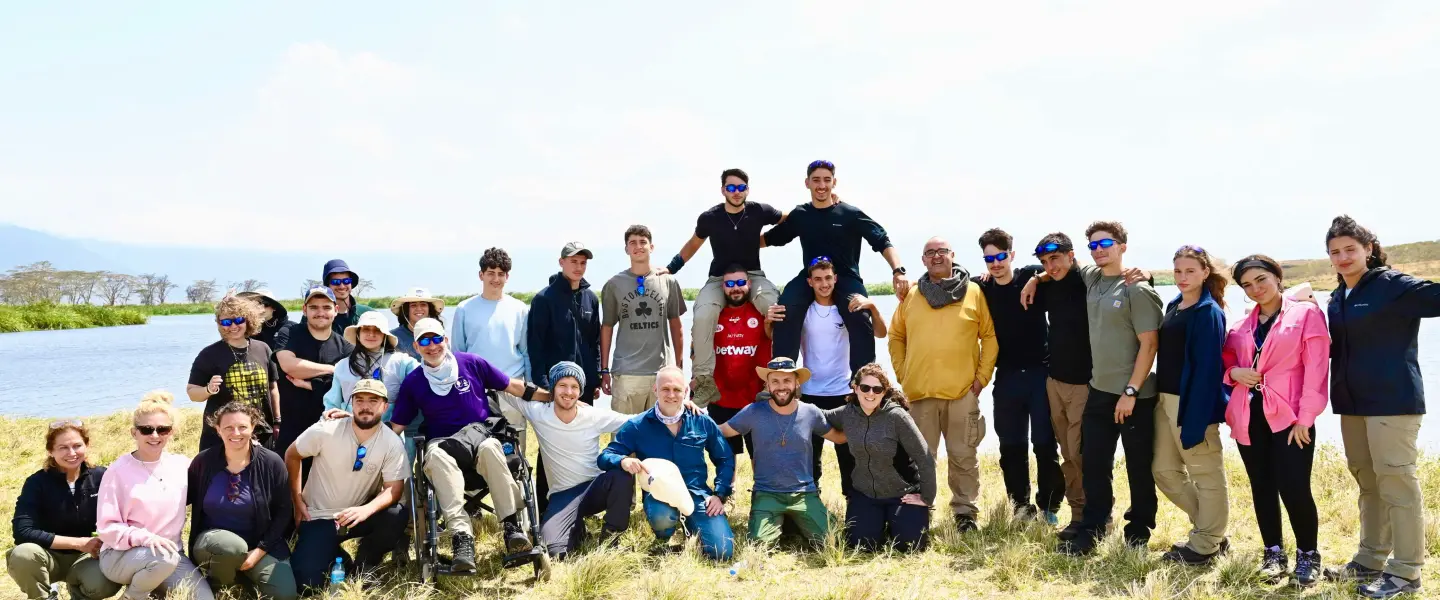
For a group of determined Israelis, climbing Mount Kilimanjaro in Tanzania, which rises 5,895 meters (19,341 feet), was only the most recent challenge they have had to overcome.
Thirty-six Israelis—Jews, Muslims and Druze—including people with disabilities, those dealing with cancer or loss, victims of terror, soldiers with war wounds and PTSD, and those evacuated from their homes in the north, set out in late July to climb Africa’s tallest mountain—and to show what is possible even when facing a range of life challenges.
The 36 Israelis and another 30 participants from the United States took part in the fifth Kilimanjaro climb coordinated by Accessibility Accelerator, the U.S. partner of Access Israel, a nonprofit organization that promotes accessibility and inclusion for people with disabilities.
The goal of the expeditions is to promote accessibility and inclusion. It was the second year that a delegation from Jeremy’s Circle, an Israeli NGO, participated in the climb.

‘A lesson for life’
Pamela Becker, co-founder and CEO of Jeremy’s Circle, said, “When we returned from the first expedition, we realized that the real journey had not ended at the summit of Kilimanjaro. We saw teenagers return with self-confidence, a sense of capability, and resilience that will stay with them for years to come.
“They moved from being the ones receiving support to becoming the ones offering it to others, discovering that sometimes by helping someone else you discover your own strength. That is why it was clear to us that we wanted to give more teenagers the opportunity to experience this journey. For them, Kilimanjaro is not just a mountain; it is a lesson for life.”
Becker founded the organization in 2008 after her husband, Jeremy, died of cancer, leaving her with three children under the age of six. She said the organization currently supports 1,280 families and hosts 20 events a year.
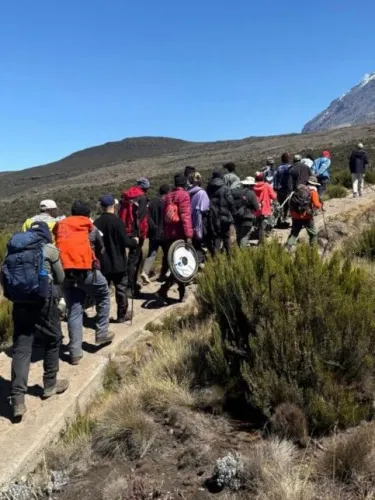
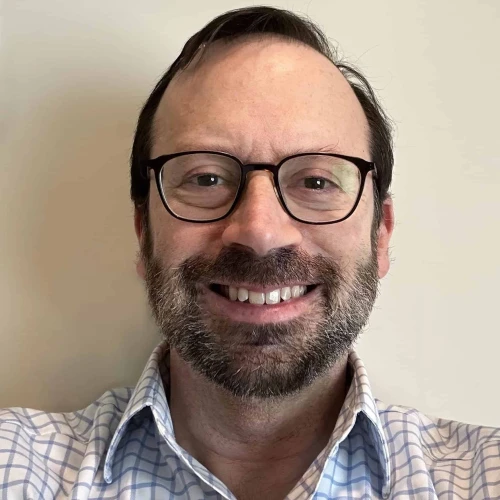
Daniel Nativ-Halperin of Jerusalem, a cancer survivor and member of Jeremy’s Circle, was pleased with his accomplishment on Kilimanjaro.
“I am proud and happy that I made it,” said Nativ-Halperin, who admitted that two weeks was a long time to be away from his family. “I never did something like this in the past!”
He was particularly impressed by the way participants helped one another. “It was a great, supportive atmosphere. Everyone helped each other—especially on the final ascent.”
The team traditionally sets out at 10 p.m. and continues through the night to reach the summit at sunrise.
Becker said one participant hiked, unbeknownst to his family, wearing a shirt bearing a picture of his father, who had recently died.
“His father had wanted to climb Kilimanjaro but was too ill—he wanted to feel close to his dad!” she said.

‘I learned what I am capable of doing’
This year, Becker’s team also included youth from Tzevet Ran, an organization that prepares teenagers for meaningful military service. Members of the group had been evacuated from their homes in northern Israel during the war.
Two wheelchair users were part of the Israeli delegation, including Abu El Haj Mahmoud, a Muslim man who has served as a team leader in Access Israel’s Purple Vest Mission.
The Purple Vest Mission, launched in March 2022, is an emergency preparedness and rescue initiative aimed at ensuring that people with disabilities and the elderly are not left behind during crises.
Mahmoud, 54, who lives in Acre, said he was inspired to participate in the Kilimanjaro climb after learning the story of Yuval Wagner, a former IDF helicopter pilot who was paralyzed in a crash during a training mission and went on to found Access Israel.
“When I met Yuval Wagner at Access Israel, I learned what life really is. I learned what I am capable of doing in life,” Mahmoud said.
As a Purple Vest volunteer, Mahmoud answered a call seeking someone with a large accessible van to help evacuate elderly people and people with disabilities from Kiryat Shmona.
“During the recent war, I found myself helping evacuate people, including women and Holocaust survivors, while under fire. Every evacuation was truly a story in itself!”
His work with Purple Vest and the Kilimanjaro climb have also affected Mahmoud’s sense of self.
“I am proud of myself today, after the Kilimanjaro journey. I am proud that I move around in a wheelchair. It doesn’t take anything away from me. On the contrary, it lifts me higher and higher and higher.”
Mahmoud and other wheelchair users who have participated in previous Kilimanjaro missions made the ascent with the help of a large support team and Paratrek Trekkers, specialized off-road mobility chairs.

‘Far more than a mountain’
Jamie Lassner, CEO of Accessibility Accelerator, the U.S. partner organization of Access Israel, said, “Watching this extraordinary group of Israelis take on Kilimanjaro moved me deeply. Some came through Access Israel’s ‘The Day After’ program, rebuilding their lives after devastating injury and trauma. Alongside them were two heroic Purple Vest Mission drivers who have repeatedly run toward danger to rescue people with disabilities and older adults, determined to leave no one behind.
“This was about far more than a mountain. It was about finding the courage to move forward when life has been forever changed, discovering what is still possible, and knowing we do not have to climb alone. Kilimanjaro rises 19,341 feet. What these remarkable men and women overcame to get there is immeasurable.”