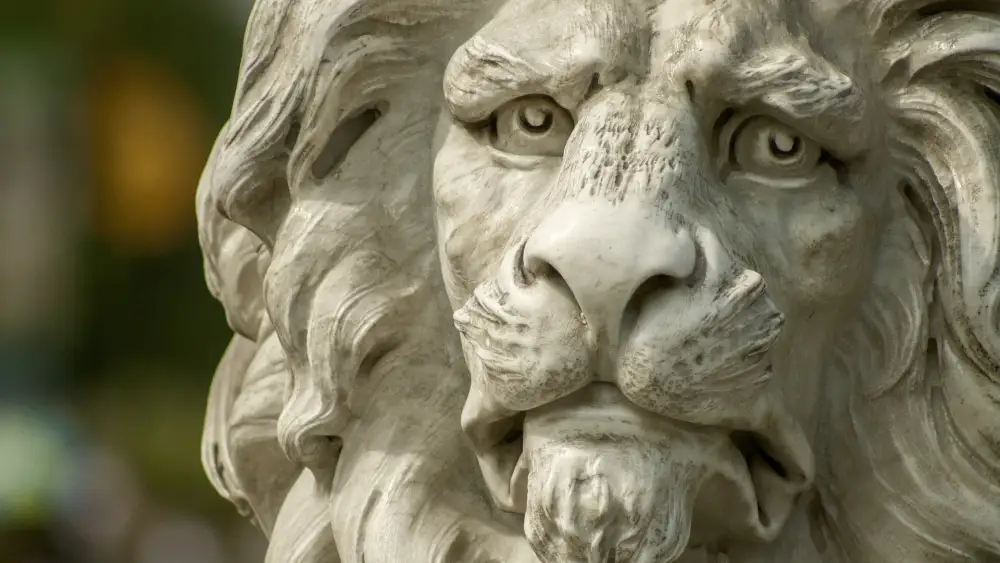

As Israel’s “Operation Roaring Lion” proceeds, mascots come to mind.
A mascot is “a person, animal or inanimate object that represents an organization or a group, often symbolizing good luck and fostering unity among members and supporters.”
Sports teams have mascots, as do fraternal/service organizations (Elks, Eagles, Moose). The two major American political parties each have a mascot, as does a certain American insurance company (think “Emu”). Thinking about what’s been happening to Jews around the world even before Oct. 7, it occurs to me that it’s time for Jews to revisit the subject of our mascot.
To be sure, the Jewish people never had a prior “official” mascot. But for centuries, the lion was the de facto representation of the Jewish people.
Based on Jacob’s blessing of his son Judah—“Like a lion he crouches … who dares arouse him?” (Genesis 49:9)—the feline became the emblem/mascot of the tribe of Judah. The prophet Balaam used the same words when he grudgingly blessed the entire Jewish people (Numbers 23:24, 24: 9).
For centuries, lions have artistically adorned the covers and silver accoutrements of Torah scrolls and countless Holy Arks. They are usually depicted as guarding the tablets of the law and the crown representing God’s sovereignty.
Symbolizing nobility, strength and courage, they are meant to inspire such attributes in keeping our covenantal commitments. In ancient times, the lion stood as a symbol for the Jews as a free and fierce people living in their own land.
However, as a result of two catastrophic wars with Rome, the exile of most Jews from the land, and the Jews being at the mercy of those among whom they lived, power and strength virtually disappeared. Jewish self-perception palpably changed.
Enduring constant hatred and violence with no meaningful recourse to defend themselves, our ancestors understood their plight to be both a punishment for their collective sins and an ongoing sanctification of God’s name. Looking to the book of Isaiah, they understood their misery and martyrdom to personify the “suffering servant” who goes silently “like a lamb to the slaughter” (53:7). Thus, the lion became a lamb.
This symbolism was reinforced in the beloved Passover hymn, “Chad Gadya.” The song tells of a lamb/young kid eaten by the cat, which is bitten by a dog, which is beaten by a stick, etc. The lamb/kid was/is symbolic of the Jewish people, living in exile and helpless, conquered by an array of empires and each to be vanquished until God’s kingdom on earth is realized.
Explaining the messianic prophecy in Isaiah 11, Maimonides declares that the prediction of a change in the natural phenomenon of predators and prey should not be taken literally. Rather, it is a metaphor referring to when the nations of the world will no longer prey upon the Jewish people: “Do not presume that in the Messianic age any facet of the world’s nature will change or there will be innovations in the work of creation … .” Although Isaiah 11:6 states that “the wolf will dwell with the lamb, the leopard will lie down with the young goat,” these words are a metaphor and a parable.” (Mishneh Torah, Sefer Shoftim 12:1)
But given recent events, how should Jews see themselves today—as lions or as lambs?
Some are for keeping the lion. Concerned about increased anti-Jewish attacks worldwide and inspired by the successes of the most recent Israeli military operations against Iran—“Rising Lion” and “Roaring Lion”—some feel that our response to our enemies needs to reflect the lion’s courage and ferocity.
Thankfully, more Diaspora Jews are not just fighting on the battlefield of the mind. Learning various forms of self-defense, they’re learning to respond to physical attacks with lion-like ferocity, if necessary.
But others prefer retaining the lamb. Indeed, recent polls report that Jews who have been physically attacked still respond meekly, internalizing the trauma and often not even reporting incidents. Still, recalling images of Jews going to their deaths “like lambs to the slaughter” during the Holocaust, images that inspired the slogan “Never again!” So, how does the lamb still have cache?
Because some Jews seem to believe it is more noble and moral to remain victims, rather than get one’s hands shmutzig from resorting to force. Indeed, the various responses to the recent Super Bowl ad depicting a Jewish teenager rescued by another bigger (and Muslim) teenager beg the question: lion or lamb?
Again, the lion is working well for Israeli Jews.
Often ‘outgunned’ in size
But for us Diaspora folk, there are reasons why it’s not such a good fit: unlike in Israel, we are a minority in Diaspora locales; we don’t have the numerical “mass” that parallels the body mass of a lion, meaning our “size” in our respective communities is much more modest; Diaspora Jews are not predatory nor are we known for our physical prowess; and we do not instill dread in others, nor do we menace others by “roaring.”
In truth, we want to be left alone.
So, for those of us who, for whatever reasons, have not yet made aliyah, what is a good mascot choice?
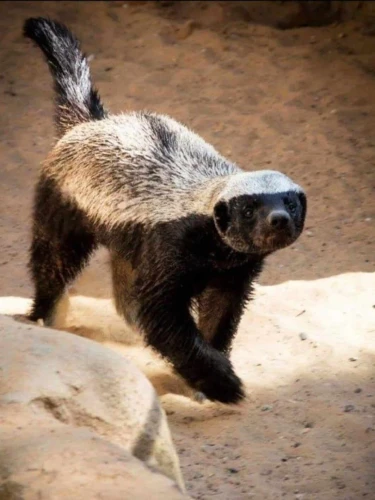
Acknowledging the suggestion of my student/friend Jaime Padilla, I nominate the honey badger.
Found in Africa, Southwest Asia and southern India, this is a mammal that resembles the skunk (an epithet often applied by our detractors). It is a solitary animal, again recalling Balaam’s words: “A people that dwells alone, not reckoned among the nations” (Numbers 23:9). While not physically large, it is nevertheless known for its intelligence, fearlessness and toughness.
What it lacks in size it makes up for in tenacity. With strength, agility and ferocious defensive abilities, it does not flee from or submit to predators.
On the contrary, it will retaliate against more powerful foes with every ounce of strength it has. Just watch a few YouTube videos to see how would-be predators (even lions) often pay a high price trying to vanquish this unassuming, “just-leave-me-alone” creature. Though they are often “outgunned” in size and perceived ability to intimidate, they refuse to be victims. They are fiercely tenacious, even when they ultimately don’t survive a confrontation.
And so, for these reasons (and with tongue only a bit inside cheek), I nominate the honey badger.
Of course, others may have their own suggestions. But there is no denying that the honey badger embodies attributes that we Diaspora Jews desperately need to reclaim—not just a desire to be left alone, but also the capability to stop being easy prey by defending ourselves tenaciously and ferociously whenever and however necessary.
That said, feel free to come up with a better suggestion. Just don’t let it be the lemming!