


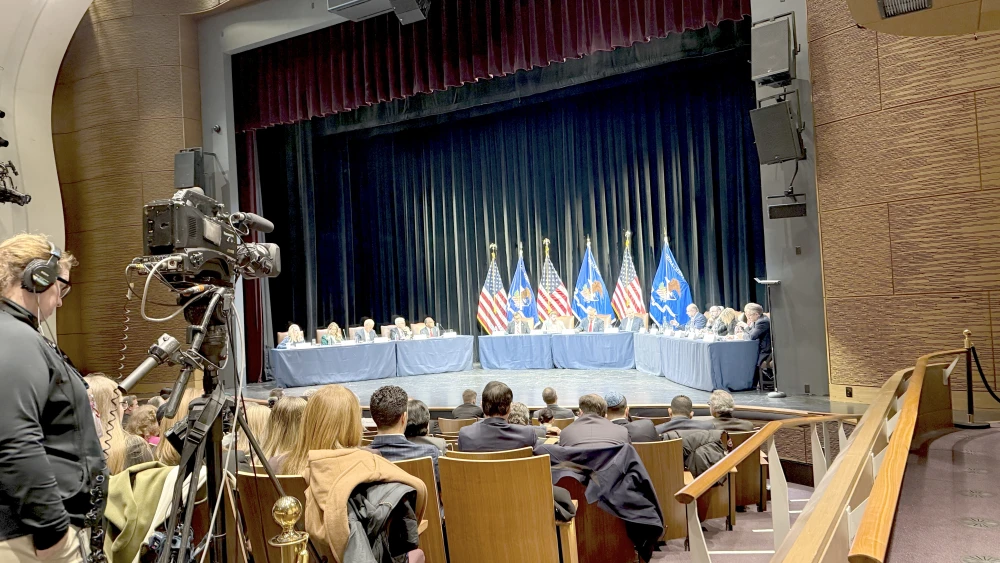
A U.S. Religious Liberty Commission hearing on antisemitism in Washington, D.C., on Monday featured testimony about the challenges facing Jews in American society that digressed, at times, into questions about whether it is antisemitic to oppose Israel.
The commissioners, whom U.S. President Donald Trump appointed in May, questioned witnesses from religious organizations, college campuses and the administration about their experiences, and possible legal and cultural remedies to Jewish bigotry during four hours of panels.
One of the commissioners, Carrie Prejean Boller, a former Miss California who is now a conservative activist and commentator, peppered witnesses about Israel’s conduct in Gaza and her interpretation of the Roman Catholic position on Zionism.
“Since we’ve mentioned Israel a total of 17 times, are you willing to condemn what Israel has done in Gaza?” Boller asked Shabbos Kestenbaum, a Jewish activist.
Boller is one of 13 members that Trump appointed to the commission when he created it in May.
In recent months, her social-media posts have been dominated by defenses of the conservative commentators Candace Owens and Tucker Carlson, whom Jewish groups have repeatedly accused of Jew-hatred. She returned to those defenses on Monday.
“I would really appreciate it if you would stop calling Candace Owens an antisemite,” Boller told Seth Dillon, CEO of the satirical Babylon Bee. “She’s not an antisemite. She just doesn’t support Zionism, and that really has to stop. I don’t know why you keep bringing her up, and Tucker.”
“Because they’re the two most famous antisemites,” Dillon replied.
“There you go again,” said Boller, who in the second half of the hearing appeared to wear a Palestinian flag pin on her lapel. “I guess everyone’s an antisemite.”
Boller’s lines of questioning drew booing from the audience several times and seemed to exasperate the commission’s chairman, Texas Lt. Gov. Dan Patrick, a Republican.
“I’m going to interrupt the discussion,” Patrick said. “This is not a commission on defining religions or calling out any theology. This is not the commission for that.”
“This could be another discussion on another day, and you two can have coffee,” Patrick said, of Boller’s questions of Kestenbaum.
JNS asked Kestenbaum what he expected, when he woke up in the morning, would happen at the hearing.
“Not to get in a foreign policy debate about Israel,” he said. “In fact, I’m so often accused about being ‘Israel first,’ being a ‘Zionist shill,’ which is why in the hearing today and in all the hearings that I’ve spoken at, I deliberately do not mention Israel.”
“I want to get the point across that what is happening at American universities is happening to American students, and it’s an affront to American values,” he said. “The fact that a commissioner would bring in a foreign conflict, which was not part of my narrative, demonstrates that there was an agenda.”
“She decided that this should be a debate on Israel’s conduct in Gaza, which I’m not entirely sure how that affects American students being discriminated against,” he said. Kestenbaum added that it was curious that Boller said Catholics don’t support Israel “given that there are hundreds of millions of Catholics, including some who are on this commission, speaking at this commission today, who would vehemently disagree with such a grandiose assertion.”
At one point, after Rabbi Ari Berman, president of Yeshiva University, said that it is antisemitic to say Israel cannot exist as a Jewish state while there are many Christian and Muslim states, Boller said Islamophobic statements shouldn’t be acceptable at the hearing.
Berman told her, “God forbid” that anyone would say something anti-Muslim.
“If your reaction to the fact that Christianity is outlawed in Saudi Arabia is to blame Islamophobia, you’re not seriously engaging with the political and religious issue,” Kestenbaum told JNS of the exchange.
Berman told JNS that interaction was a small part of a much longer hearing and shouldn’t overshadow what he saw as the more important parts of the testimony.
“To build a coalition of angels is what is necessary,” he said. “What we’ve seen in universities is that fear has replaced leadership, and we need to find those that speak with moral clarity and courage and build around them. That was my recommendation to the committee, and that was my recommendation to the secretary of the Department of Education.”
Asked what the statement about Islamophobia meant, Berman told JNS, “it wasn’t clear to me either.”
“That was like one minute. That wasn’t that session,” he said of the exchange. “It’s silly to focus on that.”
The takeaway Berman hopes viewers will emerge with is that there is a need to incentivize universities to teach American values. “I think the government should be funding those universities that see themselves as repositories of cultural inheritance and of a Western tradition that undergirds what America stands for,” he told JNS. “Faith-based universities are great examples of that.”
At the same time that the hearing got underway at the Museum of the Bible in Washington, a coalition of religious groups filed suit against the Trump administration and the commission in federal court in New York for allegedly excluding non-Christians and lacking ideological diversity in violation of the law.
“No members of the commission represent other minority religions, such as Islam, Hinduism or Sikhism, and none of the members on the commission represent an interfaith organization, despite the commission’s mandate to celebrate America’s history of religious pluralism,” the lawsuit states. “Its members, consisting of almost exclusively Christians with one Orthodox Jewish rabbi, represent the narrow perspective that America was founded as a ‘Judeo-Christian’ nation and must be guided by Biblical principles.”
The plaintiffs, who include Interfaith Alliance, Muslims For Progressive Values, Sikh American Legal Defense and Education Fund and Hindus for Human Rights, argue that the commission, as structured, violates the Federal Advisory Committee Act, which requires such presidential commissions to be “fairly balanced in terms of the points of view.”
JNS asked Patrick, the commission chair who is also the Texas lieutenant governor, about the lawsuit after the hearing was over. He declined to comment.
Patrick told JNS, of spirited questions of the witnesses, that “it didn’t surprise me.”
“Organically, it took a life of its own that I think led to some really great discussion on a number of issues,” he said. “Everything from where the Catholic Church stands to Zionism to anti-Zionists.”
“There was so much great testimony and so many great quotable moments, it’s hard for me to—I’m going to go back and watch this,” he said.
JNS asked if there was one thing he hoped people would take away from the hearing. Patrick said that he loved how Fr. Thomas Ferguson, Good Shepherd Catholic Church, “summed it all up about the death of Christ.”
“I thought that was powerful,” he said.
“I thought that settling the Catholic issue was powerful,” he added. “I think just that the general recognition that we have no room in this country whatsoever for anyone to give any type of foothold on this antisemitism that is going around.”
“We have to all stand together, all denominations, all faiths. We have to all get together and say, ‘This will not stand in America,’” he said. “I think maybe that’s the key.”
JNS also spoke with Bruce Pearl, former coach of the Auburn Tigers—the men’s basketball team at Auburn University in Alabama—and founder of the Jewish Coaches Association, who testified at the hearing.
“I thought it was great,” he said. “The fact that we did have some open dialogue, and even if you’re referring to when it got a little tense, I actually thought it was good, because the question was, ‘I’m a Catholic,’ to paraphrase, ‘but I don’t support a lot of things regarding Israel.’ She basically said, ‘So if I’m anti-Zion, is that antisemitic?’”
“I think that the committee was able to explain to her that, ‘Yes. It was,’” he said. “Not calling her an antisemite. These are antisemitic thoughts, because we try to connect the Jewish faith to the State of Israel and our Bible and our history and our culture and our everything.”
“That doesn’t make me any less American,” he said.
“Some people apologized for it,” he told JNS of the tense exchanges. “I think it’s great. I think we should have these discussions, because well-intentioned, she doesn’t want to be an antisemite. But if it was able to be discussed and explained, ‘These views are antisemitic,’ because if you don’t believe Jewish people have a right to return to our ancestral home, this is our religious belief. It kind of gets in the way of our religious liberties.”
His main takeaway was about higher education.
“There was a lot of discussion about American universities and what is being taught, and what is being allowed, and some of the hypocrisies,” he said. “We have to teach the truth, and we have to teach the good versus evil even though it may well be uncomfortable.”
“I don’t think universities should stay institutionally neutral,” he added. “There’s a difference between freedom of speech and moral clarity, and I think that was pointed out very clearly today.”



