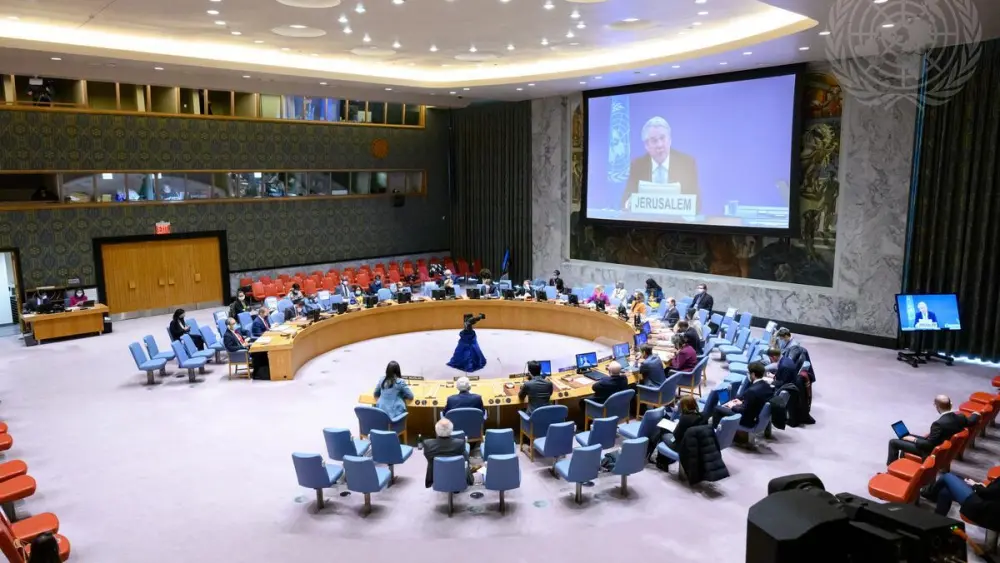
After threatening to veto a U.N. Security Council resolution demanding an immediate ceasefire, the United States is floating a ceasefire draft of its own, albeit with watered-down terms.
Washington’s proposed text includes “support for a temporary ceasefire in Gaza as soon as practicable,” in line with language that U.S. President Joe Biden has used in talks with Israeli Prime Minister Benjamin Netanyahu.
The United States has yielded its veto power, as one of five permanent U.N. Security Council members, to thwart any imposition of a ceasefire—humanitarian or otherwise—claiming that ongoing negotiations between Israel and Hamas via intermediaries ought to take precedence.
That stance has isolated Washington on the council, though the United Kingdom has joined it at times.
The new U.S. draft resolution calls for the “lifting of all barriers to the provision of humanitarian assistance at scale” and demands that “all parties to the conflict cooperate with the United Nations’s appointed humanitarian and reconstruction coordinator to facilitate the unimpeded flow of aid.”
The draft also rejects the creation of any security buffer zone in the Gaza Strip and condemns calls by Israeli government ministers to resettle Gaza or relocate the population there.
Additionally, the draft text “determines that under current circumstances a major ground offensive into Rafah would result in further harm to civilians and their further displacement including potentially into neighboring countries.”
The Israeli government and military have announced plans to launch a major operation in Rafah to root out Hamas’s last remaining stronghold in Gaza.
Washington’s proposed language regarding a temporary ceasefire is seen as ineffectual by critics and open to wide interpretation as to whether such a halt in hostilities would be “practicable.”
It is not yet clear whether the draft resolution has sufficient support to pass the 15-member council or whether Washington would try to force a vote.
The Security Council is set to vote on Tuesday on an Algeria-drafted resolution, which demands an immediate humanitarian ceasefire.
Multiple members of the U.S. delegation to the United Nations have stated that they will not allow Algeria’s resolution to pass.
Washington has already vetoed two council resolutions since Hamas’s Oct. 7 massacre. It also abstained twice, permitting the adoption of resolutions aimed at boosting humanitarian aid to Gaza.