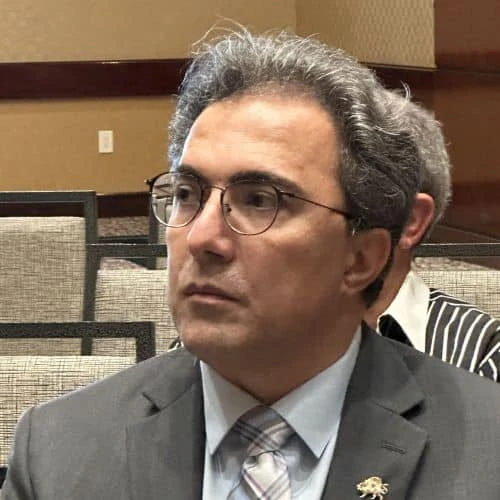
Stéphane Dujarric, spokesman for United Nations Secretary-General António Guterres, didn’t name Francesca Albanese in response to a question from JNS about the special rapporteur’s comment that appeared to partly justify an attack on journalists. But he rejected her statement in strong terms.
Albanese, whom the global body considers an independent “expert” and who has denounced Israel frequently in ways that U.S., Israeli and other diplomats have called Jew-hatred, drew criticism from across the Italian political spectrum, including the left, when she responded to an anti-Israel attack on the offices of Italian paper La Stampa on Nov. 28.
After the attack, Albanese, an Italian native, reportedly said that “we must not commit acts of violence against anyone, but at the same time this should also serve as a warning to the press to go back to doing its work.”
The comment was widely viewed as a threat that journalists should cover the war against Hamas in Gaza differently.
Dujarric told JNS during the Tuesday U.N. press briefing that, for Guterres, “it is very clear that journalists should never come under any violence wherever they may be, whether that violence is physical or whether that violence is verbal, whether they are intimidated.”
“Journalists need to be able to do their work freely, and they should never ever be intimidated,” he said.
Dujarric did not address Albanese’s comments directly, in line with a broad U.N. policy that special rapporteurs and independent “experts” appointed by the U.N. Human Rights Council are beyond Guterres’ purview.
Separately, Dujarric told JNS that it is a priority for Guterres to wind down the U.N. peacekeeping mission on the Israel-Lebanon border.
Envoys of the states that are U.N. Security Council members are slated to visit the region later this week with officials from the U.N. Interim Force in Lebanon, as UNIFIL approaches its mandated conclusion at the end of 2026, despite renewed tensions on the border.
The Security Council’s resolution to shutter UNIFIL operations calls on Guterres to present options for proceeding without a UNIFIL presence in 2027. Multiple diplomats told JNS that ambassadors of states that are council members aim to return from the trip with ideas for Guterres.
The U.N. secretary-general’s radar “is wide and it is deep,” Dujarric told JNS, when asked if the UNIFIL issue had Guterres’s attention.
“Of course it’s a priority,” Dujarric said, noting Guterres’s longstanding support for the mission. That has come amid persistent efforts by Israel, and more recently the United States, to close the mission in the wake of accusations of its ineffectiveness and passive complicity in Hezbollah’s military buildup in southern Lebanon.