


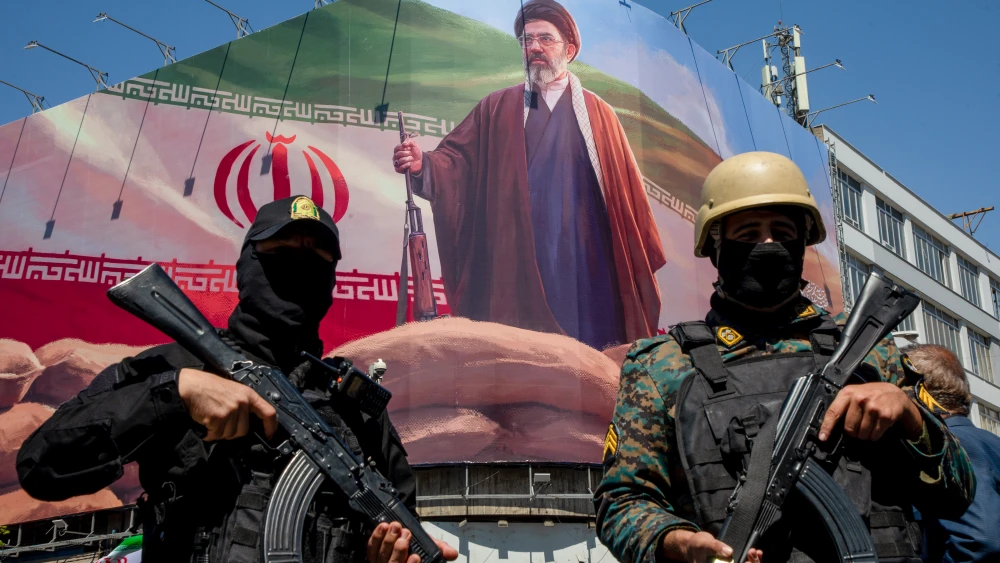

In an interview on May 3, Islamic Revolutionary Guard Corps spokesman Brig. Gen. Hossein Mohabi pointed out something that the West has trouble grasping about asymmetric warfare. “In the unequal battle we are facing, Iran’s armed forces will be the final victors,” he told the Islamic Republic of Iran News Network. “They fight with the culture of Ashura and consider surrender a disgrace for themselves.”
For Shi’ite Muslims, Ashura is a memorial marking the anniversary of the death of Husayn ibn Ali, grandson of the Prophet Muhammad. Though he was killed during the Battle of Karbala in 680 C.E., Husayn is still held up as a hero who didn’t surrender to the massive army of the caliph, Yazid.
“Our model in today’s wars is [that] of Ashura—steadfastness in an unequal battle,” Mohabi said, describing Tehran’s current predicament.
Referring to the United State and Israel, he went on, “Our enemies are specifically one country and one regime with enormous equipment. America brought its latest defensive and offensive equipment to the battlefield. Our equipment and the number of our forces are very unequal compared to theirs.”
However, he said, “our spiritual power enabled us to stand against them.”
To clarify, he added, “In this arena, our fighter either wins or is martyred. Martyrdom is happiness for him. In such a situation, our forces do not falter.”
This wasn’t rhetorical bravado. It’s the essence of radical Islamism and the reason that the phenomenon has been nearly impossible to combat, let alone eradicate.
Mohabi admitted that Iran’s forces are outmatched in conventional terms, with fewer resources and an inferior arsenal. He didn’t mention his regime’s goal of obtaining nuclear weapons, of course. Not only has the Islamic Republic insisted that its nuclear program was always for “peaceful purposes,” but the enriched uranium in its possession was and is President Donald Trump’s casus belli.
So Mohabi steered away from that particular topic. He focused instead on the main weapon that compensates for the deficiencies he acknowledged: the willingness, even desire, to die as martyrs for the cause of regional and worldwide hegemony.
Herein lies the weakness of liberal democracies in the face of barbarism. Such societies sanctify life and human rights, and their militaries operate under legal, ethical and psychological restraints.
In the United States and Israel, for example, soldiers are trained to minimize civilian casualties and the governments that send them into battle and are held accountable by courts and public opinion. Jihadist states and organizations scoff at these practices, viewing them as the enemies’ Achilles’ heel.
Israel has been grappling with this reality since long before Mohabi put it so bluntly. During the first and second intifadas, Palestinian terrorists employed tactics that epitomize asymmetry: rock-throwing at passing vehicles, suicide bombings on buses and in cafés, stabbing sprees in crowded streets and car-rammings. None of these was a random assault, including when perpetrated by so-called “lone wolves.”
The Palestinian Authority has for decades has maintained a system of stipends to terrorists and their families—the infamous “pay-for-slay” policy. The more heinous the attack, the higher the reward. Imprisonment becomes a source of income. Death in the act of murder becomes a financial windfall and a badge of honor.
P.A. leader Mahmoud Abbas put it bluntly in 2018, declaring: “The martyrs and their families are sacred, [and so are] the wounded and the prisoners. We must pay all of them. If one penny remains in our hands it is for them and not for the living.”
Mere months earlier, the U.S. Congress passed the Taylor Force Act—named after an American graduate student visiting Israel who was slaughtered in 2016 by a Palestinian knife-wielder—to halt all American economic aid to the P.A. until it stops stipends to terrorists.
Money isn’t the only incentive for would-be terrorists, though. The promise of paradise, along with endless posthumous glory, is also a huge draw.
Then there are the less talked-about cases. Some Palestinian men suffering from depression opt for “martyrdom” over suicide, which Islam strictly forbids. Some young women about to become honor-killing victims at the hands of their fathers or brothers choose to die as “martyrs” in order to avoid the “shame” they’ve supposedly brought upon their families.
No wonder Trump describes the mullahs and their henchmen as “sick people.” The same depiction applies to their Fatah, Hamas, Islamic Jihad, Hezbollah and Houthi proxies in the P.A., Gaza, Lebanon and Yemen. All embrace the same form of depravity with a vengeance. Literally.
Mohabi’s message left no room for doubt about the source of the might of the Islamic Republic, even when it’s being pummeled beyond recognition: “Ashura—steadfastness in an unequal battle.”


