Newsletter
Newsletter Support JNS

Biden administration approves large-scale military sales to Gulf states

Saudi Arabia will receive Patriot missiles and the UAE will receive Terminal High Altitude Area Defense missiles to protect against Iran-sponsored threats.

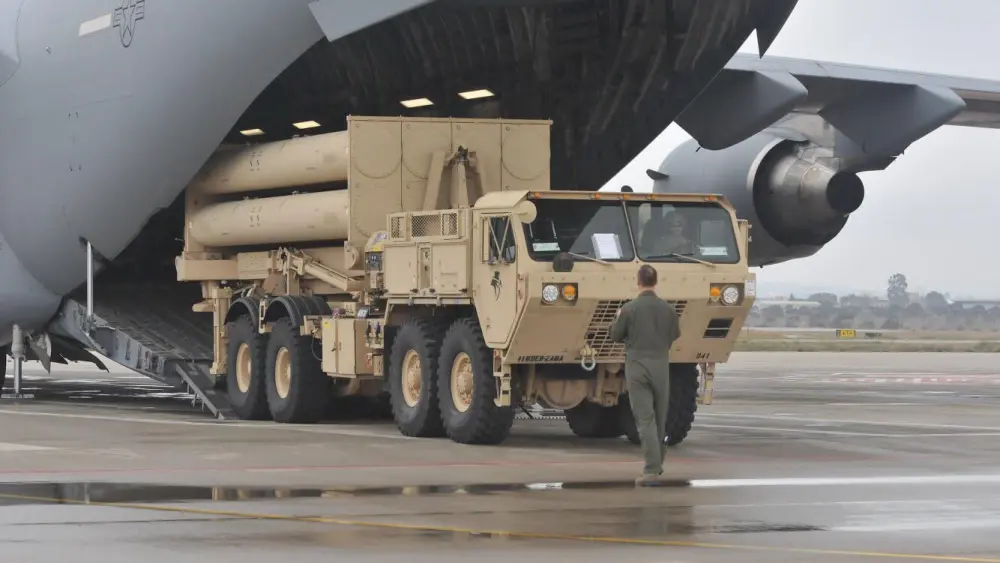
The Terminal High Altitude Area Defense (THAAD) mobile ballistic missile interception system being loaded by the U.S. Air Force for delivery to Israel. Credit: U.S. Army Europe.

The Biden administration authorized two large-scale defense sales to Saudi Arabia and the United Arab Emirates on Tuesday to help defend against threats from Iran, reported the Associated Press.

The more than $5 billion in missile defense and related sales come after U.S. President Joe Biden’s trip to the Middle East last month, which included meetings with a number of regional officials and leaders in Saudi Arabia.

The new sales include $3 billion for Patriot anti-missile missiles for Saudi Arabia to defend against Houthi missile attacks and $2.2 billion for high-altitude missile defense THAAD (Terminal High Altitude Area Defense) missiles for the UAE.

In a notice informing Congress of the sale, the U.S. State Department said: “The proposed sale will improve the Kingdom of Saudi Arabia’s capability to meet current and future threats by replenishing its dwindling stock of PATRIOT GEM-T missiles.”

“These missiles are used to defend the Kingdom of Saudi Arabia’s borders against persistent Houthi cross-border unmanned aerial system and ballistic-missile attacks on civilian sites and critical infrastructure in Saudi Arabia,” the statement continued.

The sale to the UAE would “support the foreign policy and national security of the United States by helping to improve the security of an important regional partner. The UAE is a vital U.S. partner for political stability and economic progress in the Middle East,” said the State Department.

JNS panel highlights the families, businesses and volunteers sustaining Israel’s war effort.
“It’s time to move forward and realize the potential of the Abraham Accords 2.0,” says Asher Fredman, director for Israel at the Abraham Accords Peace Institute.
“Despite their protestations and false statements to the contrary,” said the U.S. president, “Iran has fully and completely agreed to highest level nuclear inspections long into the future.”
Sixty-five percent of Victory’s 152 million shekel ($50 million) first-quarter year-over-year growth came from Gaza, according to a supplemental report released on June 14.
“Our victory will be to see more families, more children, and more citizens choosing to build their homes in the north,” the president said.
Benny Gantz, JNS editor-in-chief Jonathan S. Tobin, Gilad Erdan, Mosab Hassan Yousef, Nissim Black and leading voices in security, diplomacy, media, law and Jewish communal affairs headline the summit’s third day in Jerusalem.