Does it matter if a famous athlete is Jewish?
I’ve doubted it. My position used to be that while it once meant a great deal, decades after the Holocaust and the creation of the modern-day State of Israel—with all it means for Jewish empowerment—it stopped being quite so important to point out the numbers of Jews who played prominent roles in popular sports. But this week, I realized that I needed to rethink that assumption.
Most American sports fans have been celebrating Jack Hughes, the 24-year-old member of the ice-hockey team who scored the “golden goal” in the 2026 men’s Olympic final, giving Team USA its first victory in that competition since the “miracle” defeat of the Soviet Union back in 1980. But the negative reaction on social media to the way some Jews pointed with pride to the fact that he was Jewish was a sobering reminder of the antisemitism that has been surging around the globe, especially since the Hamas-led Palestinian Arab terror attacks on Israel on Oct. 7, 2023.
Jewish pride bothers some people
It was hardly surprising that Piers Morgan, the British media personality and consistent Israel-basher since Oct. 7, would respond negatively to a post by Israeli influencer Noa Tishby that noted that he was a member of the tribe. He asked, “Who cares what religion he adheres to?” As with the innumerable responses to that post and the many others like it, Morgan never questions other faith, ethnic or national groups taking pride in the achievements of their fellow adherents. But Jewish pride seems to get up his noose and that of a lot of other people who also happen to hate Israel.
Indeed, the saga of the reaction to Team USA’s historic victory and its aftermath has illustrated anew that it’s virtually impossible to separate sports from politics once you start organizing national teams, and rooting for and against them on that basis. And by throwing in the extra element of Jewish identity, the perennial virus of antisemitism will inevitably be injected into the discussion.
President Donald Trump’s honoring of the team at this year’s State of the Union also angered many of his political opponents. Trump’s detractors regard him as beyond the pale, and as a result, treat those athletes and other celebrities who allow themselves to be used in this manner (as all presidents do in such circumstances) as tools of someone they falsely label as a “fascist” or a “Nazi.” Indeed, the men’s teams’ willingness to welcome FBI director Kash Patel to their locker room celebration caused many on social media to use the same epithets and to call them “MAGA-Nazis.” They were also wrongly accused of being misogynists because of what they claimed was a tasteless joke uttered by Trump when he said that he would be impeached if he didn’t also invite the women’s team to the White House, as he did.
Hughes, who plays for the NHL’s New Jersey Devils when not representing his country, was a particular target for celebration and opprobrium for what he said after the Olympic final.
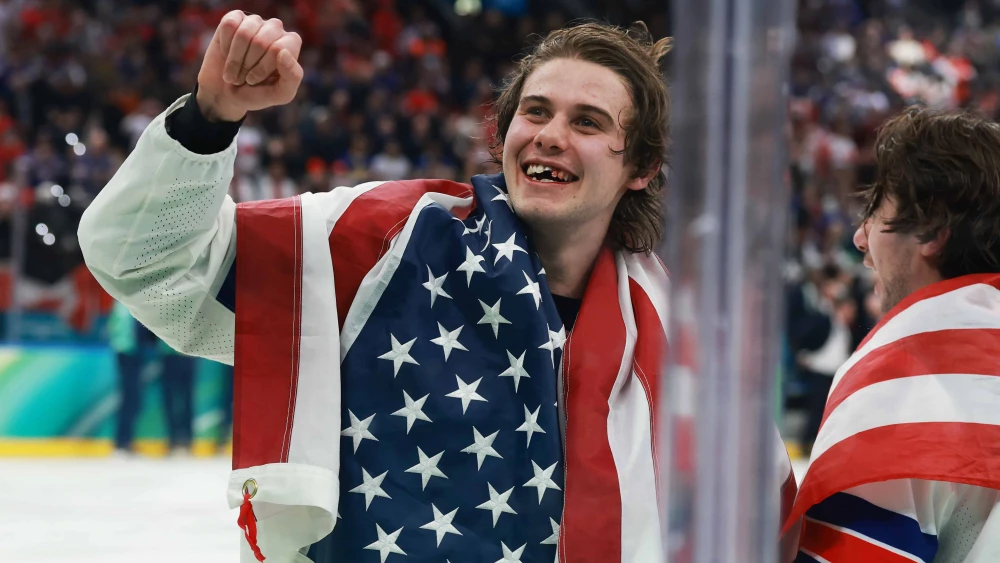
He had been injured in the game’s final minutes, struck by the hockey stick of a Canadian opponent, and lost parts of his front teeth. But he quickly returned to the ice, and soon after, he scored the winning goal. Afterward, he couldn’t stop grinning, exposing his missing teeth and creating an image of undaunted pride, as well as a stereotypical one of tough-as-nails hockey players.
And he warmed the hearts of many of his fellow countrymen when, draped in an American flag, he also used that moment to express his patriotism, saying, “This is all about our country right now. I love the USA. I love my teammates. … I’m so proud to be American today.”
This was an Olympics where some of the American athletes in Milan used their 15 minutes of celebrity to speak of their opposition to Trump and lack of comfort in representing their country at this time. They did so to the applause of much of the mainstream media. Unsurprisingly, the same press corps celebrated and defended champion free-style skier Eileen Gu, who chose to compete for China rather than for the United States, where she was born, largely because Beijing offered her a lot more financial compensation.
Unabashed patriotism
But the patriotism of Jack Hughes seemed to really get on the nerves of those Americans and others who were apparently hoping that Canadian victories in hockey would give people who don’t like Trump on both sides of the border a morale boost.
Indeed, much of the commentary about Hughes and the rest of the team after their triumph seemed to focus more on criticizing them for not refusing to have anything to do with Trump, rather than ending a 46-year-old drought in Olympic hockey. Journalists like Don Lemon and Keith Olbermann bashed them as Trump stooges, while Jerry Brewer, the lead columnist for The Athletic (the national online sports magazine that replaced the sports department at The New York Times), claimed they had tarnished their legacy by not realizing that all decent people must oppose Trump. Politics, or at least a left-wing version of it, was considered more important than national pride.
Those who use their celebrity to advance left-wing causes think that they are the good guys, while those on the other side of the political spectrum are contemptible. The fact that half the country voted Trump into office and largely agree with him on most issues is dismissed as unimportant, if not considered proof that most of their fellow Americans are crypto-Nazis and therefore have no right to express their opinions.
One can argue that the history of the Olympics, in which totalitarian governments like Nazi Germany and Communist China have used the event to whitewash their regimes, has discredited the games. So, too, did the Olympic movement’s long resistance to honoring the 12 Israeli athletes and coaches murdered by Palestinian terrorists at the 1972 Summer Games held in Munich, Germany.
Defending nationalism
But if we’re going to hold the Olympics—and the popularity of both the winter and summer events remains undiminished—then there is no reason why Americans should have to refrain from supporting their country’s national teams just because some of their compatriots and many foreigners don’t like the current president.
Indeed, it may be more important than ever to highlight the importance of patriotism. This is a time when many on the political left seem intent on erasing borders and diminishing the idea of national sovereignty as part of the war on Western civilization being waged by the red-green alliance of Marxists and Islamists. If Americans think that illegal immigrants should have the same rights as citizens (a point made by Trump in his State of the Union address that infuriated Democrats), then flag-waving over U.S. sports victories can seem off-putting. But for the majority who disagree with such attitudes, defending the red, white and blue—like the blue and white of Israel, as well as the whole idea of the nation-state being a necessity for the defense of liberty—is all the more necessary.
That notwithstanding, the question for Jews is: How important is it to treat successful athletes as heroes?
A century ago, that was not a question that was often asked. The image of Jews was the opposite of the strong and confident persona of an athlete. Two millennia of exile and persecution, coupled with the lack of opportunities to shine in anything but religious and other scholarship, reinforced not merely a general attitude about Jews but the truth about their place in the world. They were not merely a demographic slice of humanity that was uninterested in sports, but a weak people unable to defend themselves with anything but their wits and ability to flee. Worse than that, they were almost always dependent on the mercy of non-Jews to survive.
Jewish role models
In that context, the attachment of Jews to the exceptions that proved the rule about sports wasn’t so much understandable as it was a necessary reflection of their situation.
One such was baseball player Hank Greenberg, the first baseman for the Detroit Tigers and a dominant force in the 1930s, who challenged Babe Ruth’s home-run record and led his team to championships. Though he was not observant, his decision not to play in a crucial game in 1934 on Yom Kippur was an inspiring example of how one could participate in secular society without sacrificing one’s self-respect or identity as a Jew. A generation later, Sandy Koufax of the Los Angeles Dodgers did the same when he didn’t pitch the first game of the 1965 World Series. Both are still the only Jewish members of baseball’s Hall of Fame.
But at a time when Jews are fully integrated into the upper echelons of virtually every sector of American society, the need to point with satisfaction to the achievements of anyone who can be connected to the Jewish community is no longer quite so obvious. One must also add to this discussion the fact that many, if not most, Jewish athletes today are not so open about their backgrounds or willing to take pride in their heritage, let alone not take the field on Yom Kippur.
Hughes’s family background is typical of his generation, where the majority of American Jews who are non-Orthodox don’t marry within their faith. His mother, Ellen Weinberg Hughes, is Jewish. A pioneering women’s hockey player, she is currently the head of player development for the gold medal-winning Team USA women’s team. His father is Jim Hughes, a veteran hockey coach who is Catholic. The main theme of their family life is clearly hockey. Older brother Quinn was also one of the key players on Team USA and scored the winning goal in overtime in the Olympic quarterfinals. Their younger brother, Luke, also plays professionally in the National Hockey League.
The boys attended a Catholic high school in Michigan, chosen by the family because it helped their development as athletes. Despite that, the boys were raised as Jews, had bar mitzvahs and have publicly embraced their faith as adults. By any standard, halachic or otherwise, their Jewish identity is not in question. Nor is their loyalty to their country.
We need all kinds of heroes
It can be argued that the only true Jewish heroes of our day are the soldiers of the Israel Defense Forces, who put their lives on the line to defend the Jewish people against genocidal foes like Palestinian and Lebanese terrorists, and their Iranian paymasters. The same can be said about Jewish members of the U.S. armed forces.
Still, at a time when so much hatred from the left and the far right is being spewed daily, Jews are in dire need of all sorts of role models, not just those in the military. From that perspective, there is nothing wrong and much that is right about calling attention to the achievements of Jews in every field, not least those that involve physical courage and athletic skill. That is particularly true when those who exhibit such qualities and accomplish great things are not only proud of their Jewish heritage but also unabashed American patriots.
The same toxic ideological trends behind the hostility to patriotism are making college campuses unsafe for Jews. Haters of all backgrounds are particularly interested in reinforcing negative stereotypes about Jews as weak, while at the same time demonizing those who contradict that image. The most important reality for the defense of Jews against antisemitism may be a strong and secure Israel. But in this post-Oct. 7 era, when so many seek to avoid being identified as Jewish in public or are stereotypical “as a Jew” members of the community using their heritage to help attack Israel and its supporters, the need to celebrate proud Jews is not a frivolous concern.
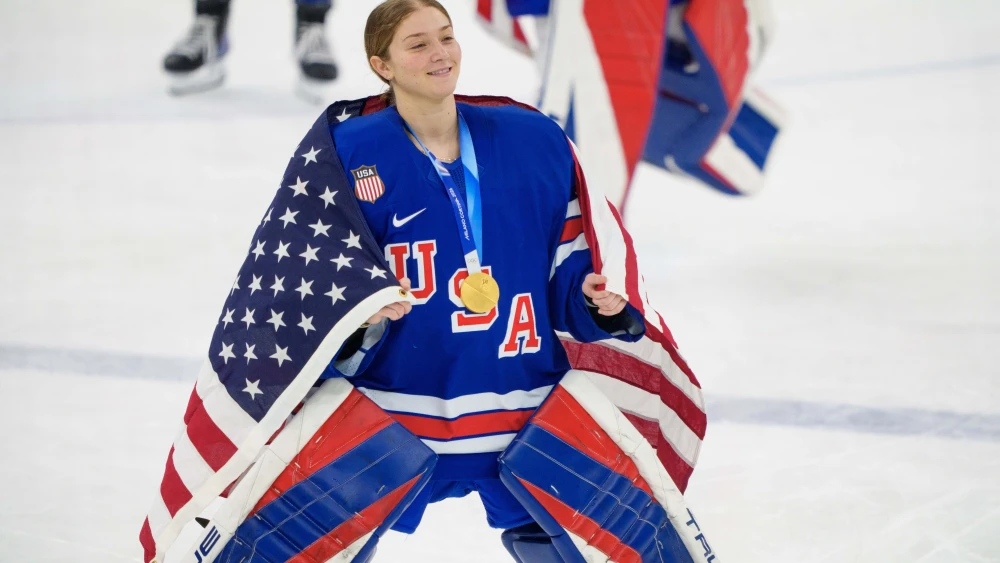
Seen from that perspective, holding up the Hughes brothers or Aerin Frankel, the 26-year-old goalie for the women’s ice-hockey team, whose record-setting performance throughout the Olympics was essential to their victories (including the overtime gold-medal game thriller against the Canadians), for praise and communal pride isn’t silly or a throwback to an earlier era. Refraining from doing so because of contempt for nationalism or Trump isn’t just wrongheaded. It’s downright unsportsmanlike.
Jonathan S. Tobin is editor-in-chief of JNS (Jewish News Syndicate). Follow him: @jonathans_tobin.