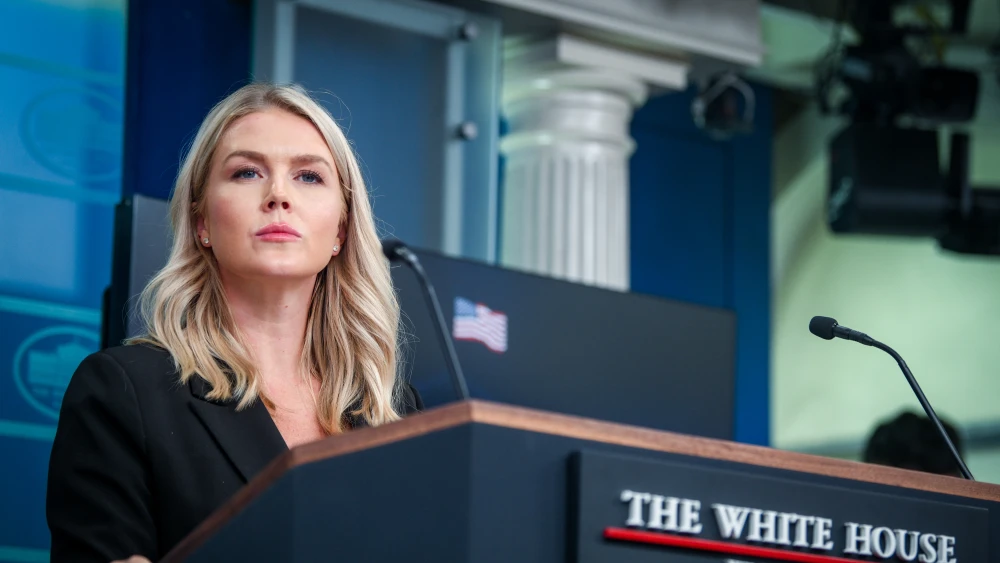
U.S. President Donald Trump’s red lines for a deal with Iran have been made “very, very clear,” White House Press Secretary Karoline Leavitt said on Monday, following Tehran’s latest proposal to end hostilities.
“I will confirm the president has met with his national-security team this morning,” Leavitt told reporters during a briefing. “I don’t want to get ahead of the president or his national-security team. What I will reiterate is that the president’s red lines with respect to Iran have been made very, very clear, not just to the American public, but also to them [the Iranians], as well.”
“I wouldn’t say [the president and national-security team] are considering it,” she added. “I would just say that there was a discussion this morning that I don’t want to get ahead of, and you’ll hear directly from the president, I’m sure, on this topic very soon.”
Under the Islamic Republic’s latest proposal, the regime would reopen the Strait of Hormuz in exchange for a long-term ceasefire or permanent end to the war, a U.S. official and two sources with knowledge of the matter told Axios.
Nuclear negotiations would only start at a later stage, after the U.S. military lifts its naval blockade of Iranian ports, according to the reported details of the plan.
A U.S. official briefed on Monday’s meeting at the White House told Reuters that Trump was unhappy with the proposal.
Washington has repeatedly stressed that the nuclear issue must be dealt with from the outset, and Trump was unhappy with Tehran’s offer for that reason, the official said.
CNN cited a source familiar with the matter as saying that the president was unlikely to accept the plan, as it could remove a key piece of American leverage in the talks.
Israel has reportedly urged the United States to continue its closure of the Strait of Hormuz and not ease the naval blockade as a goodwill gesture during the talks.
According to Israeli assessments cited by Channel 12 on Sunday, the continued blockade is expected to increase pressure on the Islamic regime by reducing revenues, exacerbating internal divisions and leaving it with a choice: ease its negotiating positions or face greater instability, potentially including renewed U.S.-Israeli military action.
According to senior Israeli officials, if Tehran does not soften its position even after a prolonged blockade, the U.S. may opt for a return to fighting. Israeli officials have discussed the option of broad strikes targeting the Islamic Republic’s energy infrastructure, per Channel 12.
The Trump administration will not tolerate Iranian efforts to hold international waterways hostage, U.S. Secretary of State Marco Rubio told Fox News on Monday.
“They cannot normalize, nor can we tolerate them trying to normalize, a system in which the Iranians decide who gets to use an international waterway and how much you have to pay them to use it,” Washington’s top diplomat told Fox‘s chief foreign correspondent, Trey Yingst.
Iranian President Masoud Pezeshkian told Pakistani Prime Minister Shehbaz Sharif in a call on Sunday that Washington “must first remove operational obstacles, including the blockade,” as a condition for “resolving issues.”
Pezeshkian said American maritime restrictions on Iran were a “clear breach of the ceasefire understandings.” Such measures, along with “threatening rhetoric” from the U.S. administration, have increased Tehran’s doubts regarding America’s commitment to the diplomatic process, he said, according to Iran’s semi-official Mehr News Agency.