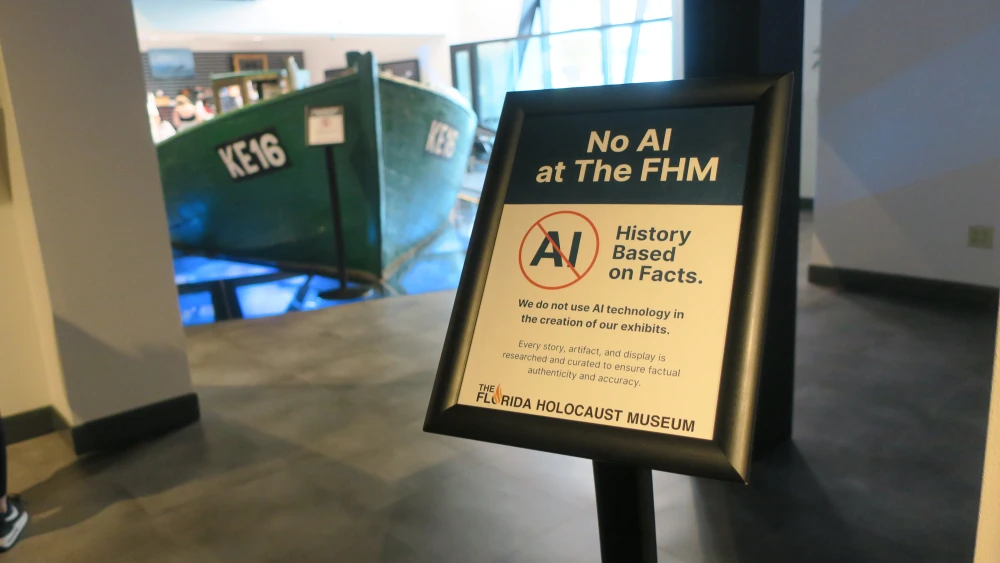
Many museums have “don’t touch” or “no photography” signs. At the newly reopened Florida Holocaust Museum, which spans 27,000 square feet in downtown St. Petersburg, several signs state that there is “no artificial intelligence” at the museum.
“History based on facts,” the signs state. “We do not use AI technology in the creation of our exhibits. Every story, artifact and display is researched and curated to ensure factual authenticity and accuracy.”
Some 25 minutes into four hours of private tours at the museum, spread over two days, JNS asked Ursula Szczepinska, senior director of education and research at the museum who calls some of her job “cold case” work, if she would ever use artificial intelligence to sift through vast amounts of information to identify things that might merit closer attention.
“I wouldn’t use that for that,” she told JNS. “This is such sensitive information, and AI makes so many errors that we actually do not use AI at all.”
Szczepinska has worked at the museum, which moved to its current location in 1998, for about 21 years. The museum, which is one of three such Holocaust institutions which the American Alliance of Museums accredits—the other two are the U.S. Holocaust Memorial Museum in Washington and Holocaust Museum Houston—was established in a “modest space” some 10 miles west in Madeira Beach, Fla., in 1992. It was then called the Tampa Bay Holocaust Memorial Museum and Educational Center.
When the museum moved into its current location in 1998, Elie Wiesel, the Nobel laureate who spent winters co-teaching at Eckerd College in St. Petersburg over 30 years and who was the museum’s honorary chairman, took part in the ribbon-cutting ceremony. The museum, which changed its name the following year, now operates with a $5.3 million annual budget.
Visitors experience the redesigned museum, which closed to the public in July 2024 and reopened Sept. 9, in largely the same way as the prior building, Szczepinska said.
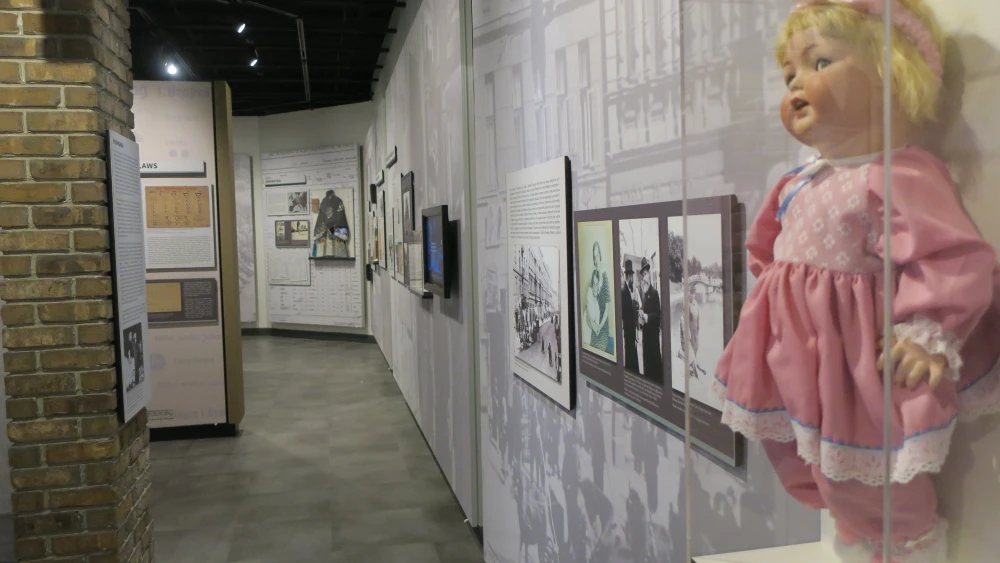
“The square footage is the same. The exhibition was smaller. It had fewer artifacts. Obviously, less technology,” she told JNS. “We have a better understanding now about people’s needs as visitors. Some people respond better to technology. Some respond better to text on the panel. Some people prefer photographs, or artifacts or a combination of all of these.”
“We made sure that we have ways to share this history for people with different preferences,” she said. “We want to make sure that there’s something for everyone. Some people spend 20 minutes. Some people spend two hours. It’s fine. Everybody learns in a different way.”
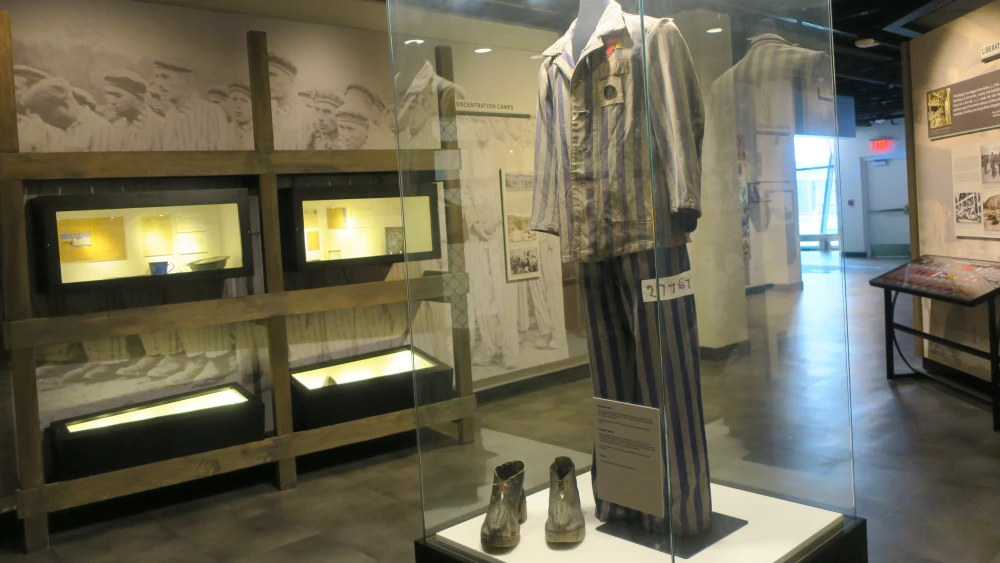
The museum, whose collection includes more than 25,000 artifacts, did and does display text-heavy labels, with more words than one typically sees at a museum. It also hangs objects and labels lower than many museums do to accommodate guests who cannot see and read things higher up on the wall.
Its new displays, shown in front of blown-up images of photographs that appear in the display, are customizable, unlike its prior labels that needed to be updated in their entirety when new research needed refreshing in a single section. “We were fitting in as much as possible, but at the same time, it needed to be updated,” Szczepinska said.
The prior permanent exhibition did not address the beginning of World War II and how anti-Jewish hatred spread, according to Szczepinska. It now addresses that in one of its sections. Another section on heroes addresses both non-Jewish rescuers and “Jews who were trying to help other Jews,” she told JNS. “Especially with that accusation that Jews went like sheep to the slaughter—it’s not true.”
‘Seen as a target’
One of the largest changes in the visitor’s experience of the museum is the process for entering the museum, which takes place on the side of the museum, which is lined with metal barriers to block vehicles from driving into the building.
Visitors go through airport-style security—which is not the case at other St. Petersburg museums—in which they go through a metal detector and put their belongings through an X-ray machine. The museum provides clear bags for those who want to carry items inside, and there are lockers for placing other belongings.
Eric Stillman, who became president and CEO of the museum three months ago—“it’s been a whirlwind,” he told JNS—came into the process “far enough along that people before me had thought through issues, and it really is of tremendous importance.”
“In the time in which we live, where anything, such as the Florida Holocaust Museum, that has Holocaust as its subject matter or ‘Holocaust’ in its name is going to be seen as a target to some people,” he said.
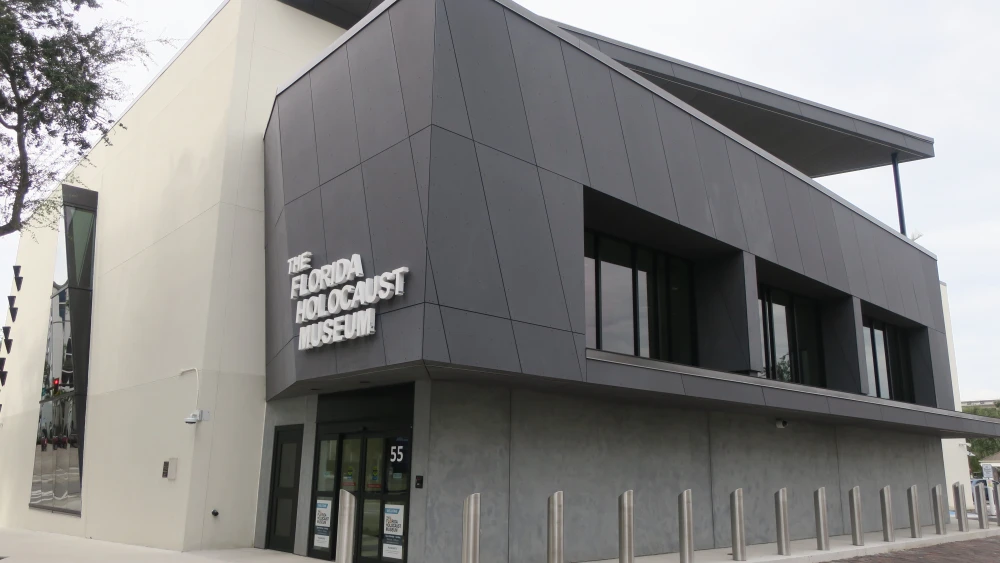
“For the safety of our staff, visitors, guests and artifacts, we’ve taken what I would consider prudent security measures, and that has made this a safer and more secure environment,” he told JNS. “At the same time, it has been done unobtrusively, which is to say that you can stand in front of our tetrahedral window, which is an architectural engineering marvel unto itself as it tilts outward, and yet we have the bulletproof or ballistic glass in front of it.”
That and the new security entrance are “measures that are not really inconveniencing people and yet enhancing their sense that when you are here and you’re visiting us, you’re safe,” he said.
Death towers over hope
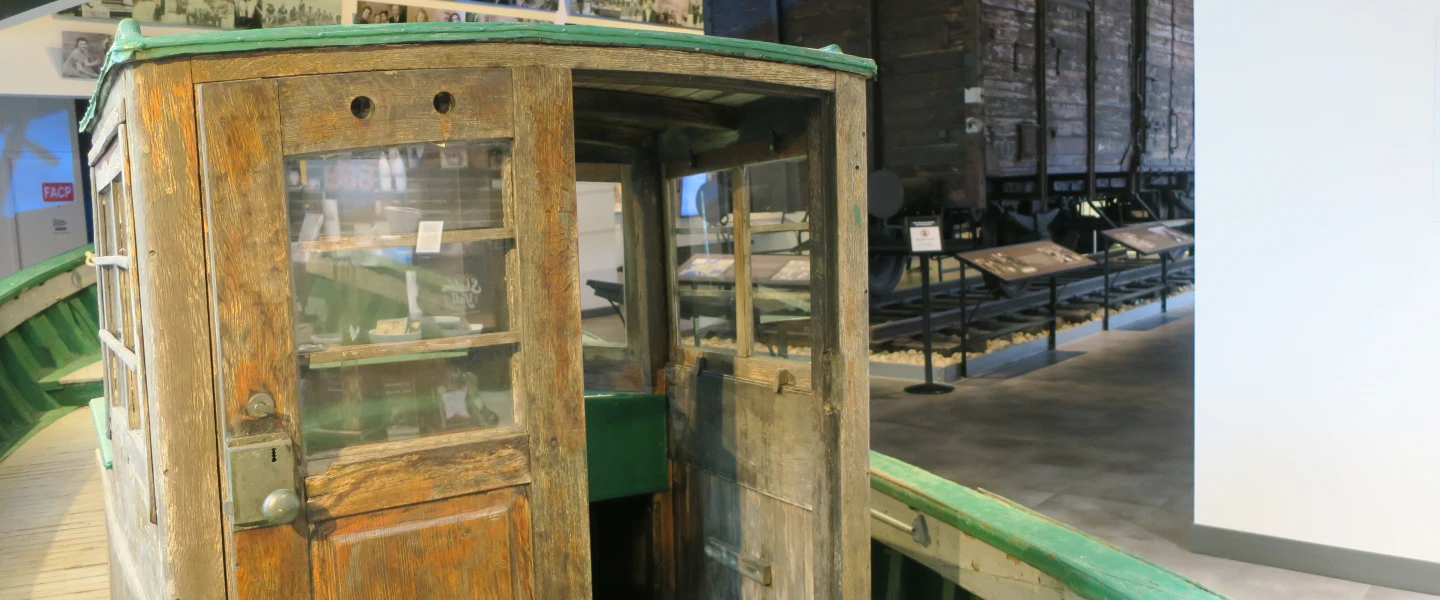
As visitors enter the museum, they experience the permanent collection on the ground floor as if navigating a monastic cloister. The exhibition winds around a central area, which contains a very dramatic juxtaposition of a boxcar and a boat, and at various points, one can see the central display through screens and doorways.
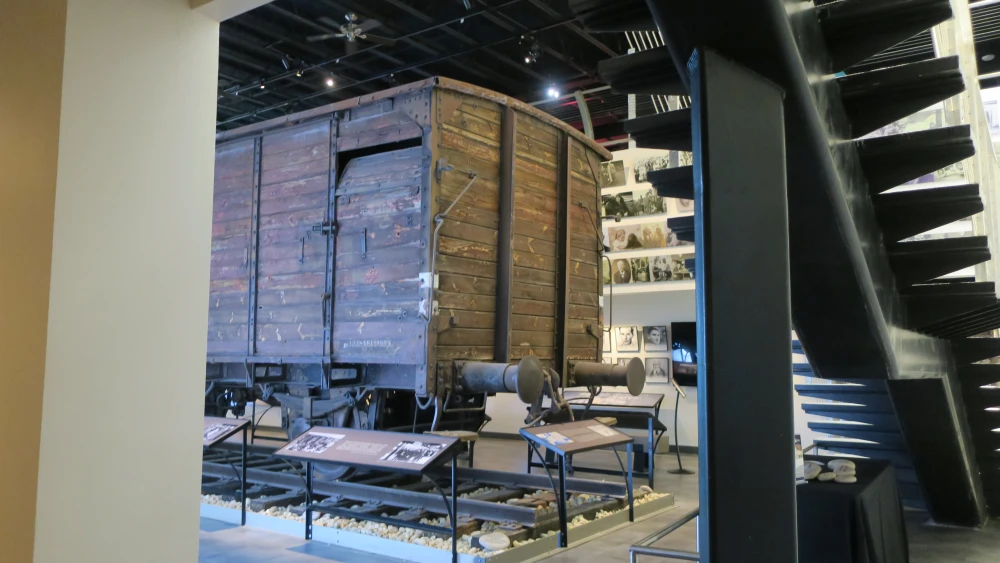
Boxcar #113 069-5, which the museum states is one of a few remaining railroad boxcars “of the type used by the Nazis to transport Jews and other prisoners to places like Auschwitz and Treblinka,” is displayed on original tracks from the Treblinka killing center. Szczepinska told JNS that rings were found beneath the floorboards of the boxcar, indicating that people were aboard, but it isn’t known exactly what route it traveled and when.
“You may be wondering why the door is closed. In other museums the door is open,” she told JNS. “Our survivors find it extremely disturbing to see the door open. For us it’s an artifact. To them, it’s a reality. So we are keeping it closed while they are still with us, because they are our priority.”
Boxcars were “the first place of death for many during the Holocaust” and “often became a suffocation chamber for some of the people—100 or more at a time—who were squeezed into it,” according to the museum. “Those who survived the trip had to endure the journey under conditions of hunger and thirst, extreme overcrowding and horrible sanitation. Many of those deported, especially the elderly and children died during the journey.”
The boxcar, which the museum dedicated as a memorial in May 1993, overlooks a more recent museum acquisition—from 2022—the Danish fishing boat Thor.
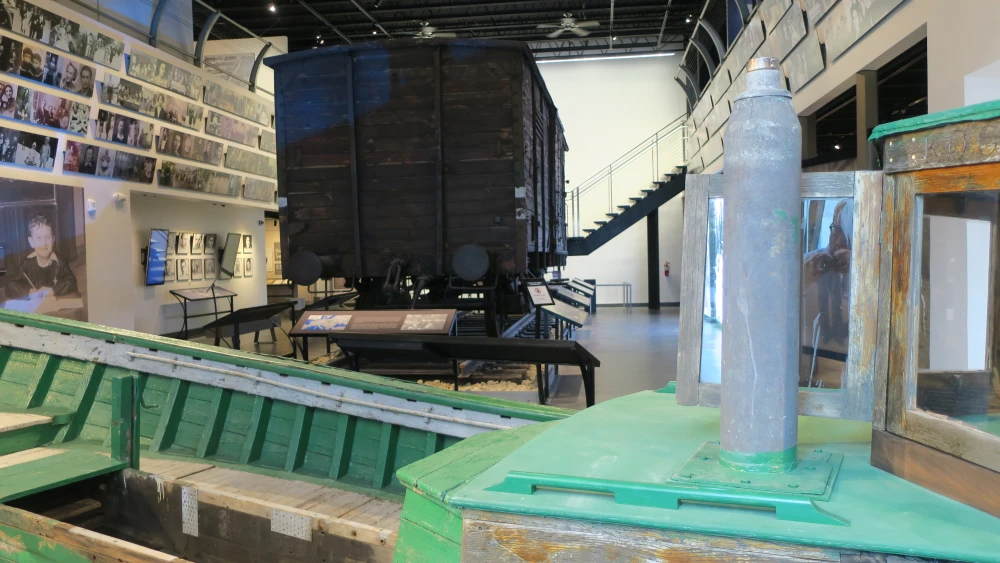
Irene Weiss worked with the museum starting in January 2022 to find a Danish rescue boat to bring to the museum. At first, none seemed available. Then she secured the help of Margot Benstock and a friend who lives in Denmark to contact someone who owned the boat Thor.
The boat’s logbook and records of purchase confirm its provenance, according to the museum. “In 1943, Erik Olsen purchased Thor, an eel fishing boat. That fall, he used Thor to transport four Jews from Køge to safety in Sweden,” the museum states, noting that Olsen’s son Claus Olsen shared the rescue story with staff. “Thor continued to serve as an eel fishing boat until the 1990s, long after the rescue operation.”
The museum states that both Weiss’s and Benstock’s relatives were rescued during a three-week period in October 1943, during which 300 fishing boats like Thor smuggled more than 7,200 Jews and 500 non-Jewish family members—accounting for 90% of Danish Jews—out of the country.
“Margot’s father sailed from Køge, Denmark, to Skanör, Sweden on a fishing boat like Thor. Her mother, Ester Fisch, who was born in Denmark, was ferried by fishing boat from Gilleleje to Höganäs. Her maternal grandparents escaped on a different fishing boat to Sweden,” the museum states. “Irene’s father was taken from Copenhagen to Sweden, also via a similar boat. Irene’s mother almost did not make it out of Denmark, as her first attempt failed before finally leaving from Copenhagen to arrive in Sweden (also on a Danish fishing boat).”
Stillman, the museum’s president and CEO, told JNS that the display of the boxcar and the boat is “very intentional.”
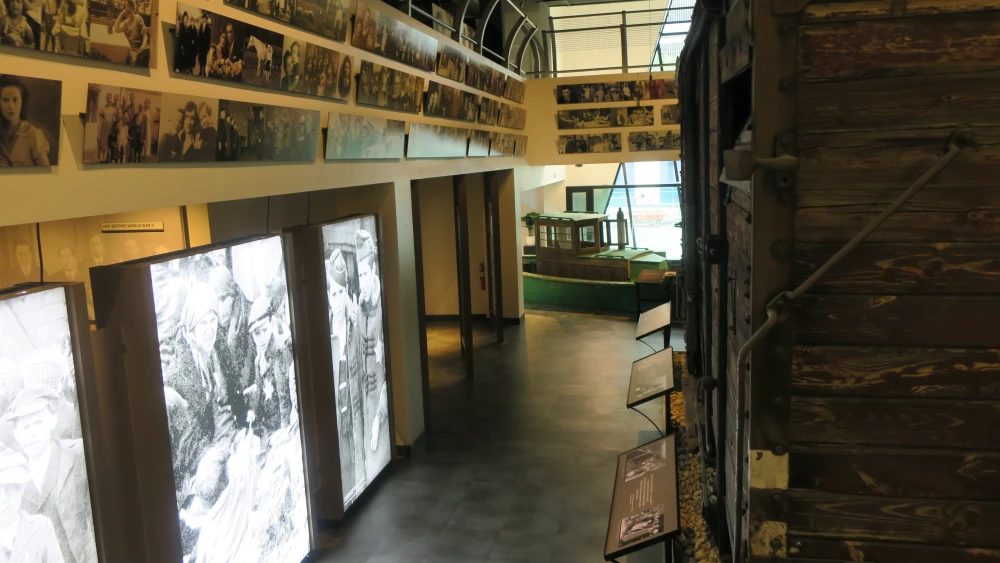
“The boxcar represents fear and death, and Thor, the Danish fishing boat, represents hope and future,” he said. “By having them juxtaposed so close together, it really makes it a very apparent way for someone to look up at the boxcar, because it’s huge. It towers over everybody, versus Thor, where you’re as if you’re at water level and you can look down and you can see into the boat.”
“You can see where the Jews were hidden under the floorboards and picture their scent being masked by fish to keep the Nazi dogs from being able to find them,” he told JNS. “That to me is probably the most powerful place, and wherever I am in the museum, I think of myself as being centered there.”
Wiesel collection
During its tours of the museum, JNS viewed both its “sneak peek” of its newly acquired Elie Wiesel collection on the second floor and the voluminous third-floor space, whose non-load-bearing walls it intends to take down, which will serve as a center of study (the “Wiesel experience”) connected to the survivor and Nobel laureate.
Stillman, who is fundraising to support the third-floor displays, told JNS that he thinks that the Wiesel collection and experience will become “another signature component for me of this museum, and I think for many, many visitors.”
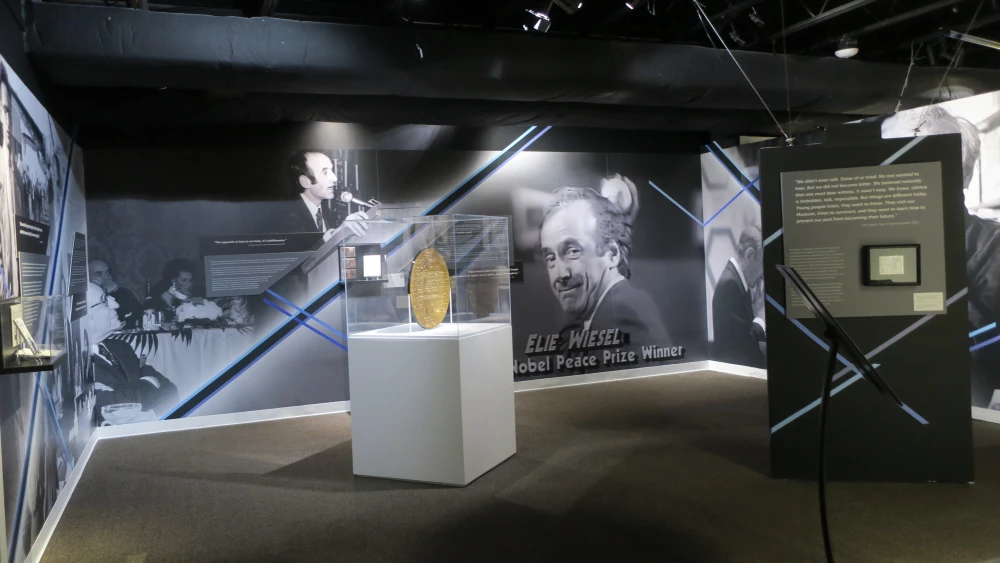
“We have received and are cataloguing an enormous quantity. I think 30 cubic feet is the term,” he told JNS. “Documents, photographs, passports, clothing and books.”
The museum states that part of the collection is 800 boxes from the late professor’s office in New York City. Other materials come from his Boston office and from his wife, Marion Wiesel, who died in February.
On the third floor of the museum, Marion Wiesel’s pink blazer—which her friend and executive assistant dubbed her “power blazer” and which she wore to all of the White House events that she attended—is displayed in the preview of the collection. (It is a loan from the Wiesel family.)
Stillman told JNS that it is important for the museum to display photos and other materials of Marion Wiesel’s to tell her story (she was also a Holocaust survivor) and to tell human stories rather than ones of only her iconic husband. Marion Wiesel has never been the subject of a museum exhibit, he said.
“We’re presenting her to the world for the first time,” he told JNS. “Even though she was a known person, she was never known in this context.”
The Wiesel family and foundation chose the St. Petersburg museum in 2024 to receive its entire collection. “We are giving people truly a glimpse into the person, who was both the Holocaust icon who is known throughout the world, yet also a father, a grandfather, a husband, a son, a grandchild,” Stillman told JNS. “What we are really challenged to do is help introduce the person as well as the icon.”
The museum has also committed to using “a substantial portion of our physical space” to show materials related to Wiesel. “I don’t believe that any other institution that was competing for this opportunity, this honor, would be able to have made that level of commitment,” he said. He added that a terrace on the third floor, outside the Wiesel experience, which offers sweeping views of the city, affords those who have had an emotional experience to “have the proverbial and literal breath of fresh air and contemplate and reflect.”
The space for which Stillman is now fundraising will include pods, learning centers, a replica of Wiesel’s office and areas for conversation, and it will have interactive, large touch screens to access the digital collection. “Really to sort of pose the challenge to people, if you were a student of Elie Wiesel’s today and you were facing the ethical and moral dilemmas that we have in our world, how would you respond?” Stillman said. “What questions would you be asking? What questions would you be answering? And do it in a way that you’re surrounded by his life, his work, his family in the digital sense.”
Local flavor
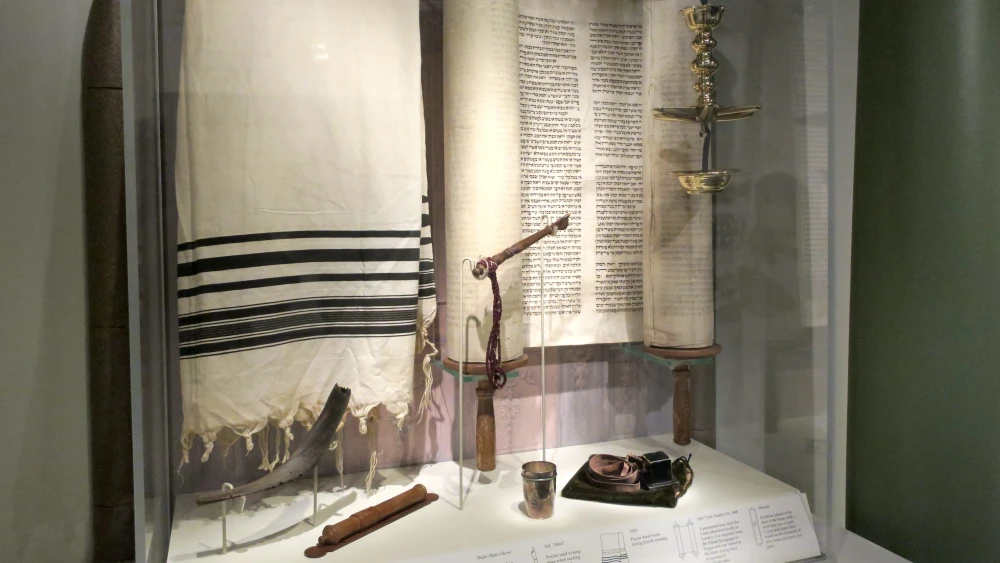
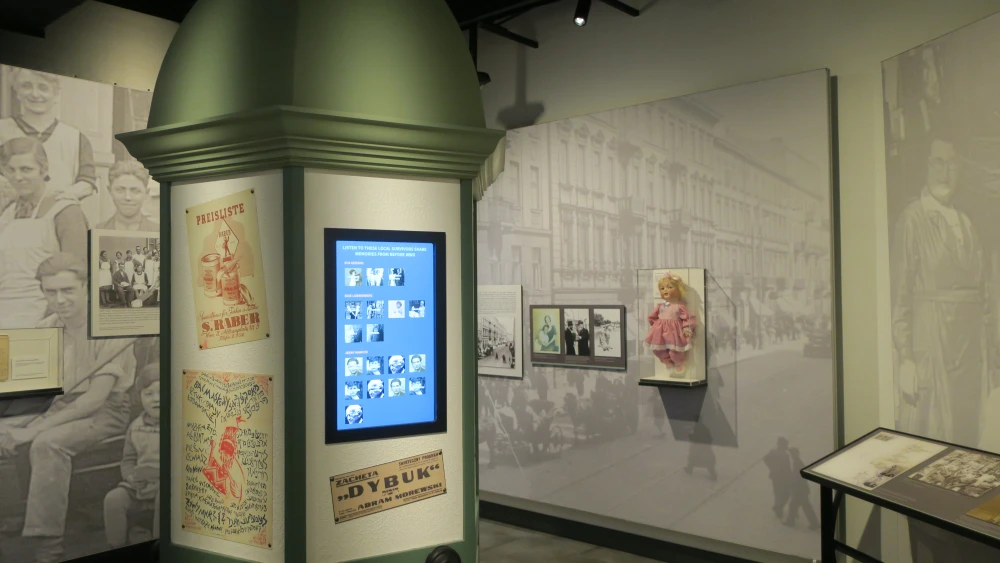
Throughout the museum, hometown stories weave in broader attention to the Holocaust.
One of many objects with a local angle is a pan, which was used to make a Passover version of a traditional Sephardic donut that generations of Rosa Miller’s family used. A Holocaust survivor from Salonika, Greece, Miller “carried her family’s traditions with her through war, displacement and ultimately, survival,” according to the museum.
After surviving the war, Miller was a linguist for the CIA and the NSA and moved to Tampa, where she “became a dedicated volunteer at the Florida Holocaust Museum, sharing her story with students and visitors,” the museum states.
The museum also interviewed four survivors for 10 hours a day, daily for a week, to create interactive displays, in which visitors can pose questions to the survivors and they “answer” from among the 1,000 questions that museum staff asked them. The technology is created to recognize keywords in the question and match them up with an appropriate answer.
“That’s the closest you can get to talking to a survivor,” Szczepinska told JNS.
Other metaphorical “dialogs” emerge in the collection, like an image of Anne Frank in school in Amsterdam in 1940 (displayed alongside one of Albert Einstein riding a bicycle in Santa Barbara, Calif., in 1933) directly across from another image of Frank, with her father Otto, mother Edith and sister Margot in Basel, Switzerland, in 1941.
One fortuitous connection emerged from the way the designers arranged materials, according to Szczepinska. “We had no way of knowing these pictures would end up near each other,” she said.
An image of Henryk Ross photographing ghetto residents for identity cards for the statistics department at the Lodz ghetto, around 1941, shows him positioning large groups on a platform that he built. By photographing many residents at once—and then cropping the negatives into individual portraits—he saved film that the Nazis assigned him. He used the leftover film to secretly capture pictures of the ghetto.
Near the image of Ross photographing is an image of a Lodz ghetto work permit for Ferka Herman, who wove straw overboots for German soldiers to wear over their leather boots for warmth. The picture shows Ross’s white platform behind Herman and a cropped arm of another person. This image was one of the ones that Ross used to save film, Szczepinska told JNS.
Local angles also emerge in the museum’s temporary exhibit “I’ll Have What She’s Having: The Jewish Deli,” curated by the Skirball Cultural Center in Los Angeles.
Stillman learned that the exhibit was planned when he applied to be the museum’s CEO and director, he told JNS. He asked why a Holocaust museum would show such an exhibit.
“It was explained to me, and I’m learning as I go, that the cuisine of American Jewish delis in fact very much hearkens back to the cuisine that the Jews in central and eastern Europe from before the Holocaust were accustomed to eating,” he said. “So it was familiar to them, and we have survivors and others from our local Jewish community who are connected to Jewish delis.”
Among the additions that the museum placed in the show—with permission from Skirball—in a section titled “A local taste” are a shirt from Jo-El’s Kosher Deli, in St. Petersburg, and a booklet to track monthly dues to the Amalgamated Meat Cutters and Butcher Workmen of North America issued to Sam Lefkowitz, a Berlin native and champion boxer who survived a brief imprisonment in a concentration camp after Kristallnacht. He fled to the United States via Shanghai.
The section also includes soda bottles, soap, a wall calendar, a blank receipt and meat counter number 38 from Katz Grocery, a local Jewish-owned establishment in a “historically segregated and predominantly black neighborhood” of St. Petersburg. Abe Katz, who took the store over after his father’s death, “was known locally for helping his customers in need,” per a wall label, “including cashing welfare checks, loaning money, providing goods to those who couldn’t pay and teaching kids how to drive.”
He and his wife Bunnie and their daughter Sandy ran the store until 1987, “when the business was demolished to make way for Tropicana Field,” home of the Tampa Bay Rays, per the label. “Abe didn’t let his business go easily, though, fighting for two years to keep his store open for the sake of his customers.”
‘Lessons for today’
JNS asked Stillman and Szczepinska how the museum addressed Jew-hatred today and how it would respond if, say, a young person on a tour asked a museum guide about allegations that Israel is committing “genocide” in Gaza.
“We are a non-political organization,” Stillman told JNS. “Because we have a clear mission and purpose, which is to honor the memory and to teach of the Holocaust, people come to this museum and they hopefully leave this museum with a deeper understanding of what were the root causes of the Holocaust, what occurred in the Holocaust, what has occurred since the Holocaust and then be better educated and better able and better informed to be able to apply those lessons to understanding both antisemitism and other forms of hatred and bigotry.”
In the exhibition state devoted to Wiesel, the museum plans to “definitely include” that he was a staunch Zionist, according to Stillman, “so people can come to understand what his perspective was on Israel and Zionism and how he viewed it.”
The core exhibit on the museum’s floor includes a “lessons for today” display, which contains entrance doors to a doctor’s office with one reception area marked for “white” and the other for “colored” people.
A panel on “modern antisemitism,” with a photo that Szczepinska took at a memorial at the site of the Nova festival, which Hamas attacked on Oct. 7, addresses the violent attacks against Jews globally, which have been “on the rise in the second decade of the 21st century.” The panel notes the 11 Jewish worshippers killed in the attack at the Pittsburgh synagogue Tree of Life “by a follower of antisemitic conspiracy theories.”
It states that Oct. 7 was “the largest mass murder of Jews since the Holocaust,” which was carried out by “Hamas, a Palestinian terrorist organization, and other Palestinian terrorist groups.” It states that more than 1,200 people—including 45 U.S. citizens—were murdered, and “some victims were also subjected to sexual violence.”
“After Oct. 7, antisemitic incidents have skyrocketed in the United States and around the world,” it adds. “The number of incidents on college and university campuses was 84% higher than in 2023 and increased more than in any other location.”
The label also names Israeli embassy staffers Sarah Milgrim and Yaron Lischinsky, who were murdered in an antisemitic attack outside the Capital Jewish Museum in Washington on May 21, and the “antisemitic terror attack” less than two weeks later in Boulder, Colo., in which people were injured including an 88-year-old Holocaust survivor, Barbara Steinmetz, and Karen Diamond, 82, died from severe injuries from the attack.
“Since the Holocaust, including to the present day and will be going on, unfortunately, probably forever as part of the human condition, we know that there are acts of antisemitism which occur,” Still man told JNS. “We know there are other forms of bigotry, hatred and violence toward other people simply because they’re different.”
“Whether it’s different by religion, different by race, different by ethnicity, there’s unfortunately no end to the way in which humanity and people can treat each other in these ways,” he said. “While we are not a museum devoted to Oct. 7 and not specifically a museum about antisemitism, I’ve said very much that I consider Holocaust education to be a very important tool in fighting antisemitism.”
Visitors “will understand more about antisemitism and hopefully how to react and respond to it by learning about the Holocaust through the experience of this museum,” he said.
Szczepinska told JNS that the museum will receive questions about whether Israel is committing “genocide.” She said it also received antisemitic messages prior to Oct. 7.
“We are not a political organization, so we don’t make any comments about politics,” she said. JNS pressed what a museum docent would say if a student asked directly about Israel committing “genocide.”
“We do not engage in discussions about politics, but we do engage in history, so we refocus,” she said, noting that the museum has issued statements since Oct. 7. JNS asked directly if the museum would tell someone posing the question that Israel isn’t guilty of genocide or would it say that it doesn’t talk politics. “I think both,” she said. “We believe in facts, so we would absolutely share the information.”
The panel on present-day antisemitism is necessary “to make sure that visitors understand that antisemitism is not something just of the past, that it’s actually happening right now,” she told JNS. “These are facts.”
Right before the panels were sent to production, she was able to add the names of the more recent victims. “There will be a QR code,” she told JNS. “Because sadly this continues.”