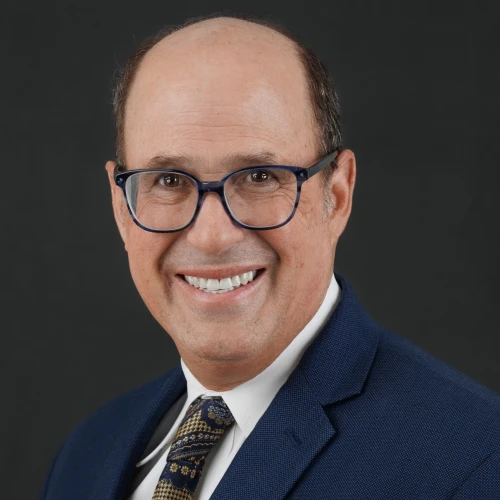
Philanthropist and president of the World Jewish Congress–Israel Sylvan Adams told JNS on Sunday that, in partnership with Beersheva Mayor Ruvik Danilovich, he aims to double the city’s population of approximately 220,000 people.
Adams made the remarks in the context of his visit to Beersheva following a series of donations to the region since Hamas’s Oct. 7, 2023, massacre, whose impact was concentrated in southern Israel.
“We need to populate and own our periphery by populating it,” he said. “Israel is very densely populated in its center, in Gush Dan and the Jerusalem area. Our north and south are sparsely populated, especially since Oct. 7.”
Within weeks of the attack, Adams donated $100 million to Ben-Gurion University of the Negev, describing the contribution as a direct response to the massacre.
The gift to what is widely seen as the economic engine of the south was intended to signal that the region would recover and rebuild “bigger and better,” he said. “It was important to tell our people, but also our enemies and our friends, that we are here to stay.”
As part of his visit to Beersheva, Adams toured the university to review how the funds were being used. At the time, he noted, it was unusual to donate $100 million without earmarking it for a specific project. Instead, the money was placed in the university’s general fund to enable long-term development plans. “During my visit, I saw all these new facilities and buildings—it’s very impressive,” he said.
Advancing David Ben-Gurion’s vision to develop and populate the Negev is among Israel’s most important missions, according to Adams. “We need to create the conditions for immigration to the periphery—the north as well—but my activities are directed toward the south symbolically because of the tragedy of Oct. 7. I hope others will invest equally in the north,” he said.
Israel needs roughly one million immigrants to the region to maintain the country’s demographic balance, he said, adding that rising antisemitism in the developed world has prompted many to inquire about aliyah, potentially helping to fill that gap.
“To bring the majority of that million immigrants, we need a pull factor—good employment, affordable housing, recreational facilities, culture and, of course, healthcare,” said Adams. “We need to develop these in the south, and I think we are on a good path.”
He acknowledged that immigration is not an easy decision. “Nobody wants to downsize. Many in the West—in Europe, the United States and Canada—are unhappy with their situation, but they have their lives there. We need to offer them a better life with their brothers and sisters in the Holy Land. I am confident we will achieve our goal,” he said.
During his visit, Adams toured the new army intelligence base in Beersheva for the first time, describing it as a major draw for residents and industries and a natural recruitment hub. He also praised Danilovich’s commitment to developing the city in a modern and attractive manner.

In November, Adams, together with Clalit Health Services and the State of Israel, committed 1 billion shekels (about $318.4 million)—with each party contributing a third—to Soroka Medical Center in Beersheva to rebuild and fortify facilities damaged in an Iranian missile attack in June.
“My response to Iran was that we would rebuild Soroka bigger, stronger and better, with the attainable goal of making it the best hospital in the country and perhaps the entire Middle East. This is our vision,” said Adams.
He described visiting the missile strike site and seeing the damage to surrounding buildings. “It shattered every single window on the campus in that area. It was shocking to see the devastation and destruction,” he said.
In a failed attempt to justify targeting the hospital, Iran accused Israel of using Soroka for military purposes. “I invite any journalists from Iran to tour the premises with me to see that this is an absurd inversion of truth,” Adams said, arguing that Tehran was projecting tactics used by its regional proxies.
Despite the damage, Adams said Israelis are neither impressed nor deterred.
“We continue to build and they continue to destroy. We see it in their own country,” he said. “Their costly and foolish activities—their proxies and nuclear program—have cost them so much that their people have reached their limit. I pray they will succeed, perhaps with a little push from President [Donald] Trump, in removing this regime they loathe and becoming a normal, functioning democratic nation.”
Adams described Iran as a great nation with an educated and advanced civilization that could join Israel as a democratic representative in the Middle East and serve as a model for others.
He pointed to protests that broke out in Iran on Dec. 28 over the country’s collapsing currency and expanded into demonstrations across all 31 provinces, only to be met with violence by the regime. Thousands, or even tens of thousands, were reportedly killed, injured or arrested.
Describing the regime’s ruthlessness, Adams said security forces used machine guns against demonstrators and brought in foreign militias to assist in suppressing the unrest.
“There are reports of troops entering schools and grabbing students who may have participated in protests, or healthcare workers who treated the wounded being killed or jailed for doing so. It’s an unspeakable tragedy,” he said.
In response, Adams said he would seek to mobilize contacts to invest in healthcare in Iran. “I believe these investments would be prosperous and beneficial for the economy and the people of Iran,” he said.
He stressed that he trusts Trump to fulfill promises of support to the Iranian people.
“It cannot be that the Iranians suffered so badly and again get stuck with the same regime after negotiations with an untrustworthy negotiator,” said Adams. “It cannot be that President Trump makes a promise to the people and then cuts a deal for less than what was discussed.”
No good deal can be made with Iran, Adams said, arguing that the regime is known for breaking commitments and would either wait out Trump’s presidency or violate any agreement reached during it.
“I am in touch with Iranian expats, and they are all waiting to see the outcome of this crisis. Many are enthusiastic to return to their homeland and invest. I am ready to invest alongside them and ‘Make Iran Great Again,’” Adams said, referencing Trump’s “Make America Great Again” slogan.