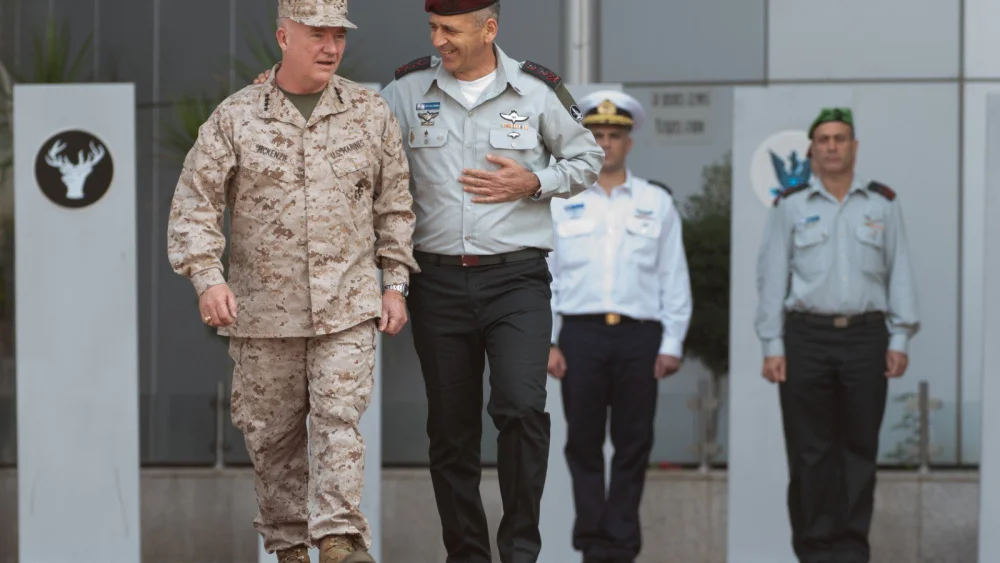
The Israel Defense Forces is preparing to host some 25 foreign military delegations this week for a first-of-its kind conference dedicated to sharing knowledge about the world of combat computer simulations.
The conference, scheduled for Nov. 12-14 in Tel Aviv, will see the IDF Operations Branch’s Chief Methodologist of the Concepts Laboratory, Professor Col. (Res.) Gabi Siboni, discuss how the Israeli military has come to use the increasingly powerful simulations as a key tool for military planning.
Battle simulations help commanders and planners make decisions such as how to prepare forces against the enemy and how to build up forces in the years to come. They also help the military consider decisions on which weapons systems and platforms to acquire, and where optimally to deploy against enemy forces.
“We think this is a central issue, and we want to build an international knowledge community around it,” said Siboni.
He stressed that the simulations are not a prediction tool since it’s impossible to know in advance how real battles will actually turn out. But by running simulations of the same scenario and changing one of the factors—a tactic known as comparative simulations—it’s possible to make better-informed planning decisions at little cost, he explained.

Battles involving tens of thousands or even hundreds of thousands of soldiers are simulated over a 24-hour to 48-hour period repeatedly before the Concepts Laboratory changes one of the factors and reruns the simulation.
At the end of the simulated battles, commanders receive figures regarding the location of friendly and hostile forces; the extent to which they have been exhausted and eroded; casualties on both sides; and other key figures. This enables the military to assess the strategic value of factors such as where and how to deploy forces, and the effects of a variety of weapons—from jets to missiles to artillery guns.
The simulations factor in field data about combat arenas on land, at sea and in the air. They enable commanders to examine various combinations of forces (i.e., different combinations of infantry and armored forces) and the impact they might have on the potential outcomes of battles, said Siboni.
“It’s like an electronic sand table. You can go to commanders and say, ‘Look what happened here.’ It doesn’t mean that this is what will happen in battle. But it could have happened,” he explained. “So we tell the commanders to take this into account when you organize your responses. It’s a very strong tool to support commanders in force activation, and for integrating new military means,” he said.
‘Our limitations lie in what can’t be measured’
The Concepts Laboratory, founded in 2006, takes classified military data to build up a picture that includes the order of battle on each side, operational plans and enemy fighting doctrines. Intelligence also plays a central role in shaping this picture.
Siboni also stressed the limitations of the system. “We can’t accurately simulate the battle spirit of the forces or the quality of commanders. We can’t know in advance if the commander is struck by fear, and whether he will or will not storm the enemy. The mind of the commander and his common sense must remain the main tool,” he stated.
Instead, the comparative simulations provide pre-battle support for decisions-makers. Siboni described how, prior to the Syrian civil war, the Concepts Laboratory simulated a defensive battle against Syrian military forces on the Golan Heights.
The simulations tested different combinations of Israeli infantry and armored units to see how this could change the outcome.
“For little money, one can see what would cost billions to see in real life,” he said. “Our limitations lie in what can’t be measured, like quality of commander. I’ll give you an example. If the Maccabi Tel Aviv basketball club plays a series of games and loses them, then replaces the manager and starts winning, how can you simulate this? These are the same players. These are the soft factors that can’t be simulated. In the military world, it’s the quality of the commander and the fighting spirit. We ensure that we don’t try to simulate these things.”
Siboni cautioned that “the big danger in the military profession is to stop depending on the professionalism of commanders. I don’t see a way how, in the foreseeable future, it will be possible to forecast if someone is afraid to storm enemy position. When you have a robot, it could be predicted.”
He pointed to the prediction system most invested in by humanity to date—weather forecasting—to underline his argument.
“Huge sums were invested in this. They know all of Earth’s figures, its rotation and receive satellite feeds,” he pointed out. “Does anyone know whether it will it rain in Tel Aviv next month? They do not—and this is without people, just physics. So anyone expecting to predict the battlefield will be throwing money down the drain.”