Inna Vernikov, 41, had been speaking with JNS for about an hour when she delivered one of her characteristically blunt verdicts on New York City Mayor Zohran Mamdani.
“He’s a liar,” the New York City Council member said matter-of-factly. “He’s a fake.”
The statement was natural coming from the Ukrainian-born Republican, who has built a reputation for being one of the mayor’s most fiery, out-spoken opponents within the City Council.
“It’s very clear to us who this guy is and what exactly he’s here for,” Vernikov told JNS. “It’s not for affordability, because he knows he can’t accomplish the majority of the things he’s promising.”
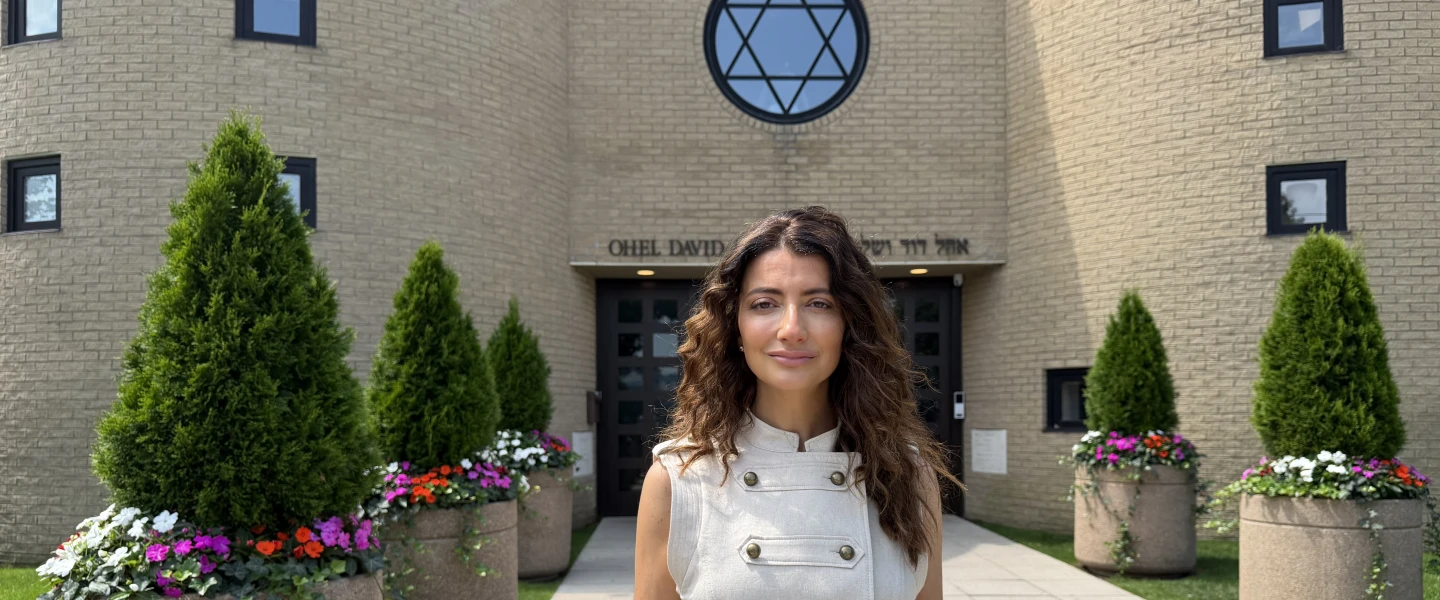
Vernikov, who is Jewish, spoke with JNS outside her synagogue, Ohel David and Shlomo, an Orthodox Sephardic congregation in Manhattan Beach.
She has represented Brooklyn’s 48th district in the City Council, which includes several Orthodox Jewish and Russian-speaking enclaves, including Manhattan Beach, Sheepshead Bay and Brighton Beach, since 2021.

The mayor, of whom she is so critical, has said that he would have the Israeli prime minister arrested in New York City, and his spokeswoman said that synagogues violate international law when they host pro-Israel events.
Mamdani’s primary concern has “always been” opposing the Jewish state, and he “ran on ‘free buses to free Palestine,’” she said. “You can quote me on that.”
She grew up in Chernivtsi, in western Ukraine, when it was part of the Soviet Union, which, she told JNS, means that she recognized the dangers of socialism taking hold in the United States before many others did.
“Free stuff is very attractive to young people, who didn’t grow up in communism and don’t understand what it is,” she said. “They don’t understand that the government will just lie to you and tell you, ‘Oh, free, free everything,’ and then they’ll steal your money, because somebody has to pay for it.”
Vernikov, who co-chairs the City Council’s bipartisan task force on Jew-hatred, doesn’t recall experiencing Jew-hatred in Chernivtsi, a city near the Romanian border that was once home to a large Jewish population before the Holocaust.

She remembers cobblestone streets, her mother playing piano, communal Passover Seders and a culture that placed a premium on education.
“There were no snow days,” she said. “Everybody went to school.”
Her family was not observant, and her grandfather was a fervent communist, but Vernikov enrolled in Chernivtsi’s first Jewish school after the Soviet Union’s collapse. It was around that time that she remembers one of the earliest conversations about Israel taking place in her home.
“A lot of Jewish families were having the same conversation, which was, ‘OK. We need to leave this place. Where are we going? Are we going to Israel, or are we going to America?’” she told JNS. “I was little, but I remember it very well. We sat around the table and they were deciding, and they decided, ‘We’re going to America.’”
At 12, Vernikov arrived in Brooklyn with her parents and two siblings. She learned English within five months and was soon the family’s designated negotiator. She was sent often to make phone calls, challenge an agency or solve issues when something went wrong.
“My mom would tell you that anything they wanted, they would always push me to do it,” Vernikov told JNS. “Any phone calls, any way we had to fight to get through.”
Even at restaurants, her parents would turn to her when there was a problem. “‘Oh, she will take care of it,’” they would say, according to Vernikov.
The role suited the self-declared “bit of a troublemaker,” she told JNS with a smile.
“Every time I saw something wrong, I always wanted to fix it,” she said. “I always wanted to say something, do something. I never wanted to stand by or stay on the sidelines.”

Jew-hatred was the first issue she felt compelled to confront herself. The 2012 attack on the U.S. diplomatic compound in Benghazi, Libya, was another turning point, she said.
“When we were in the Soviet Union, this country was painted as such an amazing place, where the government doesn’t lie and there’s no corruption,” she said, of the United States.
Watching then U.S. Secretary of State Hillary Clinton testify before Congress about the terrorist attack, which killed four Americans, made Vernikov think that “they didn’t protect their own people, and then they lied about it and Americans died.”
“I felt like that was horrible,” she told JNS.
That impatience with inaction, in particular when it came to Jew-hatred, drew her to law and later to leave a successful legal practice for politics. At the time, the seat that she now holds had not gone to a Republican nominee for 100 years, she said.
“It was probably one of the hardest things I’ve ever done,” she said. “Law school was tough but this was very stressful, very tough, very challenging. It involved so many moving parts, so many people.”
“It was a reflection of how angry this community was at the Democratic Party, to the point where I flipped this district, which was two-to-one Democrat,” she said.
She campaigned tirelessly, forging relationships with constituents across religious, cultural and political lines.
“If you want to win, if you want to flip a seat, and you’re in a political environment where nobody from the establishment is backing you and everyone is against you—all I had was the people,” she told JNS. “That’s actually all you need.”

Vernikov said that although she now earns far less than she did as an attorney, she does not view her City Council position as just a job.
“I’ve had to give up to do this, because I just felt like it’s so important for my future family, my future kids, the community here and the broader Jewish community, because I knew I was gonna be fighting antisemitism,” she said. “I didn’t see politicians doing that on a big scale. I just saw a lot of pandering on both sides.”
She also doesn’t shy away from what she sees as misogyny at times.
“If somebody is biased or whatever because I’m a woman, too bad,” she told JNS. “I feel like I’ve proven myself, and so many successful women do so many amazing things, especially today. I’m very grateful that we have so many opportunities.”
And to antisemites, she told JNS, “I don’t care that people hate me.”
“I’m serious. I don’t think it’s important,” she said. “What I care about is when that antisemitism is emboldened, then when it comes out, and when there’s action—when they act upon it.”
“I don’t care how people feel,” she added. “It just doesn’t impact my life in any way if somebody’s sitting in their house or in their basement and hating on me.”
Since taking office and winning reelection in last year’s primary against former City Council member Ari Kagan, who is also Jewish, by more than 32 percentage points, Vernikov has worked hard to advance legislation in response to rising Jew-hatred in New York City.
One such bill would have made it a misdemeanor to block access to an educational facility or prevent students, staff members or university employees from attending classes, meetings or events.
Violations would be punishable by up to six months in jail, a fine of up to $1,000 or both.

“The bill had consequences,” she said. “At the end of the day, if we don’t have consequences, what are we doing?”
Vernikov told JNS that she modeled the proposal on an existing law protecting access to abortion clinics, the Freedom of Access to Clinic Entrances Act (FACE) law. Her legislation never made it through a vote.
“That was the funny part,” she said. “It’s ironic that the abortion clinics we can protect, but educational facilities and houses of worship, when we’re talking about Jews, that’s a problem.”
The City Council later advanced separate legislation requiring the police commissioner to develop plans for addressing obstruction, intimidation and physical interference at educational facilities. It did not create the misdemeanor offense that Vernikov proposed in her bill.
Though she voted for the other version of the bill, Vernikov said that she would have preferred a stronger bill with a specific buffer zone and criminal penalties for blocking an entrance. (Mamdani nixed the bill after it passed the City Council without a veto-proof majority.)
“The better bill would be, ‘Create a buffer zone with a specific parameter,’” she told JNS. “But I also would have preferred that the bill actually included consequences, like making it a misdemeanor to block educational facilities.”
Still, “the choice was no bill or some bill, and it’s obviously better to have some bill,” she said.
Vernikov doesn’t hold the mayor to the same standard. Asked what Mamdani can do better to fight Jew-hatred, she said that she would prefer he do “nothing.”
“If I had a choice between the mayor doing anything on antisemitism and doing nothing, I’ll choose nothing,” she told JNS. “Every time he claims to stand up against antisemitism or the Jewish community, he’s actually making it a lot worse for us.”

Vernikov told JNS that she recently confronted the Mayor’s Office to Combat Antisemitism, in-person, for “operating in secret.”
“‘You’re afraid to get pushback from certain communities, or whatever the excuse is, but your boss, the mayor, is not secretive about his opinions on Israel and Zionists and Zionists are the majority of Jews,’” she said she told the office.
Former New York City Mayor Eric Adams created the office. Mamdani has drawn widespread criticism for his appointment to run the office, Phylisa Wisdom.
Legislation, or “politics,” as Vernikov put it, is only half of her job as a member of the City Council.
She drew the attention of JNS to flaking paint on railings along the Sheepshead Bay canal. That is one of many more mundane, “quality-of-life issues,” that fill her time.
“This is gonna be completely renovated,” she told JNS. “It costs a lot of money. I had to work with the borough president and senator to fix it.”
She repeated several times throughout the conversation that she refuses to pander to any political party and is “not here to make friends.”
The Democratic party is “a horrible place for Jews,” she told JNS. “Everybody should exit the Democratic Party.”
“That’s not to say that the Republican Party is perfect either,” she said. “But the Jewish community, in particular, shouldn’t be taken for granted. We’re not tied to a party.”
“We’re facing an existential threat right now, and politicians should know that we will exit any party that’s going to be very hostile to the Jewish community, because we know our history,” she said.
Vernikov is willing even to criticize U.S. President Donald Trump on how he handled the war with Iran, she said.
“I’ve met Trump and I supported him, because I liked a lot of his policies,” she told JNS. “Nobody’s perfect, but I’m not in a cult. I am very grateful to him for a lot of his stances, especially when it comes to Israel and the Jewish people. But no administration is perfect.”
“I think it’s important to call them out when I feel like they’re wrong,” she told JNS.