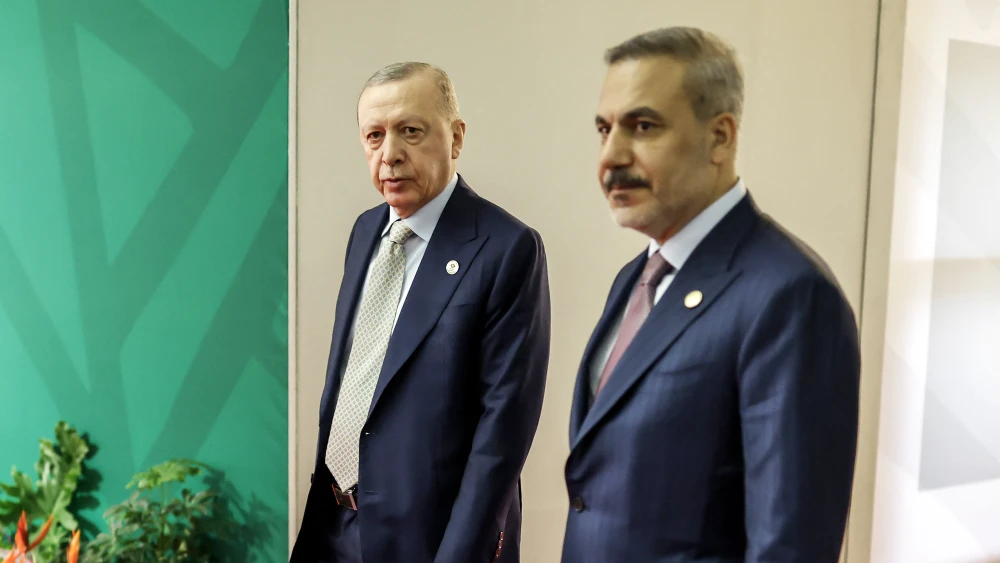

He was the man who was not supposed to be there. Turkish Foreign Minister Hakan Fidan, the son of a middle-class family, was not destined for greatness in Turkey of the 1980s. His father, born in the Kurdish village of Varto and later the head of a family in Ankara, was merely a low-level clerk.
Those dry facts alone were enough to seal his fate. But decades passed. Turkey changed beyond recognition. And suddenly, a gray, unassuming intelligence official is being identified as the heir to Turkey’s undisputed leader. He may well be the man who leads Ankara into a new era as a regional power, and in an extreme scenario, could steer it toward a historic confrontation with Israel.
“As of July 2026, Fidan is one of the most important figures in Turkey’s foreign policy and security establishment,” Burak Çelik, a Turkish expert on foreign policy and Middle East affairs, told Israel Hayom. “Still, the idea that he will definitely lead Turkey after President Recep Tayyip Erdoğan should be treated as speculation, not as a settled political fact.
“Fidan has political weight, but he does not enjoy Erdoğan’s power. Fidan’s power comes mainly from the security bureaucracy, meaning his long tenure as head of Turkey’s intelligence services, his experience in foreign policy and his relationship of trust with Erdoğan. There is no evidence that Erdoğan has officially designated him as his successor,” said Çelik.
Speaking from Istanbul, Çelik noted that the Warsaw-based Centre for Eastern Studies (OSW) found in March 2026 that polls showed that many voters of the ruling Justice and Development Party preferred Fidan as the 72-year-old Erdoğan’s successor. They described him as a popular figure whose standing rises during international crises. However, popularity among the party’s voters is not the same as selection by Erdoğan, or acceptance by all the party’s elites.”
“There are four main possible successors to Erdoğan,” Dr. Asa Ophir, an expert on Turkey at Ariel University’s Department of Political Science and Middle Eastern Studies, told Israel Hayom. “Two belong to Erdoğan’s family circle—his son Bilal and his son-in-law Selçuk Bayraktar, and two are from the political leadership. Over the past two years, Bilal has been seen at the forefront, but is not especially liked by the public. Bayraktar, by contrast, is very popular, and is considered someone who advanced Turkey’s standing through the drone industry, which has become a source of national pride.
“At the top of the political echelon are the two senior officials who have worked closely with Erdoğan for years—Hakan Fidan and Ibrahim Kalin, who currently heads the MIT intelligence agency. He studied in the U.S. and knows the West well. He is also intelligent, sharp and quite well liked, but he is not as charismatic as Erdoğan.
“Fidan has several advantages,” the researcher added. “Everyone knows Erdoğan values him. He is also the right age, 57, neither too young nor too old. Beyond his closeness to Erdoğan, he revolutionized the MIT intelligence agency. During his tenure, the entire balance of power in Turkey changed. The politicians managed to make the body truly subordinate to the political echelon, instead of to the military. That is how Fidan became a key figure in the regime.”
But, according to Ophir, Fidan has one glaring disadvantage. “At the end of the day, he is a rather gray figure, and not much was known about him until he was appointed foreign minister. He is not a colorful figure like Erdoğan, who can stir up the masses.”
On the seam line
During Fidan’s 15 years in the army, he dealt mainly with intelligence-gathering missions and never served even as a junior officer. The dramatic turning point came in the courtyards of Ankara’s Bilkent University. It was precisely from the place that seemed farthest from the army that his meteoric rise to the top of the Turkish security establishment began.
“At the university he met Ahmet Davutoğlu, a professor of international relations who would later become Erdoğan’s close adviser and foreign minister,” Ophir said. “This is the man who wrote the book that served as the compass of Turkish foreign policy over the past two decades. Erdoğan is a giant politician, but he is not a strategist or an academic. Davutoğlu was the one who brought Fidan into his inner circle.”
In his years as minister and adviser, Davutoğlu dictated an activist foreign policy intended to increase Turkey’s influence across the Middle East. One of the key figures who shared in that vision was Fidan. In 2003 he was appointed chairman of TIKA, the Turkish Cooperation and Coordination Agency. This is the agency responsible for the activity of Turkish nonprofit organizations in Jerusalem and Gaza.
“This body also operates on the seam line between diplomatic involvement, aid and intelligence gathering,” Ophir explained. “Everything there is coordinated from above, and it may be one of the most important bodies in projecting Turkey’s and Erdoğan’s soft power. They go to all kinds of war zones and serve as Ankara’s long arm under the cover of humanitarian aid.”
Step by step, Fidan drew closer to Erdoğan through his ties with Davutoğlu and his role as head of TIKA. In the next stage, he became undersecretary in the office of Erdoğan, who was then prime minister. There, he became one of his close advisers, paving the way for his dramatic appointment as deputy head of Turkey’s intelligence agency, one of the country’s most important security organizations and the equivalent of Israel’s Mossad.
Within a relatively short time, in May 2010, he was chosen to head the agency and began a long and stormy term. As noted, the agency, which had been one of the arms of the military deep state, gradually submitted to the foreign and security policy of Erdoğan and his associates. Internally, power shifted to the political echelon. But in the regional context, Turkey began flirting with actors hostile to Israel and the West.
For example, in those years, the German news weekly Der Spiegel exposed the relationship between Fidan and Qassem Soleimani, commander of the Quds Force, and the man considered the head of Iran’s shadow army.
On the one hand, Turkey followed with concern the deployment of pro-Iranian militias in Iraq and Syria against the backdrop of the civil war and the rise of the Islamic State. On the other hand, Ankara forged secret ties with Tehran that helped the latter bypass quite a few economic sanctions imposed by the U.S. administration.
After about 13 years in the powerful post of intelligence agency chief, Fidan was promoted to the front line of political activity. In the summer of 2023, he was appointed foreign minister, a few months before the Oct. 7, 2023, Hamas onslaught on Israel.
Since the war in Gaza, relations between Jerusalem and Ankara have reached a historic low. Direct flights were halted, a trade embargo was imposed, and Israeli ships were even barred from docking at Turkish ports. During this period, it seemed as though Erdoğan and Fidan were competing in antisemitic statements.
Only this month, the president called the Israeli government “the Zionist slaughter gang.” Fidan declared that Israel was “a problem for all of humanity.”
“Unfortunately, these people apparently see Israel as a greater threat than Iran to Turkey’s national security. At the most basic level, they simply do not like this idea of a Jewish state in the heart of the Middle East. We are essentially two powers that appear to be on a collision course like icebergs,” Ophir said.
Perhaps one of the tensest fronts in the friction between Israel and Turkey is Syria. In December 2024, Bashar Assad’s pro-Iranian regime collapsed, and an Islamist coalition backed by Turkey rose to power.
The new president, Ahmed al-Sharaa, formerly a senior Al-Qaida figure, is described by the top echelons of Israel’s security establishment as Erdoğan’s disciple. He is seen as someone who receives advice from Ankara on media conduct and on the need to prettify himself in Western eyes.
Syrian sources who spoke with Israel Hayom expressed great concern over Turkish activity in the country. For example, they described how Turkish elements were working to purchase real estate belonging to minorities who preferred to leave the country. The Syrian sources claimed that this was, to a large extent, a return of the Ottoman era, during which the Syrian space was under the control of the sultans in Istanbul.
Fidan is one of the architects of Ankara’s policy in Syria, Çelik confirmed. After Assad’s fall, Turkey became one of the most influential external players in Damascus. Fidan is a central link in Ankara’s communication with al-Sharaa.”
A red flag
Fidan long aroused the concern of senior officials in Jerusalem. In 2010, then-Defense Minister Ehud Barak described his appointment as head of MIT and his attitude toward the ayatollah regime as a troubling development.
“Israel has a serious problem with Fidan,” Ophir said. “From the security establishment’s perspective, he is defined as a red flag. This is a man who, during his tenure as head of Turkey’s intelligence agency, apparently passed information, according to The Washington Post, to the Iranians that burned Israeli assets in Iran.”
However, the Turkish researcher Çelik noted that “Fidan’s approach is security oriented. Turkey held technical talks with Israel regarding Syria when necessary, but made clear that such talks did not indicate normalization. This suggests that Fidan’s approach toward Israel can change according to circumstances, especially if there is a ceasefire in Gaza, a reduction in tensions in Syria and a regional framework supported by the U.S. However, under current conditions, a warming of relations and a normalization process appear unlikely.”
According to Çelik, “Fidan’s recent diplomatic moves regarding Gaza have focused less on slogans and more on issues on the ground, including governance, a police force, international stabilization forces and access to humanitarian aid.” Reuters reported that Fidan argued that Gaza governance and a police force should come before the disarmament of Hamas.
This point is important because Turkey is a member of Trump’s Board of Peace, which is meant to lead his plan for the Gaza Strip. However, due to Israel’s insistence, Turkey is not part of the U.S.-led international forces command that is supposed to implement the plan.
“In general, he is a strong, credible figure of strategic importance. He is one of the few senior Turkish officials who can combine intelligence and diplomacy, but he does not have a status equivalent to Erdoğan’s, and he has not yet proved himself in elections,” he added.
“His future depends on three things: Erdoğan’s preference, the consensus of the elite in the Justice and Development Party, and whether the Turkish public will accept a security-bureaucratic figure as a national leader,” Çelik said.
Originally published by Israel Hayom.