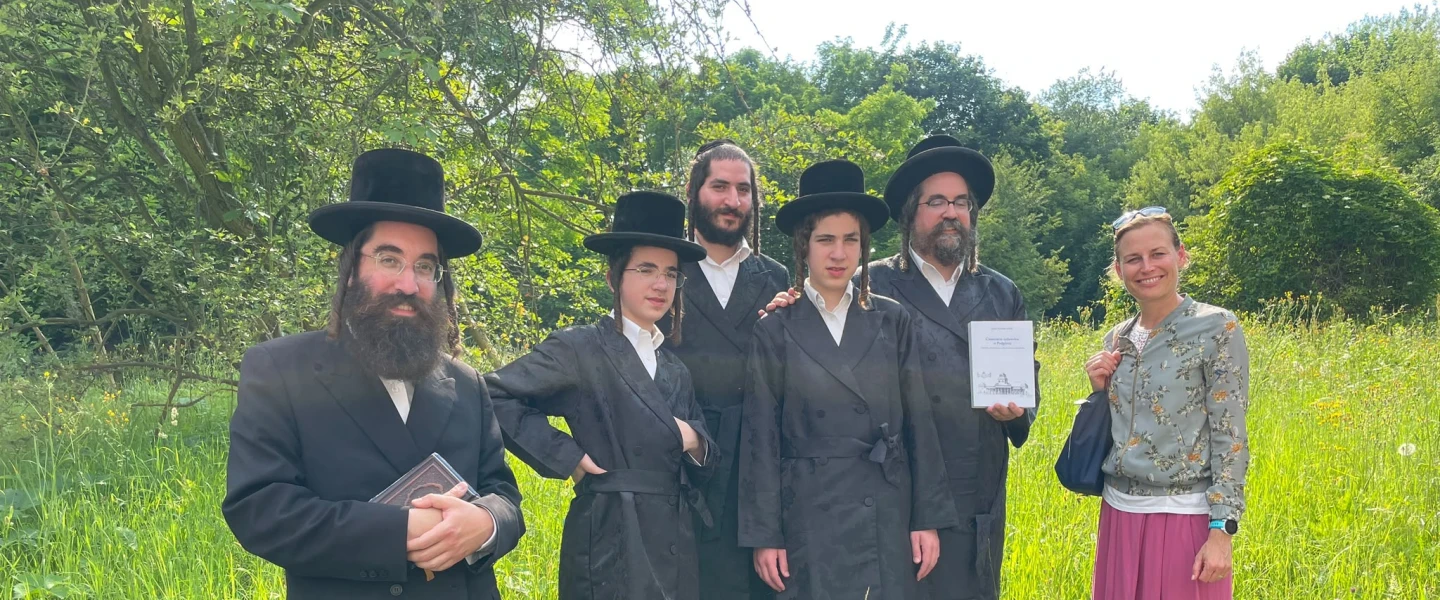
KRAKÓW, Poland—The minibus carrying a group of ultra-Orthodox Jewish men from New York pulled up to the site of the demolished Jewish cemetery turned Nazi labor and concentration camp in the southern Polish city of Kraków in June, seeking out a blonde Polish tour guide.
Janina Naskalska-Babik, 42, who was dressed for summer and had not expected such a religious group, quickly put on a jacket from her bag out of respect.
“In other circumstances, we would likely have never spoken to each other,” Naskalska-Babik told JNS, noting the unusual encounter between the men in black hats and sidelocks and a shiksa, the Yiddish term for a non-Jewish woman, which can sometimes have a derogatory tone.
But the unlikely tour guide had something they wanted: information about their ancestry and relatives buried at the site in Plaszów, on the outskirts of Kraków, before the Nazis destroyed it during the Holocaust—records she had painstakingly researched and digitized.
Naskalska-Babik accompanied them to the barren hill, where only one intact Jewish gravestone remains from the cemetery where thousands were buried, and guided them to the likely burial site of their relatives so they could recite the Jewish mourner’s prayer, Kaddish—the purpose of their visit.
“It gave me a sense of fulfillment and satisfaction to do something for others who are so different from yourself,” she said.

‘It came as a shock to me’
It was a decade and a half earlier that the tour guide first became interested in Jewish history after studying to become a licensed city guide.
She was stunned to learn, almost in passing, that Krakow had been one-quarter Jewish before World War II, with nearly its entire Jewish population decimated in the Holocaust.
“It came as a shock to me that there was so much history I wasn’t told about,” she said, noting that Jewish history was not part of Poland’s educational curriculum at the time.
She enrolled in courses at the Jewish Historical Institute, then became determined to visit the Yad Vashem World Holocaust Remembrance Center in Jerusalem and learn Hebrew.

After returning home and while stuck at home during the COVID pandemic with two young children, she pursued an online master’s degree in Jewish studies at Krakow’s Jagiellonian University and set out to write a meaningful thesis.
She began guiding small groups around the mostly barren site of the Nazi camp at Plaszów, which, since the Communist era, has been used as a public park, although a museum is scheduled to open there next year. Officials told her that they had extensive archival material on the two Jewish cemeteries that had existed there before the war, but no one to focus on the research.
The camp, immortalized in the 1993 Academy Award-winning film “Schindler’s List,” was built in 1942 on the grounds of two former Jewish cemeteries that the Nazis forced imprisoned Jews from the Krakow Ghetto to demolish.
Today, the site is barren, having been destroyed by the Nazis during the Holocaust. Two monuments honor the camp’s 6,000 Holocaust victims. Dotting the landscape is the lone surviving prewar Jewish gravestone and fragments of others; a restored monument marking the grave of Bais Yaakov founder Sarah Schenirer, who was buried there in 1935; the original building of the Jewish Burial Society (Chevra Kadisha); and the house where notorious Nazi German SS commandant Amon Göth lived.
‘I felt as if I was with them’

Getting to work, the tour guide used local death records to compile a list of 9,100 Jews buried in the cemeteries before the war and digitized the information in both a book and an online database, where the New York Hasidim who sought her out last month found details about their relatives.
“The research was a little melancholy,” she acknowledged, “but I felt as if I was with them.”
Her family was convinced that her interest in Jewish history was “a short-term fascination” that would eventually pass. (“Are you still counting the Jews?” her young daughter once asked while watching her work through the database.)
But it did not.
She is now pursuing a Ph.D. in Jewish studies, and in addition to her city tours, leads specialized tours focusing on Jewish women and Krakow’s mezuzah trail, tracing the small decorative cases affixed to the doorposts of Jewish homes.
“When you uncover these names, it’s like meeting these figures, and it gives you the energy to go on,” she said.
“These people didn’t know what happened to their ancestors, and this is another stone I can add to their story.”