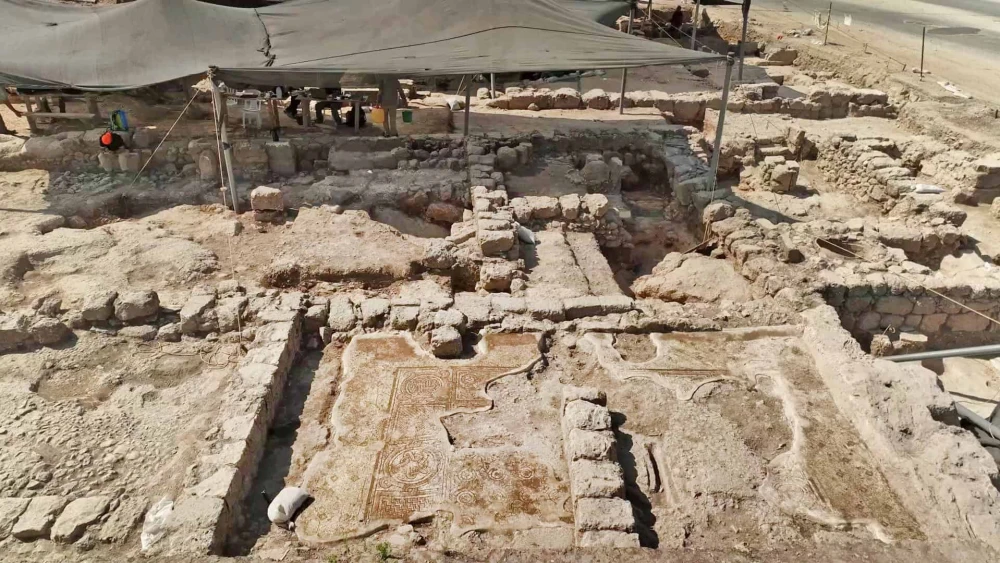
An expansive agricultural estate that was part of an ancient Samaritan settlement, about 1,600 years old and decorated with colorful mosaics, has been uncovered in central Israel, the Israel Antiquities Authority announced on Tuesday.
The property was unearthed over the last several months during an excavation in the central Israeli city of Kafr Qasim ahead of the construction of a new neighborhood, the state-run archaeological body said.
The Samaritan settlement existed for about 400 years, from the end of the Roman period to the end of the Byzantine period (fourth–seventh centuries C.E.), according to the IAA.
The Samaritans are an ancient, nearly extinct ethnoreligious group from the region of Samaria who follow a form of religion closely related to Judaism. They call themselves the “Children of Israel” (Bene Yisrael) and believe they are descended from the Israelites who remained in the northern kingdom of Israel after the Assyrian exile of 722 BCE.
The area where the excavation took place is described in historical sources as the birthplace of Menander, the Samaritan magician, successor of Simon Magus, who was considered the father of the Gnostic sects and one of Christianity’s first converts, according to the IAA.
“The size and splendor of the buildings discovered, the quality of their mosaic floors and the impressive agricultural installations, all point to the great wealth and prosperity of the local Samaritan community over the years,” said excavation directors Alla Nagorsky and Daniel Leahy Griswold.
In one of the buildings, a magnificent mosaic floor was preserved, decorated with a dense geometric pattern and vegetal images. Alongside its central medallion are acanthus leaves combined with rare decorations of fruits and vegetables such as grapes, dates, watermelons, artichokes and asparagus.
At the entrance to the room excavators found a partially preserved Greek inscription wishing the building’s owner good luck.
An olive press, a spacious warehouse building and a public purification bath, or mikvah, were also unearthed in the northern part of the estate. The proximity of the oil press to the bath was probably used to produce olive oil while in a state of ritual purity, according to the excavation directors.
“This is a fascinating site, which displays the historical gamut between the days of prosperity and the decline of the Samaritan community,” says Nagorsky. “Its long-term existence and impressive findings will allow us to reconstruct its history over centuries and will enrich our knowledge about this population in ancient times.”