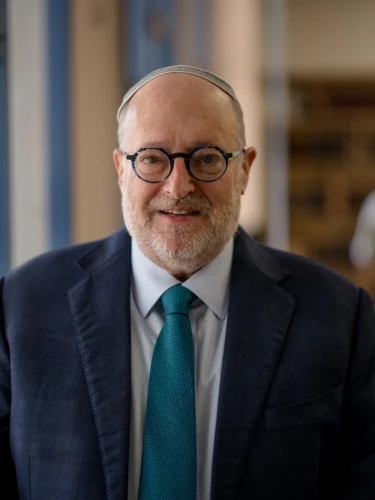
For Rabbi Kenneth Brander, the so-called “million-man march” in Jerusalem on Thursday to protest efforts to reach a Knesset compromise on drafting Haredi men into the Israeli army brings “a different pain,” the president and dean of Ohr Torah Stone told JNS on Wednesday.
Brander, a former senior Yeshiva University official, runs a network of 32 Religious Zionist institutions, including hesder yeshivahs that combine Torah study and military service, that has sent thousands of alumni to serve in the Israel Defense Forces, including 24 who were killed in the war against Hamas in Gaza, Brander told JNS.
“I didn’t think I could be in as much pain as I was spending half days at Har Herzl,” Brander said, of the cemetery at Mount Herzl for fallen soldiers. (Brander’s son is currently serving in the Israeli military.)
“This is a different pain,” he told JNS. “It represents the fact that we’re not all rowing in the same direction when it comes to” responsibilities to the Jewish community. “It’s very painful to see that,” he added.
He told JNS on Thursday that it’s “heartbreaking that a group of Torah students could unite in solidarity with a handful of young men jailed for failing to submit deferment forms, yet over the past two years, they haven’t marched together for the hostages taken by Hamas.”
“Imagine the moral power and spiritual force such a gathering could have if it were instead dedicated to praying for and demanding the release of the remaining bodies of hostages,” he said.
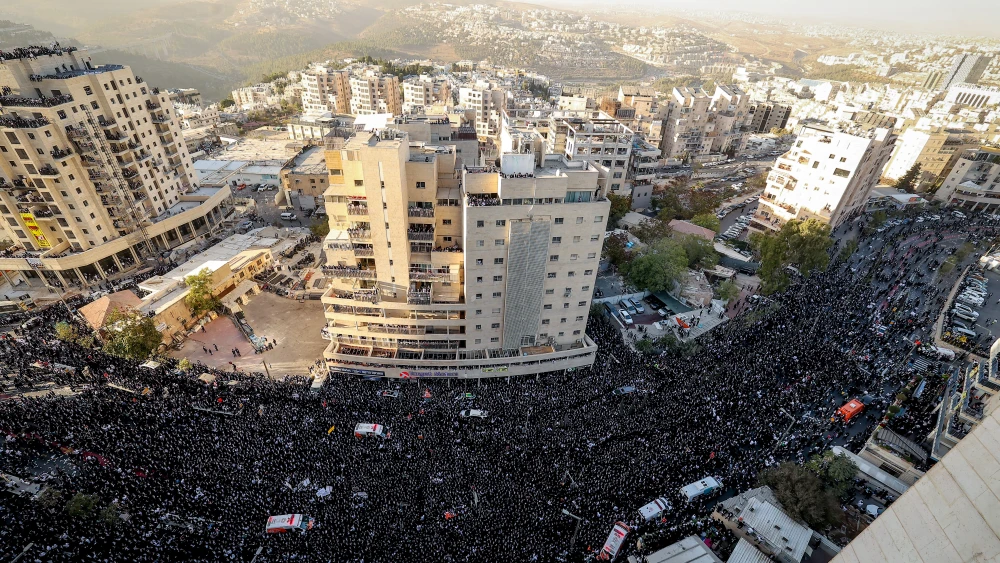
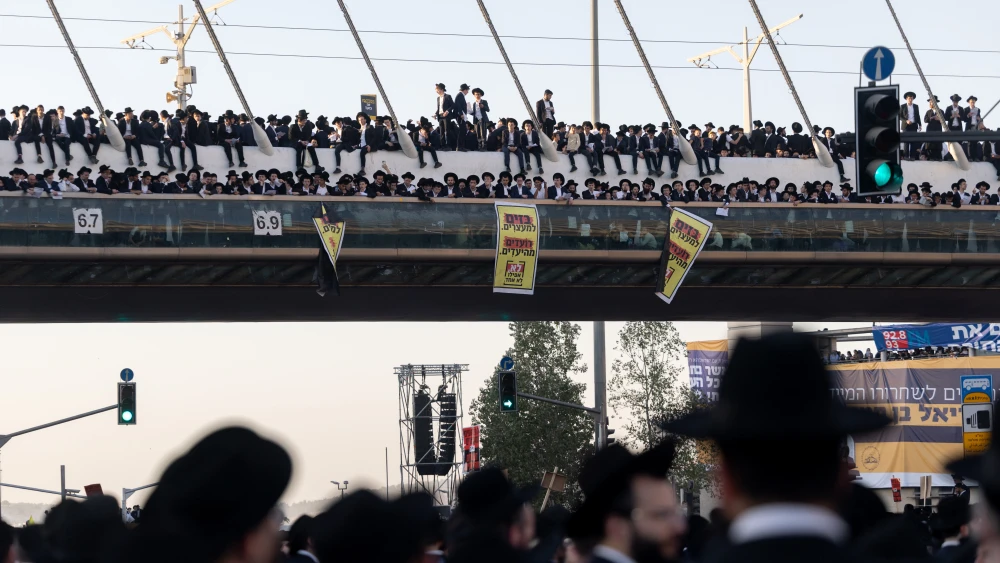
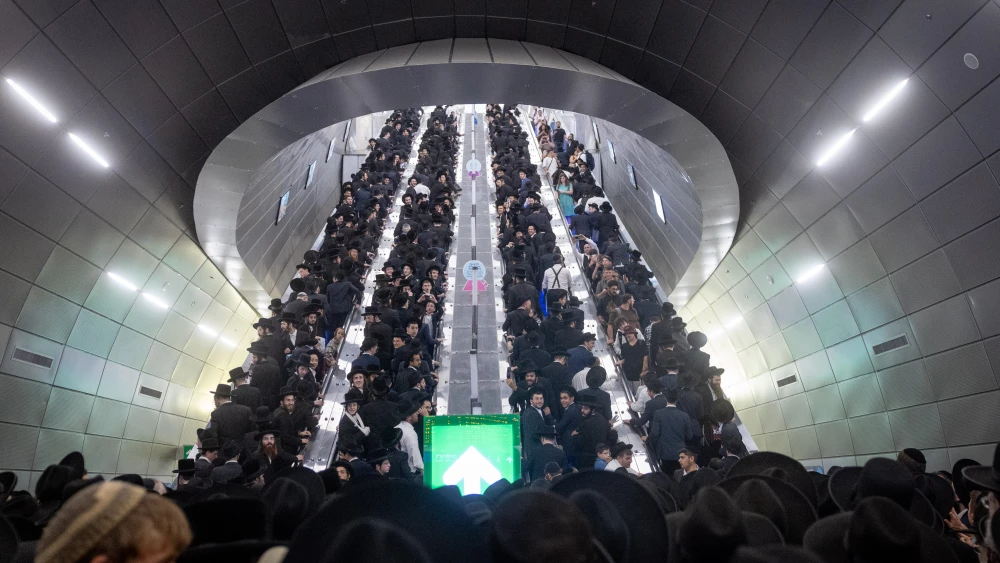
Some 500,000 people were expected at the protest, which was scheduled to take place at the city entrance between 2:30 p.m. and 4:30 p.m. local time. Police urged people to avoid the area and said that there will be firm responses to road blockages.
Police estimated that more than 300,000 Haredim protested at the city entrance, per Hebrew media reports. The rally, in which protesters prayed and recited Psalms without political speeches, included participants from across Haredi communities, including Lithuanian, Chassidic and Sephardic Jews.
Some 2,000 Israel Police officers, including Border Police, secured the rally and directed traffic as the demonstration got underway in the nation’s capital, which was effectively closed off during the event.
Protest organizers called on participants to leave early after a 15-year-old boy fell to his death from a 10-story building at a nearby construction site, from which he was reportedly watching the demonstration.
Israel’s Magen David Adom medical emergency response group said that it received a report around 4:30 p.m. local time of “a teenager who fell from a height at a construction site on Sderot Shazar in Jerusalem.”
Paramedics at the scene reported a “boy, approximately 15 years old, who fell from a great height, with no signs of life and multiple-system trauma, and declared his death at the scene.” Jerusalem District Police “are at the scene and have begun investigating the circumstances,” it stated.
Magen David Adom teams treated more than 50 participants, four of whom were evacuated to Jerusalem hospitals, it said. Two were said to have fainted, and one suffered a heart attack. Another sustained a “minor injury.”
One of the victims was a police officer, who was hurt moderately when a tour bus transporting participants in the protest hit him. The incident is reportedly under investigation.
‘Obligation to fight’
“We have students missing limbs. Students whose spouses won’t let them stay home with their children because their mental state isn’t stable enough,” Brander said. “We have people struggling.”
That other Jews are saying “in the name of Torah” that they don’t need to fight is “against halachah,” rabbinic law, which requires those who are eligible for service to report for duty during an “obligatory war,” when the Jewish people’s survival is at stake, the rabbi said.
Brander told JNS that Israel’s defensive war against Hamas falls into that category, because it aims to vanquish an enemy that is determined to destroy the Jewish nation.
“We’re fighting ‘from the river to the sea.’ I believe that’s what Hamas wants, and I have no doubt they won’t keep Bnei Brak protected, nor anywhere else,” he said, of a Haredi enclave.
Brander added that fighting has been conducted with strict adherence to Jewish legal protocols. “We have lost students who went out of their tanks to feed children when the children were being used as decoys so snipers could find soldiers and murder them,” he told JNS. “We fight with dignity and responsibility, but we have the obligation to fight.”
The protest follows a series of arrests of ultra-Orthodox students who refused military conscription, including Ariel Shamai, a student at the Ateret Shlomo yeshiva in Rishon Lezion. Israeli military police detained Shamai, despite him being a full-time yeshivah student, and reportedly sentenced him to 20 days in jail for ignoring a summons to report to the draft office.
Ariel Rosenzweig, a student at the Neve Eretz Yeshivah in Be’er Yaakov, was also arrested while he was sitting shivah (mourning) for his father last week. He was subsequently released from custody.
Military police have arrested several other Haredi draft dodgers, sparking large-scale protests across the country by their communities. Some ultra-Orthodox leaders, including those at Ateret Shlomo, have sparked outrage by using symbols associated with freeing the hostages to argue against conscription.
The Israeli Supreme Court ruled last year that after an exemption law expired in 2023, the Israeli military must start drafting Haredi men. The IDF began criminal proceedings against such draft candidates who failed to report for enlistment this year.
Israeli Prime Minister Benjamin Netanyahu’s ultra-Orthodox coalition partners, Shas and United Torah Judaism, exited the government in July over the issue, leaving the coalition without a clear Knesset majority.
Boaz Bismuth, chairman of the Foreign Affairs and Defense Committee, is expected to present a draft bill regulating exemptions of Haredi yeshivah students from IDF service.
Netanyahu hailed the establishment of the all-Haredi Hasmonean Brigade as a “genuine revolution” in a Knesset address last week. “These bold fighters enlisted in the IDF as Haredim and will be discharged as Haredim, and we will add more tracks that will make this possible,” the Israeli premier said.
Brander agreed that such integration is possible, noting that the more Haredi men enlist, the more the IDF will adapt to meet their religious needs.
The rabbi told JNS that the Israeli military placed a kiddush cup and grape juice in every guard booth, so soldiers could break their Yom Kippur fast without leaving their posts.
“The IDF is not perfect,” he said. “But bases are glatt kosher, meals are served accordingly, and there are rules against doing things that are not halachic. An officer can be disciplined for that.” (Glatt refers to a higher level of kosher inspection.)
Commanders visit each soldier’s home before service to ensure that families have adequate support, food and resources, and the army steps in when they do not, according to Brander.
“If that’s true outside the base,” he said, “then surely on base the army goes to great lengths to ensure there are opportunities to fully practice Torah and mitzvot,” or religious obligations, “which is itself a halachic responsibility.”
‘Torah and army’
The current clash over conscription stems in part from a national manpower shortage, according to Brander.
“We need more soldiers and the whole country realizes that,” he said. “The Religious Zionist community has been the glue in the country, because it represents Torah and it fights.” He added that the Religious Zionist community has suffered more combat losses proportionately than any other sector.
“There’s a sense of spirituality and ideal,” he said. “It’s really Torah and army, and neither is treated as ‘lite’. Torah at the highest level and service at the highest level.”
JNS asked Brander what Jews in the United States and elsewhere should know about the debate in Israel. The rabbi said the issue is broader than local Israeli politics.
“Any time a group wishes to fracture the Jewish people, we should all be concerned,” he said. “Any group that thinks they can benefit from the country but not be part of the support fabric doesn’t just weaken Israel. It weakens the security of Jews around the world.”
That belief in shared responsibility lies at the heart of Ohr Torah Stone’s mission to “address contemporary issues facing the Jewish people,” particularly education, Brander said.
In its six high schools (with two more under construction in northern Israel), three seminaries for women, a five-year advanced halachic program for women and several header yeshivas and a kollel, the network readies students for military service and it runs a mental health initiative supporting soldiers and their families, according to Brander.
“When you have a rebbe who lost three students in one week in three different battles, you need therapy,” Brander said. “When you have children in the same classes as young men or women, who lost half their family, the government ensures IDF children get therapy but not all their friends. We cover that.”
The rabbi said he is optimistic despite a widening rift in Israel over the draft.
He told JNS that the network’s program that represents agunot, religiously “chained” wives because their husbands deny them divorces, in rabbinical courts has developed working relationships with leading Haredi rabbis. Nearly half of the program’s clients are ultra-Orthodox, and there has been genuine dialogue with the Haredi leaders, he said.
“They tell me they’re envious,” he said. “They feel our young people, 19-25, know what they’re doing and are taking responsibility, as opposed to their young people,” he said.
Brander admitted that Thursday’s rally might “crush” his optimism a bit but told JNS it also strengthens his determination to create new programs that enable Haredi participation in the military.
“There’s already one Haredi hesder yeshiva,” he said. “We need more. I think tomorrow’s protest won’t change anything other than many Haredim will start thinking: ‘Why am I not serving? It’s the right thing to do.’”
The rabbi believes that change will come internally.
“In almost every Haredi family I’m aware of, at least one member has walked away from the Haredi lifestyle,” he said. “The older generation are worried things are changing. They feel the need to double down. I don’t think it will help. It will hurt them.”
Additional reporting from Israel by Akiva Van Koningsveld.