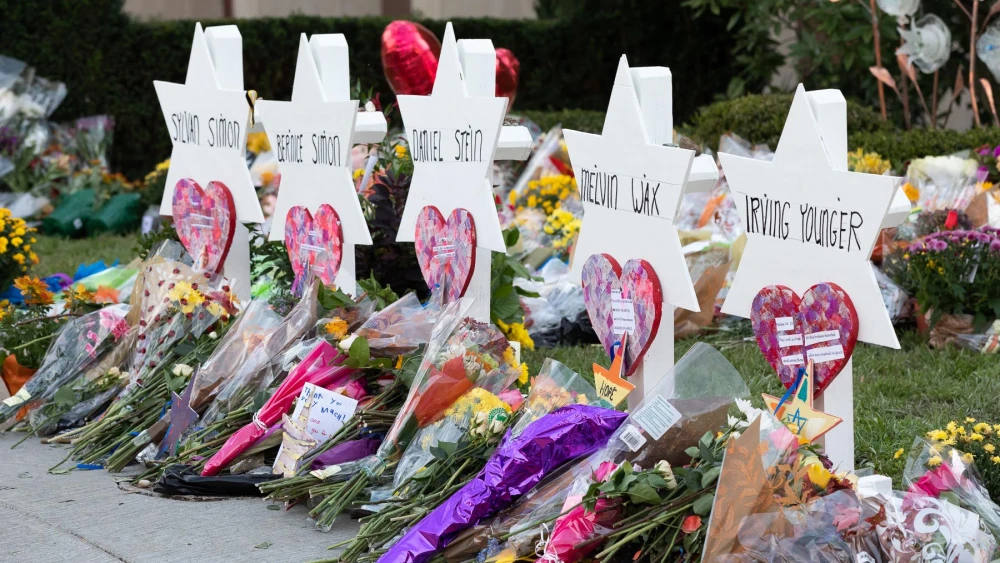
The fifth anniversary of the mass shooting at Tree of Life*Or L’Simcha Congregation in Pittsburgh on Oct. 27, 2018, in which 11 Jewish worshippers were killed during Shabbat-morning prayers, comes amid rising antisemitism following Hamas’s attacks on Israel on Oct. 7—the bloodiest day in Jewish history since the Holocaust.
From Oct. 7-23, the Anti-Defamation League recorded a 388% increase in antisemitic crimes and protests, compared to the same span in 2022. Many of those incidents appeared to respond to a former Hamas leader’s call for an Oct. 13 “Day of Jihad.”
Alan Hausman, president of Tree of Life Congregation, told JNS that the Conservative synagogue in Pittsburgh is balancing having strong security measures and being welcoming to its community and guests.
“During services every week, all congregations in and around the city of Pittsburgh have armed security,” Hausman said.
Tree of Life says they screen people randomly as they come in.
“We try to make sure we have the same security people each week, and that way they know the routine of the facility and they get to know the people who are coming in,” he said. “But there are a lot of things you can do to make a place open and inviting but still be very secure.”
Prepared to respond quickly
Hausman echoed tips on the website of the U.S. Department of Homeland Security, including the “power of hello” and looking out for suspicious behaviors.
“By saying a simple ‘Hello,’ ‘My name is so-and-so’ or ‘Welcome, what brings you here?’ to people coming into your facility that you’ve never met before, you establish a person’s reason for being there,” Hausman said. “You also establish the fact that you’re aware of them being there and you’re paying attention to people coming in.”
“There are some simple things we can do, but there’s also security there, so if something happens, we’re prepared to respond pretty quickly,” he added.
On Friday, a five-year commemoration of the Oct. 27 attack is scheduled for 3 to 4 p.m. at Pittsburgh’s Schenley Park, about a mile from the synagogue.
“This park offers us a way to do some really good security, but it’s not in-your-face security,” Hausman told JNS.
“It’s very secure. People will see some uniformed officers. There will be other officers they don’t see, and there’ll be other officers in areas they’re unaware of,” he said. “We’re fairly equipped in the city of Pittsburgh to handle this.”
Trust your gut
“Prior preparation is key,” said Michael Masters, national director and CEO of Secure Community Network, the North American Jewish community’s official safety and security organization.
Masters told JNS that SCN is unaware of current “direct credible threats” against Jews.
“It’s a very dynamic threat environment right now, so we’re encouraging synagogues and other institutions to remain open and in operation but to also be vigilant and take good security measures,” he said.
“For synagogues, that means having access control, knowing who’s coming in and out of their building, coordinating with law enforcement, coordinating with security if they’re able to have it and making sure they have people in place trained,” he said. “If they see something, say something. Trust their gut. If something doesn’t feel right, don’t let them in. Call law enforcement.”

While Jews must remain vigilant, SCN encourages them to live Jewish lives.
“That’s really important, but that means being situationally aware,” Masters said. “That means being aware of your surroundings. It means evaluating whether it’s a good idea to go to a protest or participate in a counter-protest. It means just general security efforts that any of us should be taking in today’s day and age.”
Masters noted the mass shooting in Lewiston, Maine on Wednesday night, which has left 18 people dead at a bar and a bowling alley. “Unfortunately, the reality is that these events happen regardless if we’re Jewish or not, but certainly because the Jewish community is under higher threat right now, that requires us to be aware, engaged and proactive,” he said.
“While we don’t have any direct credible threats against Jewish institutions, we are charting 300% to 400% increases in the number of antisemitic incidents and threats facing members of the Jewish community since Hamas initiated the war against Israel on Oct. 7.”
Adam Hertzman, director of marketing at the Jewish Federation of Greater Pittsburgh, told JNS that the city has a “very robust Jewish security system.”
“We’re not seeing active threats beyond the usual, so our advice to our agencies and synagogues is what it typically is, which is they continue to be vigilant. If they see something, say something, and to follow the security protocols that we have in place in the training that we’ve practiced many times.”
Several synagogues that JNS contacted to ask about how they are protecting their communities declined to comment on the record.
Five years later ...
Pittsburgh’s Jewish community has been resilient for the past five years.
“We’ve taken care of the people who were traumatized and we’ve improved security,” Hertzman told JNS. “The Pittsburgh model has really become a national model for Jewish community security in the United States and Canada. There are a lot of events going on here, and all the things you’d like to see in a vibrant and thriving community.”
At Tree of Life*Or L’Simcha Congregation, the community has made a decision.
“If people do more antisemitism, we do more Jewish,” Hausman said. “We are not going to let a person or activities prevent us from being Jewish.”
It is unrealistic with the attack five years ago to figure that time heals, or that the community will just get over it, according to Hausman. “In five years, you learn how to deal with a tragedy,” he said. “You never get over it. You just learn how to deal with it.”
“There are good days and bad days, and there are events that re-traumatize you,” Hausman said. Many people saw and learned new things that had happened while following the shooter’s trial, which was very hard.
“But we are stronger together,” Hausman said. “Pittsburgh is a big small town, so everyone leans on everyone, and we learn how to work with each other and support each other. If I’m having a bad day, someone else will help me. And if they’re having a bad day, I’ll help them.”