A building long thought to be a fourth-century church in the Ibero-Roman city of Castulo may be one of the oldest synagogues discovered on the Iberian Peninsula, National Geographic reported on Monday, citing an archaeological study published last month.
Near modern-day Linares, in the province of Jaén, about 160 miles south of Madrid, archaeologists digging in Castulo encountered several ritual objects that they associated with Jewish worship.
Some researchers believe that the Synagoga Mayor in Barcelona is the oldest synagogue in Iberia and Europe, dating sometime between the third and ninth centuries.
The findings at the Castulo dig include oil lamp fragments adorned with what appears to be a seven-branched menorah, a tile bearing a similar relief and a jar lid featuring what researchers believe is a Hebrew inscription, whose meaning scholars continue to debate, according to the study.
“This inscription, along with the menorahs, indicates the likely presence of a Jewish community in Castulo—one not previously recorded in historical texts,” one of the researchers, Bautista Ceprián, of the University of Jaén, who works on the Cástulo Sefarad Primera Luz project led by Marcelo Castro Lopez, told the magazine.
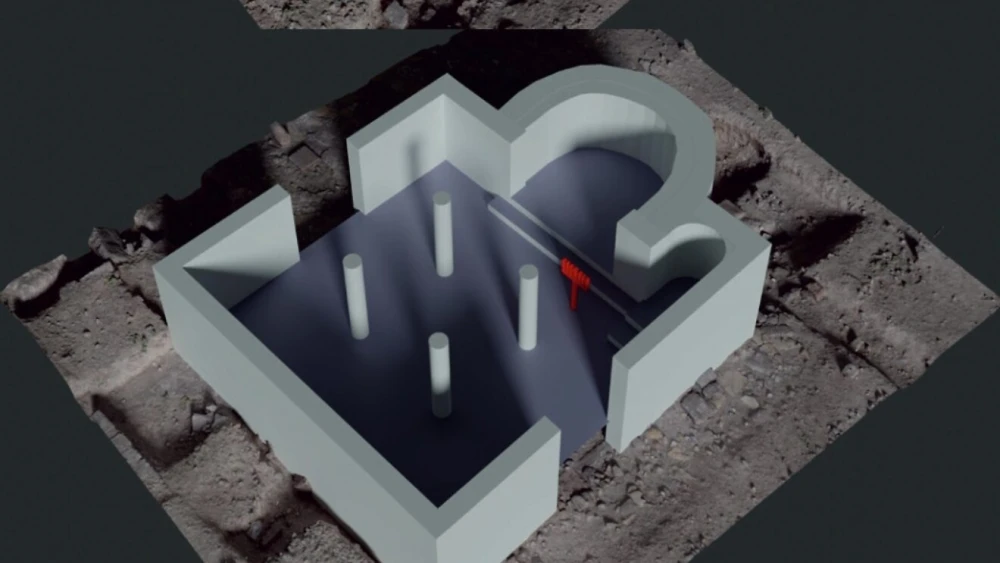
Architectural elements of the building further support the synagogue hypothesis, per National Geographic. Unlike elongated Christian basilicas, the structure is square in layout and features what researchers believe to be a bimah, a central raised platform used for Torah readings.
An apse, while typical of churches, could have housed the Torah ark in the Jewish tradition. The site lacks human remains or burial markers, in line with Jewish customs prohibiting burials near places of worship, the researchers noted in their findings in the journal Vegueta.
Christian symbols or relics are absent at the site, further suggesting it could be distinct from known Christian structures in the area.
The synagogue’s location on the former city’s edge, near Roman baths, may reflect the community’s marginal status, according to the researchers.
Despite the physical evidence, researchers remain cautious due to the absence of written records attesting to a Jewish presence in Castulo. They titled their study “A possible late antiquity synagogue in Castulo. Study of building S of the city.”
Castulo does not appear among the cities listed in the anti-Jewish decrees of Visigothic King Sisebuto in the seventh century, leading scholars to speculate that the local Jewish community had already dispersed by then.