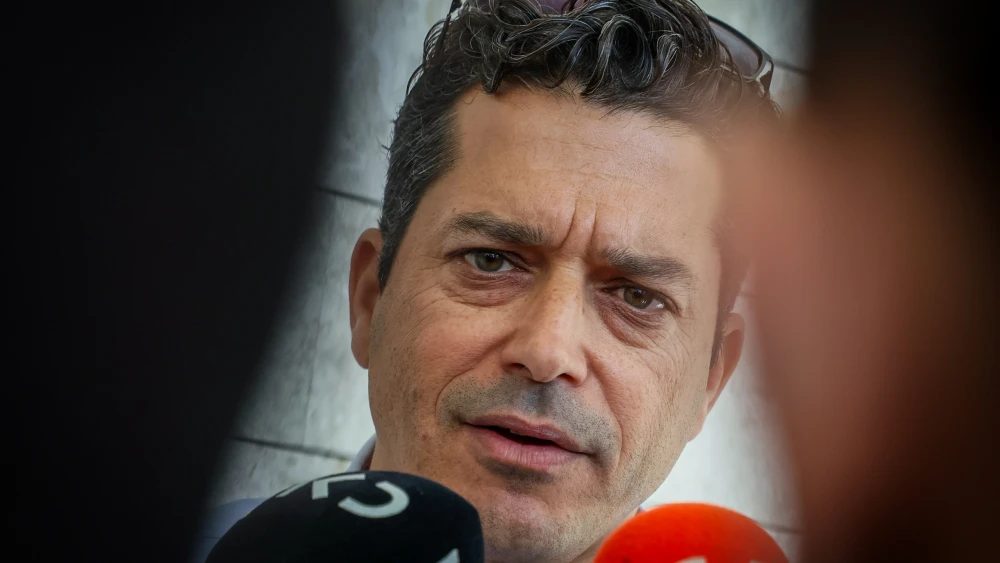
In an interview in his office in mid-February, Amichai Chikli, Israeli minister for diaspora affairs and combating antisemitism, quoted from the weekly Torah portion, Yitro, which was read in synagogues the prior day and includes one of Jewish scripture’s two versions of the Ten Commandments.
Part of the prior day’s reading was “honor your father and your mother,” Chikli said. He quoted Samson Raphael Hirsch, a famed 19th-century German rabbi, who said that the verse, which continues, “in order that your days be numbered,” suggests that mother and father (abba v’ima) are essential to Jewish continuity. “There is no replacement for abba v’ima,” he told JNS.
In August, when JNS spoke with Ofir Sofer, Israeli aliyah and integration minister, aboard the first Nefesh B’Nefesh charter flight since the Hamas-led terrorist attacks in Israel on Oct. 7, 2023, the official also quoted the Torah.
“Now we are reading in parshat ha’shavua Sefer Dvarim,” the weekly portion from Deuteronomy, in which Moses recounts the Israelites’ journey through the desert, which serves as both a roundup and a farewell address in one. “It’s so moving to read his thanks,” Sofer told JNS. He switched to Hebrew to say that Moses “is so emotional” as he tells the Jews “the most significant things to him.”
When Moses said those things, Sofer told JNS in a mixture of Hebrew and English, “he meant for us. He intended our time.”
Since March 21, Yechiel Leiter, the Israeli ambassador to the United States, has posted 11 video messages on social media that draw upon the weekly Torah portion.
In the most recent one, Sept. 12, he wrote that Charlie Kirk, the conservative activist and founder of Turning Point USA who was assassinated during a college event in Utah, “exemplified” the values of that week’s Torah portion, Ki Tavo, which teaches values that form the “foundation to American democracy: life, liberty and the pursuit of happiness.”
Experts told JNS that it is a golden age of Israeli officials quoting from the Torah, noting that Benjamin Netanyahu, prime minister of the Jewish state, quoted Samuel and Deuteronomy in his address to the U.N. General Assembly in September 2024 and drew from scripture to name the operation against Iran in June.
“This battle against Iran, I called it ‘Rising Lion,’ because in the Bible there’s a phrase that the people of Israel should rise like lions, will rise like lions,” the prime minister said at an Aug. 13 Newsmax event. “Our brave soldiers did just that.”

‘Almost hysterically anti-religious’
Rabbi Jeffrey Woolf, retired associate professor of Talmud at Bar-Ilan University in Ramat Gan and adjunct professor of Jewish history at the Touro Graduate School of Jewish Studies in New York City, told JNS that the number of religious ministers in the Israeli government and ministers who received formal religious training has grown.
“That is something which would feed the phenomenon,” he told JNS.
Woolf thinks that officials citing so many biblical proof texts is “relatively new,” although “Israel has been going through a deepening of its relationship with Judaism in a very, very profound sense already for about 30 years.”
“It took a big step forward after the intifada, but the war has accelerated the process intensely,” he said. “You see it all over the place. You see it with the soldiers. You see it in all kinds of ways.”
Israelis aren’t just quoting the weekly Torah portion. “It’s become, I don’t know if de rigueur, but certainly something which nobody is going to hesitate to do,” the rabbi said. “It’s become very acceptable, if not expected.”
“Invocations of God are just very, very common,” Woolf told JNS. He noted that Israeli soldiers wear tzitzit prominently, and faithful songs have become anthems of the war.
“It’s really transcended all of the various sectors of Israeli society except for the very, very hardcore, secularist, anti-religious elements, which are very loud,” the rabbi said.
Extreme circles have pushed back and “become almost hysterically anti-religious,” he said, “accusing everything of being messianic and crazy and so on, but that’s an extreme reaction to a very, very profound shift in the population.”
‘A living document’
David May, research manager and senior research analyst at the Foundation for Defense of Democracies, told JNS that “Jewish scripture has always been an inseparable part of the outlook of many Israeli politicians.”
“After all, part of Israel’s ethos is Jews returning to their roots in the land in which the Bible was written. Prime Minister Menachem Begin often quoted the Hebrew Bible, but the rightward shift in Israeli politics and a general reawakening of spirituality among many Jews has given rise to a new class of politicians that draws heavily from Jewish tradition,” May said.
“Given the centrality of the Bible in Israeli education and how the Torah is not a thing of the past but rather a living document, it is not surprising to see Israeli politicians quoting from their heritage,” he said.
Rabbi Moshe Hauer, executive vice president of the Orthodox Union, told JNS that Theodor Herzl, the journalist and founder of political Zionism, said that the movement represented a “return to Judaism” before a return to the land of Israel.
“While it has taken time, the linkage he noted has been restored. Jews are not colonizers of Israel, because our claim and deed to that land is anchored in scripture, in the Torah,” Hauer said. “It is fitting and encouraging to see those bearing responsibility for the modern state drawing direction from the Torah, the ultimate source of the state’s authenticity.”