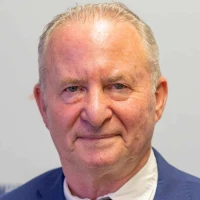
Matti Caspi, one of Israel’s most influential and innovative musicians, died on Sunday at Tel Aviv Sourasky Medical Center (Ichilov Hospital) following a prolonged battle with cancer. He was 76 years old.
“With aching hearts and deep sorrow, we announce the passing of our beloved husband and dear father,” Caspi’s family said in a statement. “His love and the creations he left behind will always remain a part of us.”
Born on Nov. 30, 1949 in Kibbutz Hanita, Caspi was widely regarded as one of the giants of Israeli popular music—a composer, singer, arranger, lyricist and multi-instrumentalist whose work blended classical music, jazz, Brazilian and Latin rhythms, rock and avant-garde influences. He studied piano at the Nahariya Conservatory and showed musical talent from an early age.
Caspi made his first public appearance at 16 on Kol Yisrael radio’s youth talent program, Teshu’ot Rishonot. During his military service in the Israel Defense Forces, he performed with the Southern Command Band, an experience that helped launch his professional career. He later formed the trio The Three Fat Men, which evolved into They Don’t Care, scoring early hits such as “Ani Met” (“I’m Dying”).

During the Yom Kippur War, Caspi toured IDF bases alongside the legendary Canadian Jewish singer, Leonard Cohen, who later arranged Caspi’s song, “Lover Lover Lover.” In the 1970s, Caspi began a celebrated collaboration with lyricist Ehud Manor, producing enduring classics such as “Brit Olam” (“Eternal Covenant”).
In 1975, Caspi married Israeli actress Doreen Lubetzky, with whom he had two children. After they separated, he married Raquel Wenger in California in 1994 and they lived in North America, mostly in Canada, and had two children.
Despite a divorce granted by the Beverly Hills Rabbinical Court, a Tel Aviv court ruled in 2002 that Caspi was still legally married to Lubetzky at the time of his second marriage and convicted him of bigamy, imposing a suspended sentence and a fine. He returned to Israel in 1997.
Musical legacy
Over the decades, Caspi released dozens of albums and wrote or composed some 1,000 songs, many of which became staples of Israeli culture.
Among his best-known works are “Eich Zeh Shekochav Echad Me’ez?” (“How Is It That One Star Dares?”), “Od Yavo Hayom” (“The Day Will Still Come”) and “Od Tir’i Et Haderech” (“You Will Still See the Way”). His last studio album, “Kmo Be’rikud” (“Like in a Dance”), was released in 2017.
In December 2023, Caspi partnered one last time with singer Shalom Hanoch to dedicate a memorial album to soundman Guy Illouz, who was taken hostage by Hamas on Oct. 7, 2023, and murdered in captivity. The album, “HaIkar Zeh HaShirim” (“The Main Thing Is the Songs”), features 12 tracks recorded during their live concert.
His final public performances were in the United States early last year, where he went on a short tour that included New York, Boston and Palo Alto. In May 2025, Caspi revealed that he had been diagnosed with cancer and canceled all future performances.
In August, more than 7,500 people attended a concert in his honor in Tel Aviv, “Singing Matti Caspi,” where he appeared briefly and thanked the artists and audience for giving him the strength “to continue fighting.”
In addition to his own recordings, Caspi served as a producer and arranger for many of Israel’s leading artists, including Yehoram Gaon, Boaz Sharabi, Riki Gal, Shlomo Gronich, Arik Sinai and Gali Atari. He also conducted at the 1976 Eurovision Song Contest, leading the Netherlands’ Metropole Orchestra in his composition, “Emor Shalom” (“Say Peace.”)
Caspi’s musical sophistication earned widespread acclaim. Musicologist Tsippi Fleischer described him as “a genius who invented his own musical language,” praising his harmonic complexity and singular impact on Israeli music standards.
Caspi is survived by his four children and a musical legacy that resonates across generations. Although “Ein Li Eretz Acheret” (“I Have No Other Country”) was written by Ehud Manor in 1982 during the First Lebanon War and a difficult period in Israel, it was Caspi who composed the memorable melody, turning it into an iconic national hymn that transcended politics and time.
President Isaac Herzog eulogized Caspi as “one of the greatest Israeli creators of our generation,” saying his melodies and arrangements would continue to accompany Israeli culture for generations.
“Just like in one of his unforgettable songs, ‘Someone is Taking Care of Me Up There’ (‘Mishu Do’eg Li Sham Lemala’), Matti Caspi—one of the greatest Israeli creators of our generation—left us far too soon and has gone on to watch over us from above,” Herzog said.
Culture and Sports Minister Miki Zohar said Caspi’s songs became “the soundtrack of love and hope” for countless Israelis.
“With great sorrow, we bid farewell today to Matti Caspi, the towering singer and songwriter who touched the souls of us all and gave us classics that became enduring pillars of Israeli music,” Zohar said.