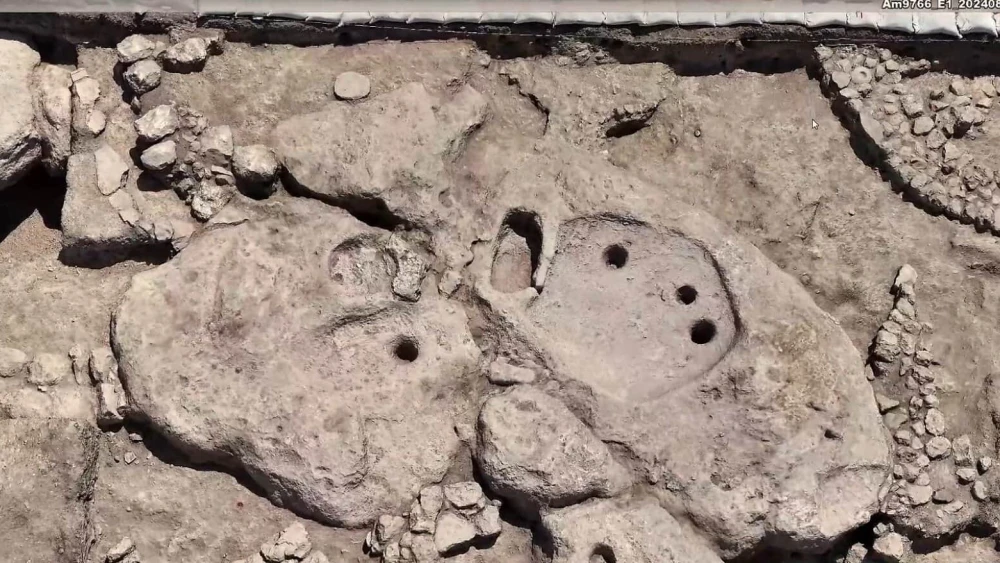
Archaeologists in Israel’s Jezreel Valley have discovered the country’s oldest known winepress and other Canaanite items in Tel Meggido, where groundwork on a new road unearthed the artifacts, the Israel Antiquities Authority said on Wednesday.
The winepress, which is 5,000 years old, and other items found ”instruct us about everyday domestic Canaanite worship taking place outside Tel Megiddo,” said the IAA. The finds will be displayed at the Jay and Jeanie Schottenstein National Campus for the Archaeology of the Land of Israel in Jerusalem.
The discovery followed earthworks for the Netivei Israel – National Transport Infrastructure Company for Highway 66. Diggers alerted archaeologists, who excavated the finds.
The items constitute evidence of Jezreel Valley settlement expansion at the onset of urbanization, according to the IAA, and of the Canaanite cult that existed in the land before the Israelites entered the region. In addition to the 5,000-year-old winepress, from the Early Bronze Period, also a 3,300-year-old ceramic shrine model and an intact ceremonial zoomorphic utensil kit from the Late Bronze Period.
The winepress was carved into the rock, with a sloping treading surface and a collection vat.
“This winepress is unique, one of very few known from such an ancient period when urbanization first took place in our region,” said excavation co-director Amir Golani, according to the IAA.
Winepresses are common throughout the country, said Golani, “but it is very difficult to date them. Until now, indirect evidence indicated that wine could have been produced 5,000 years ago, but we did not have conclusive proof of this—a ‘smoking gun’ that would clearly show when this happened in our area.”
Many residential buildings were also uncovered around the winepress, providing evidence of the area’s importance at that time and of Megiddo’s expansion.
Along with the ceramic model of the shrine, researchers found storage jars, imported jugs and juglets from Cyprus and a set of vessels probably used for libations, according to the IAA.
The set comprises a zoomorphic vessel in the shape of a ram, with a few small bowls. Such vessels are usually discovered only as isolated, occasional fragments, according to the IAA, making it difficult for researchers to understand their complete form and how they functioned together.
Yet since this set was buried intact, “and in a manner hinting to its function, it allows—for the first time in the entire region—a glimpse into the way Canaanites used these vessels in their ritual ceremonies thousands of years ago,” the statement continued.
Megiddo has been excavated for over a century, yet the new finds reveal a “new part of the matrix between the known settlement in the city—evidence of which has been revealed upon the tel—and the activities taking place in the area around and outside the city,” the researchers wrote.