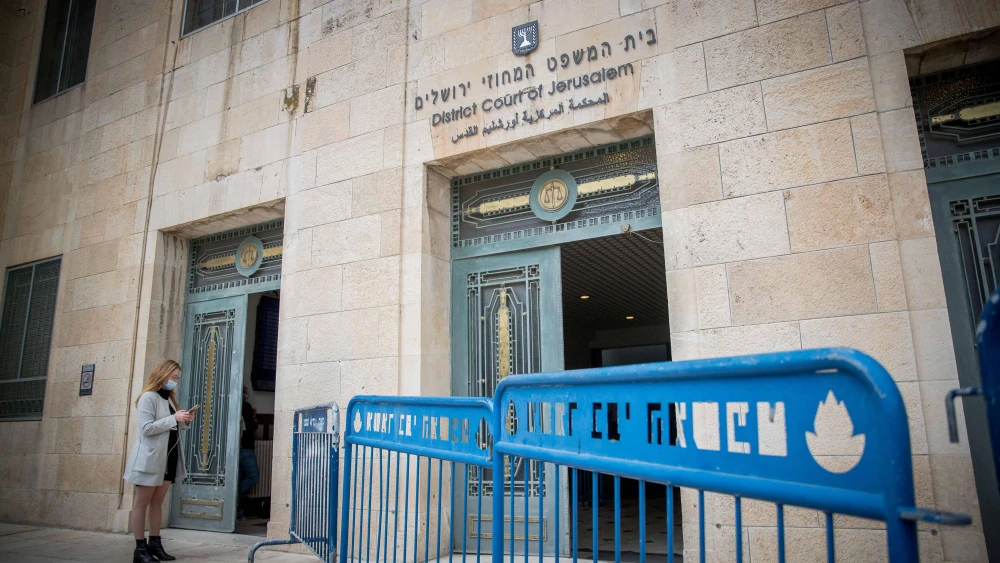
The Jerusalem District Court, sitting as a Civil Appeals Court, on Sunday overturned a lower ruling allowing Ariel Mayor Yair Chetboun to bar some Palestinian Authority workers from the Samaria capital for security reasons.
“We have found no basis for such far-reaching authority,” judges wrote. “The authority to permit entry into the closed area, including the municipality’s territory, is vested in the military commander.”
District Court judges Oded Shaham, Avraham Rubin and Nimrod Flax accepted an appeal filed by the Military Advocate General’s Office and reversed an April ruling by Ariel Local Affairs Court Judge Amir Dahan.
The latest ruling ordered the Ariel Municipality to forward any request from business owners who seek to employ P.A. Arabs to the military, which will have the final say on the workers’ admission to the area.
The Ariel Municipality “granted itself veto power over such requests; we find no legal basis for such authority,” the judges ruled. “The city has no decision-making power or veto over this issue, only an advisory role.
“Even in a time of war as harsh and bloody as this,” the ruling said, government bodies “must act within the boundaries of the law.”
Ariel was ordered to pay legal costs of 15,000 shekels (some $4,600) each to the Israeli Defense Ministry’s Civil Administration and several local business owners who had joined the appeals procedure.
Seven months ago, the Local Affairs Court ruled in favor of Chetboun’s decision to bar some Palestinian workers from Ariel in the wake of the Hamas-led Oct. 7, 2023, massacre in southern Israel, which received widespread support from Arabs across Judea and Samaria.
Chetboun had barred Palestinian laborers from returning to their employment in businesses throughout the city, though construction workers still entered daily to advance the building of new homes.
“A court must be careful not to substitute its own judgment for that of the local authority, which is legally empowered and accountable to its voters on public safety matters,” Dahan wrote in his April verdict.
The ruling marked the first time that a court had affirmed municipalities’ power to restrict P.A. workers’ entry.
Previous court battles on the issue often ended in settlements that saw the army oversee the approvals. In some cases, courts decided that local governments did not have the right to block Palestinians from entering.
An IDF spokesperson told JNS in July that the state submitted the appeal with the district court “due to flaws in the Local Affairs Court’s ruling.
“As part of Central Command’s security responsibility, the authority to approve the entry of foreign workers into Judea and Samaria lies with the military commander, not with local municipal authorities,” the spokesperson said.
Before the start of the war, some 200,000 Palestinians were employed throughout Israel, including 30,000 in Judea and Samaria.
A survey by the Ramallah-based Palestinian Center for Policy and Survey Research last week found that more than half of the Arabs in Gaza, Judea and Samaria still believe that Hamas’s decision to carry out the Oct. 7 attack was “correct.”
Arab support in Judea and Samaria for the deadliest single-day massacre of Jews since the Holocaust held steady at 59%, unchanged since a May poll, while backing in Gaza rose by seven points to 44%, per the poll.
Asked for the most effective means to end the “occupation” and achieve statehood, 41% picked “armed struggle,” a euphemism for terrorist attacks.
The Yesha Council, which represents the 500,000-plus Jewish Israelis living in communities across Judea and Samaria, in July slammed the IDF’s decision to file an appeal as proof that “in some areas, the shift that should have happened after Oct. 7 did not take place.”