


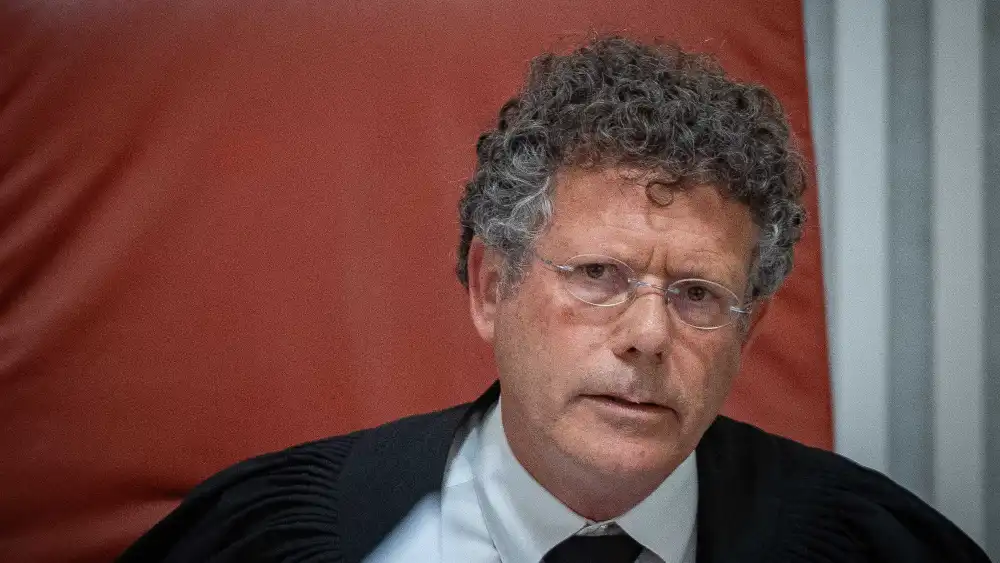
Israeli Justice Minister Yariv Levin on Wednesday demanded that the Supreme Court cancel a “radical left” conference, citing the planned attendance of Chief Justice Yitzhak Amit.
Levin said he had been informed of the conference, titled “Education for Democracy,” which was set to feature Amit and his predecessor, Esther Hayut, alongside two external speakers: Uki Maroshek, co-founder of the Adam Institute for Democracy and Peace, and Tel Aviv University professor Asa Kasher, a co-author of the Israeli military’s code of ethics.
Levin said the lineup reflected only left-wing political views, excluding other segments of the Israeli public. He added that holding the event at the court, while it is organized by the judicial system, undermines the appearance of judicial neutrality.
“Supreme Court justices are prohibited from advancing their personal political agendas by using the Supreme Court’s resources,” the justice minister added, accusing Amit of “turning the Supreme Court into an active branch of the radical left, even outside the courtrooms.”
A spokeswoman for the Israeli Judicial Authority told the Ynet outlet that Levin’s characterization of the conference was “incorrect and misleading,” describing it instead as a summit aimed at promoting “shared values and deepening understanding of the fundamental principles on which the State of Israel rests as a democratic state.”
Speaking at the Knesset on Monday, Israeli Finance Minister Bezalel Smotrich accused Amit of “doing things that have never been done before in the court.”
“The result is that we will trample him. There won’t be a choice,” he said.
Smotrich described Amit as a “violent megalomaniac who is stealing Israeli democracy.” He added that while the government wished it could reach a compromise with the court, “when one side becomes so extreme, it leaves you no option but to fight back with everything you’ve got.”
Since taking office, Amit has issued a series of rulings against the government, prompting renewed calls for Israeli Prime Minister Benjamin Netanyahu to revive his judicial reform agenda.
Amit, widely viewed as a left-leaning judge, was sworn in as president of the Supreme Court on Feb. 13, during a ceremony boycotted by Netanyahu’s government.
The decision, which was backed by coalition lawmakers on the Judicial Selection Committee, followed what Levin described as an illegitimate appointment process, as well as allegations of fraud and conflicts of interest.
The government has reportedly deemed Amit’s nomination “null and void” and has not signed his appointment. Legal commentators, however, say his appointment remains legally in force following his swearing-in.
Article 12 of Basic Law: The President of the State stipulates that the decree appointing the president of the Supreme Court requires the signature of Netanyahu, or another government minister, in addition to that of President Isaac Herzog.



