Newsletter
Newsletter Support JNS

Majority of Israeli Jews say Judea and Samaria towns contribute to security

There has been a corresponding sharp decline in Jews who believe Israel should strive for a peace deal with the Palestinians, according to a Jewish People Policy Institute poll.

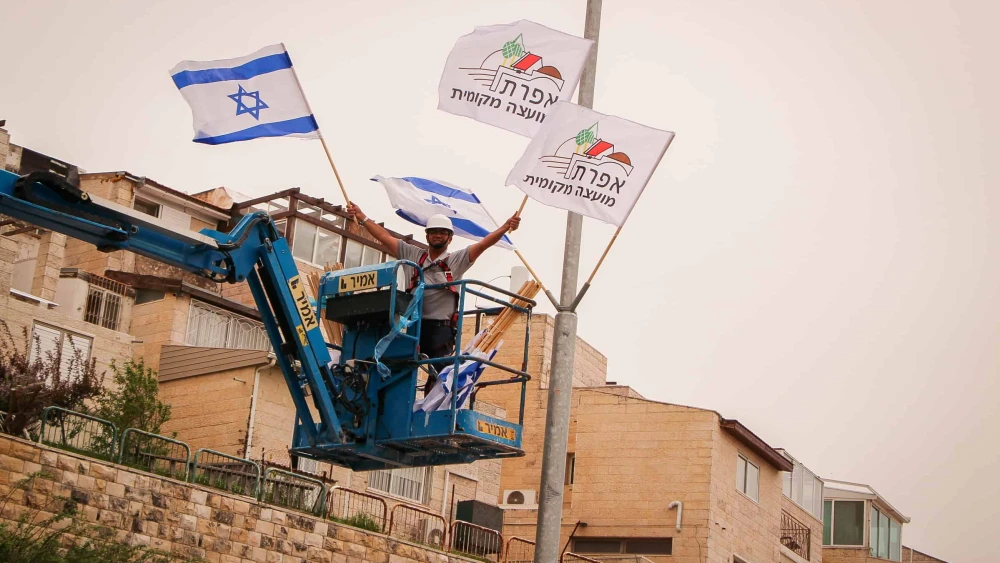
Israeli flags in honor of Independence Day in the Judea city of Efrat, April 5, 2020. Photo by Gershon Elinson/Flash90.

Fifty-eight percent of Israeli Jews believe that Jewish communities in Judea and Samaria contribute to the security of the entire country, according to a poll published by the Jewish People Policy Institute (JPPI) on Tuesday.

Asked whether they concurred with the statement that “Jewish communities in Judea and Samaria create deterrence and contribute to the security of all citizens of Israel,” 46% responded that they “very much agree,” while 12% said they “somewhat” concur.

In the past six months, there has been an increase in the percentage of Jews who believe that Israel “should strengthen its control over the Palestinians, expand settlements, consider dissolving the Palestinian Authority and perhaps annexing Judea and Samaria,” according to the survey.

While in October only a third of Israeli Jews said they agreed with this course of action, the figure has since risen to 47%.

At the same time, there was a decline in Jews who believe Israel should strive for a peace agreement with “moderate Palestinians” and allow the establishment of a “peaceful” Palestinian state alongside the Jewish one.

While in October a fifth of Israeli Jews backed a Palestinian state, this share has plummeted to 11%, according to the latest JPPI poll.

The survey suggests that 85% of the Jewish public in Israel thinks that “there is no chance of a peace agreement with the Palestinians in the foreseeable future,” including 70% that said they strongly believe this.

“The survey results show that a large majority of Israelis believe that a solution to the ‘Palestinian issue’ and Israel’s control over Judea and Samaria is unlikely in the foreseeable future,” said JPPI director-general Shuki Friedman.

This represents “an opportunity for Israeli society to move past this dispute and address pressing internal issues,” he added.


Akiva Van Koningsveld is a news desk editor for JNS.org. Originally from The Hague, he made the big move from the Netherlands to Israel in 2020. Before joining JNS, he worked as a policy officer at the Center for Information and Documentation Israel, a Dutch organization dedicated to fighting antisemitism and spreading awareness about the Arab-Israel conflict. With a passion for storytelling and justice, he studied journalism at the University of Applied Sciences Utrecht and later earned a law degree from Utrecht University, focusing on human rights and civil liability.
The U.S. has “flattened” Iran’s air defenses and defense industrial base, including the factories and production lines supporting missile and drone programs, the American defense secretary said.
“Terrorist propaganda online can incite real-world violence,” stated Pamela Bondi, the U.S. attorney general.
“The Iranian regime executed a 19-year-old for demanding democracy,” stated Sen. John Fetterman. “I stand with his memory and the thousands of other young Iranians.”
More than 70,000 Americans have returned to the United States from the Middle East since the Iran conflict began on Feb. 28.
“If this thing is growing, this inauthentic account is going to deceive more people,” Rep. Chris Smith told JNS. “Especially overseas, where there’s a language barrier or something.”
“We are now part of a process at the International Court of Justice initiated by Nicaragua,” Berlin said. “We have decided to focus on this process.”