During a phone call with Russian President Vladimir Putin on Tuesday, Israeli Prime Minister Benjamin Netanyahu discussed developments in the Middle East, the Prime Minister’s Office in Jerusalem said.
According to the Hebrew-language PMO statement, the two leaders also “exchanged warm greetings on the occasion of the 80th anniversary of the victory over Nazi Germany in World War II,” which Moscow is set to celebrate on Friday with the annual Victory Day parade in the capital.
Netanyahu was said to have “emphasized the decisive contribution of the Red Army to the victory over the Nazis, highlighting the significant role played by the many Jewish commanders and soldiers in the war.”
Russia has invited the Jewish state to Victory Day celebrations alongside representatives of China, Brazil, Slovakia and Serbia, but not Germany, the United States or most European nations. The annual May 9 event on Red Square in Moscow features a military parade and a speech by Putin.
Netanyahu last attended the parade in 2018 as one of the only Western leaders present. Israel designated May 9 the previous year as a holiday.

Moscow has moved closer to the Islamic Republic of Iran in recent years to obtain drones, missiles and other arms for the war against Ukraine that started in February 2022.
Earlier on Tuesday, Maria Zakharova, a spokeswoman for the Russian Foreign Ministry, told reporters in Moscow that Iran’s regime has a legitimate right to develop its own civil nuclear-energy programs.
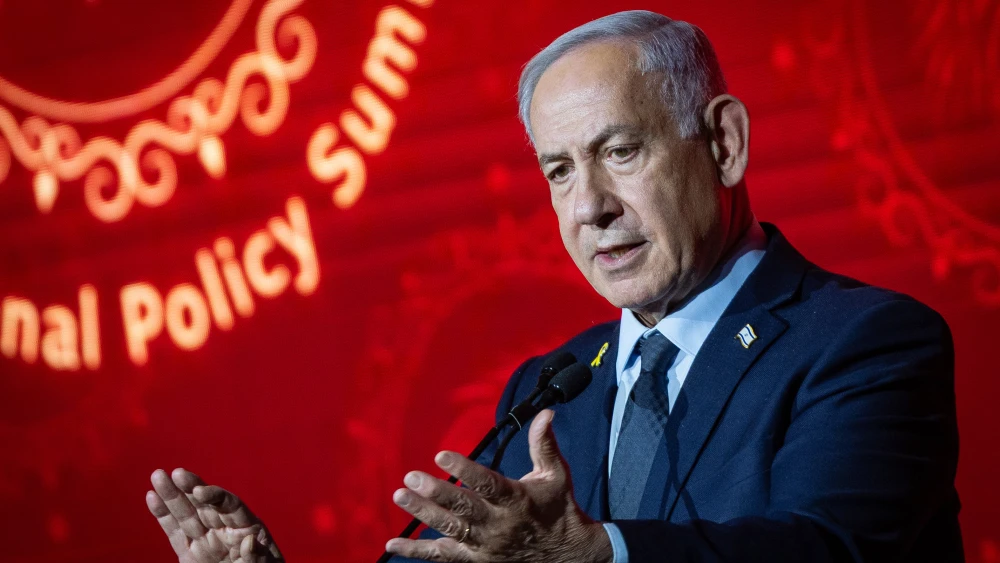
Netanyahu, however, has said Israel would only agree to a deal with Iran that fully eliminates the Islamic Republic’s capacity to enrich uranium, speaking last week at the JNS International Policy Summit in Jerusalem.
The only way to prevent Iran from building nuclear weapons is to fully dismantle “all the infrastructure of Iran’s nuclear program,” the prime minister declared at the conference. “That is the deal.”
Israel, he continued, “cannot live with anything short of that. Anything short of that could bring you the opposite result, because Iran will say, ‘All right, I won’t enrich,’ wait, run out the clock, wait for another president, do it again.”
This, he said, was “unacceptable.”