
There’s a new cocktail on the menu at Busboys and Poets, the restaurant and bookshop chain adored by the progressive left in Washington, D.C.
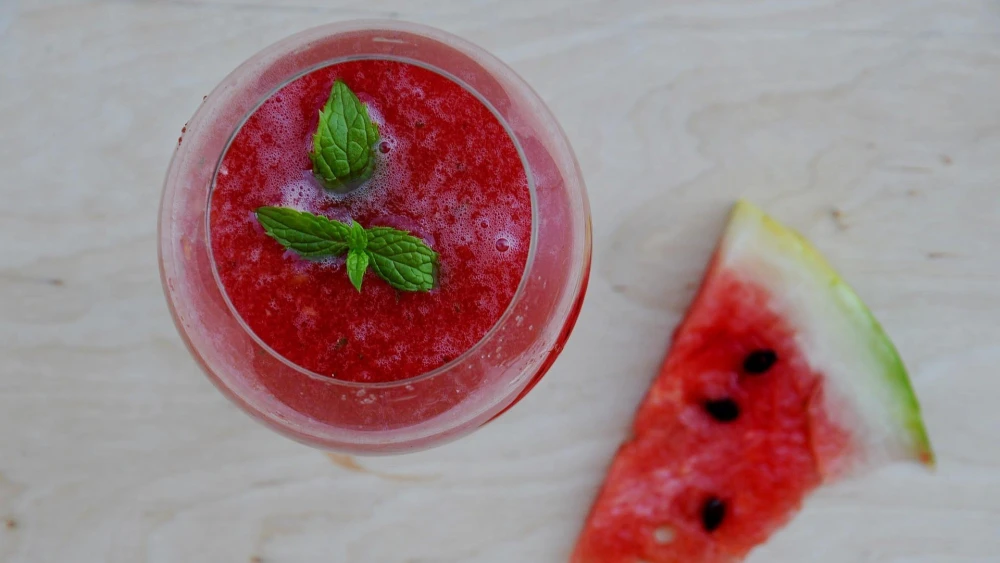
To my mind, any charm that Busboys and Poets has is restricted to its name. I certainly won’t be visiting to partake of its $14 “Free Palestine” concoction, which fuses Tito’s vodka with, obviously, watermelon—the fruit appropriated by pro-Hamas demonstrators around the world because its green-and-white rind, red flesh and black pips match the colors of the Palestinian flag.
You’d have to be pretty humorless to react to this menu addition with pure outrage. The performative antics of the pro-Hamas protesters have often been, as this new cocktail demonstrates with aplomb, laughable cosplaying spectacles executed by privileged radicals. Quite how imbibing it helps to “Free Palestine” is a question you’d have to ask the bartender, but I’m guessing the answer would be along the lines of “raising consciousness and awareness.” Have three or four of them, of course, and you won’t be raising either.
What’s truly ludicrous is naming an alcoholic beverage to honor a people who are 99% Muslim—and devoutly so. The Quran tells us that the vice of alcohol is, along with drugs and gambling, “an abomination of Satan’s handiwork,” regardless, presumably, of whether one’s preferred poison is named for “Palestine.” Serving this cocktail in Gaza, at least openly, would at minimum result in a nasty beating from the Hamas enforcers roaming the streets of the enclave.
That said, if you were a Jewish or Israeli customer standing at the Busboys and Poets bar and saw this on the menu, you would likely feel more uncomfortable than amused. Several unnamed customers who spoke to Jewish Insider last week said as much, with one woman protesting that the cocktail is named after a slogan that has unleashed discrimination and exclusion against the Jewish community.
That, I would say, is precisely the point.
There will always be a handful of Jews willing to embrace anything that the “Free Palestine” movement throws at them—from keffiyehs to cocktails. But for the vast majority of Jews who identify with Israel and its fate, and who proudly describe themselves as “Zionists,” the flood of Palestinian propaganda into activities traditionally associated with our leisure time has been one of many concerning developments over the last three years. We’ve seen it in the worlds of literature, theater, art, music and sports. Now it’s the turn of the foodies.
When you stand back from the melee, you realize that this is just more performative nonsense.
In New York City, the food war is becoming fiercer.
Back in August, New York magazine ran a special issue heralding the city’s “SWANA” (“South West Asian and North African”) communities—an utterly contrived acronym, incidentally—that erased the enormous Sephardic and Mizrahi Jewish contribution to the cultures and cuisines of these countries. It also referred to Israel as “the land mass currently called Israel,” underlining the noxious view that the Jewish state and the Jewish people are temporary interlopers in the region rather than integral components of its history and present.
Arguably the most tangible expression of this trend is another restaurant chain called Ayat, which has eight branches in various New York neighborhoods, as well as in Dallas and Washington, D.C. The restaurant made the news earlier this month when Zohran Mamdani, New York’s anti-Zionist mayor, dined at its outlet near Columbia University with Palestinian friends on Oct. 7—at the very moment that the city’s Jewish population was mourning the third anniversary of the mass atrocities carried out by Mamdani’s Hamas allies.

Both New York magazine’s special issue and Ayat’s menu drive at the same point: the cuisine in the land sandwiched between the Mediterranean Sea and the River Jordan can only be known as “Palestinian.” Anything labeled “Israeli”—hummus, falafel, shwarma—is artificial and therefore odious.
Yet there is a massive set of inconsistencies here. Firstly, the same argument is never applied to Turkish food, where hummus is among the appetizers on nearly every Turkish menu, despite the fact that hummus really did come to Turkey as a result of an imperial project—namely, the Ottoman Empire, which appropriated some of the dishes in the Middle Eastern lands it colonized. Secondly, hummus was part of the cuisine of the Jewish communities in Syria and Lebanon, many of whom came to Israel following independence in 1948.
And then there’s Ayat’s own culinary free-styling. Among the dishes on offer is a margarita pizza spiced with za’atar, a Middle Eastern herbal blend usually baked into bread or sprinkled on salads. It also offers a “Pizzawarma,” which is something I’ve never seen in any restaurant that describes itself as Israeli or Palestinian. If the emphasis is on purity of cuisine, untainted by the nefarious Jews, then how do you end up stealing from the Italians? Or don’t these rules apply to Palestinians?
Cooking and eating should be activities that bring people together, rather than tearing them apart.
As with the cocktail at Busboys and Poets, Ayat similarly pushes away the great majority of Jewish customers through the wording of its menu sections. A selection of fish dishes can be found under the heading “From the Rind to the Sea”—a play on the antisemitic slogan “From the River to the Sea,” urging Israel’s elimination, that is heard at every pro-Hamas hate march. It is the equivalent of going to an Austro-German restaurant and ordering a Wiener Schnitzel based on the theme of “Ein Volk, Ein Reich, Ein Führer.”
However, when you stand back from the melee, you realize that this is just more performative nonsense. It certainly does nothing to aid or assist the denizens of war-torn Gaza, functioning instead as a means of making leftists in Western urban centers feel virtuous.
The crying shame is that any of this should matter. Cooking and eating should be activities that bring people together, rather than tearing them apart. In the hands of the pro-Hamas movement, though, as with everything else, the goal is to leave Jews on the outside, accepting them grudgingly only if they renounce Zionism and admit that every item on an Israeli menu has been stolen from the Palestinians.
Even so, the arrival of Palestinianism in the world of food will have less of a practical impact than it has done in other cultural spheres. Jews who observe kashrut wouldn’t eat at these establishments to begin with, while those who don’t can, along with their observant brethren, dine at any number of the excellent Israeli restaurants that have flourished in the U.S. over the last 20 years.

In any case, there is one dish that for me exemplifies the Jewish presence in the Middle East that you won’t find on the menu at any Palestinian restaurant and very few Israeli ones in America. It is called a meorav Yerushalmi (“Jerusalem mixed grill”), and I discovered it as a kid in Jerusalem during the 1970s.
The meorav is a pita sandwich containing grilled chicken hearts and livers flavored with paprika and garlic, dressed with cooked or raw onions, and topped with tehina and a dash of amba.
Like the Cobb Salad, its origins are slightly shrouded in mystery. Conventional wisdom is that the sandwich first appeared in the food stalls of Jerusalem’s Machane Yehuda open-air market, eagerly consumed by hungry taxi drivers, municipal workers and drinkers seeking a satisfying meal to soak up the booze late at night.
Not only is this sandwich ambrosial in its taste and deliciously original in its ingredients. The meorav is a journey through the Sephardi experience, developed in Israel using spices found across the region.
Find a restaurant that serves one, or look up the recipe online and prepare it yourself. And as you savor the flavors, remember: You are not a colonialist. You are not an interloper. You are a proud Jew, and you are eating an Israeli dish rooted in the modern street culture of our ancient capital.
B’tayavon!