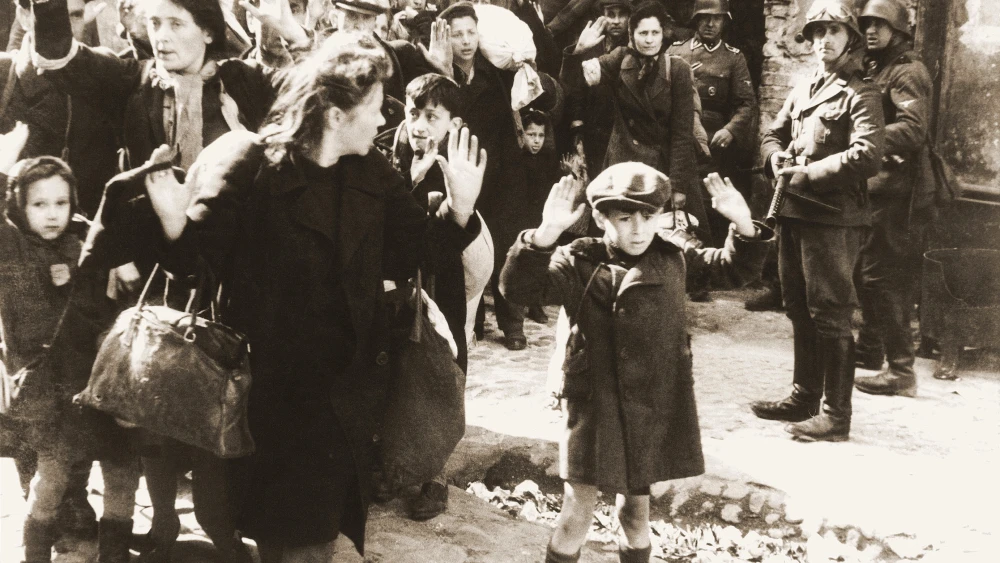
A high school ethnic studies course at Pittsburgh Science and Technology Academy, which is part of the Pittsburgh Public Schools district, directs students to read a 20-year-old academic article that suggests that Gazans are trapped in the Strip as Jews were in the Warsaw Ghetto during the Holocaust.
The syllabus, which the North American Values Institute obtained in a records request and which JNS viewed, assigns Patrick Wolfe’s 2006 article “Settler Colonialism and the Elimination of the Native” to students.
In the article, Wolfe, who was a professor in Australia and who died in 2016, referred to “Zionism’s chronic addiction to territorial expansion.”
“It is hardly surprising that a nation that has driven so many of its original inhabitants into the sand should express an abiding fear of itself being driven into the sea,” he wrote in the article.
He added that “the positive force that animated the Jewish nation and its individual new-Jewish subjects issued from the negative process of excluding Palestine’s indigenous owners.”
“Nonetheless, as Palestinians become more and more dispensable, Gaza and the West Bank become less and less like Bantustans,” who were segregated under apartheid in South Africa, “and more and more like reservations,” he wrote. “Or, for that matter, like the Warsaw Ghetto. Porous borders do not offer a way out.”
Steve Rosenberg, regional director for NAVI in Philadelphia, told JNS that the nonprofit has two concerns. “First, the Warsaw Ghetto comparison is extraordinarily provocative and requires serious historical examination,” he said.
“The Warsaw Ghetto was established by Nazi Germany as part of its persecution of European Jews,” Rosenberg said. “Comparing it to Gaza or the West Bank risks obscuring important distinctions between the Holocaust and the Israeli-Palestinian ongoing war.”
“Students should understand those distinctions rather than encounter the comparison as an uncontested historical conclusion,” he told JNS.
Rosenberg also said that Wolfe’s article was written in 2006, predating “nearly two decades of consequential developments.”
“That doesn’t make it worthless as historical scholarship, but it makes it inadequate as a stand-alone explanation of contemporary conditions,” he said. (JNS sought comment from the public school district, which has about 18,000 students in about 55 schools.)
“The distinction matters,” Rosenberg told JNS. “The problem isn’t that Pittsburgh might assign a 20-year-old academic article. The problem is whether students are being given a 20-year-old political interpretation without the historical developments, factual context and alternative perspectives necessary to evaluate it critically.”
The syllabus, for a college-credit course at the public school, also includes a week titled “whiteness, privilege and antisemitism,” about which NAVI has concerns.
The assigned readings include Peggy McIntosh’s “White Privilege: Unpacking the Invisible Knapsack” and a chapter from Eric Goldstein’s “The Price of Whiteness: Jews, Race and American Identity.”
The lesson plan for that week “teaches students that ‘whiteness’ is a hidden system of unearned power and asks students how Jewish identity fits into whiteness as ‘an invisible system of power and privilege,’” NAVI told JNS.
According to Princeton University Press, which published the book in 2008, describes the thesis of the book, in part, as tracing “Jews’ often tumultuous encounter with race from the 1870s through World War II, when they became vested as part of America’s white mainstream and abandoned the practice of describing themselves in racial terms.”
The book “concludes that while Jews’ status as white has opened many doors for them, it has also placed limits on their ability to assert themselves as a group apart,” according to the publisher.
Another assignment in the course, titled “contemporary social movements and antisemitism,” states that “antisemitism, like other forms of racial oppression, has been used to divide marginalized communities and maintain systems of power.”
The district’s graduation policy lists ethnic studies among the courses that are to be required beginning with the class of 2028. It allows for approved equivalents for career and technical education students.
“What we’re seeing in Pittsburgh, like we’ve seen across the country in too many districts, raises serious questions about whether students are being taught history or being encouraged to interpret the world through a predetermined political ideology,” Rosenberg told JNS.
Parents ought to be concerned, he added, that NAVI had to acquire the classroom materials via public records requests.
“Pittsburgh parents deserve complete transparency, intellectually honest instruction and an assurance that their children’s education is being guided by academic excellence rather than ideological objectives,” he said.
“This isn’t about avoiding difficult history or uncomfortable truths,” Rosenberg told JNS. “It’s about ensuring that public education develops independent thinkers rather than political activists.”
Nearly 50,000 Jews live in the greater Pittsburgh area, according to a 2017 Greater Pittsburgh Jewish Community Study.