
U.S. President Donald Trump has delivered the endorsement that Israeli Prime Minister Benjamin Netanyahu was waiting for—and it could change Israel’s post-election calculations, even if it doesn’t alter many votes.
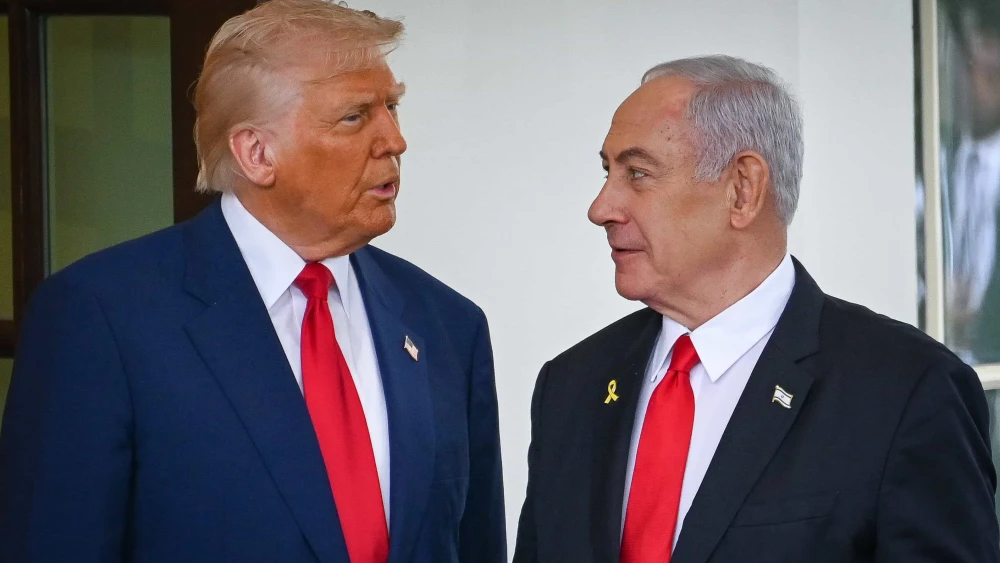
In an extraordinary Truth Social statement addressed to the “Great People of Israel,” Trump offered his complete backing of Netanyahu. He called him a “Great Warrior Prime Minister” who had been “Strong, Brave, and Brilliant” under intense pressure, concluding: “BIBI NETANYAHU WILL NEVER LET YOU DOWN!”
Yet the most consequential passage concerned Iran. Trump warned that unless Tehran rapidly changes course, “we will soon finish the job.” He then explicitly tied continued cooperation against the Islamic Republic to Netanyahu’s political survival: “If Israel has the wrong Leader, which would be anyone other than Bibi, America will have to do this work ourselves, and I am not inclined to do so,” he wrote.
This is more than a conventional political endorsement. Trump is telling Israelis that, in his judgment, Netanyahu is the indispensable partner for confronting the regime in Tehran during the remaining years of his presidency.
The message carries added weight because Israel’s threat level from Iran is at or near an all-time high. The possibility of another major escalation is not theoretical. Israel and the United States have already fought Iran together twice in little more than a year.
During the closing stage of the Twelve-Day War in June 2025, the United States launched Operation Midnight Hammer against Iran’s nuclear infrastructure. American B-2 stealth bombers struck the deeply buried Fordow enrichment facility with massive bunker-busting bombs, while additional attacks targeted Natanz and Isfahan. Fordow was the target that Israel could not reliably destroy on its own. Trump supplied the unique American capability needed to reach it.
Then, on Feb. 28, 2026, American and Israeli aircraft again flew into battle against Iran in parallel operations. Washington called its campaign Operation Epic Fury, while Israel designated its component Operation Roaring Lion. U.S. and Israeli forces attacked Iranian nuclear, ballistic-missile, air-defense, naval and regime targets. The White House described Epic Fury as a campaign conducted “in partnership with regional allies” to eliminate Iran’s nuclear threat and cripple its military capabilities.
In other words, the Netanyahu-Trump partnership has already moved beyond intelligence coordination, diplomatic support and defensive interception. Israeli and American forces have attacked the same enemy during the same campaigns.
Shortly after the announcement, a Senior Israeli official told JNS, “There has never been greater cooperation and coordination between an American wartime President and an Israeli wartime Prime Minister. Trump and Netanyahu are an epic tag team who have achieved unprecedented achievements in war and peace. That has, of course, translated into unprecedented cooperation between our great armed forces.”
Nor does Trump appear to believe the confrontation is over. At an Oct. 13 campaign rally in Alaska, he warned: “Wait till you see what we do to Iran,” adding, “We’ve sort of had it. You know, we’ve had it.”
Days earlier, Trump said that the United States would not resume strikes before the Nov. 3 midterm elections, while leaving open the possibility of renewed military action afterward. Meanwhile, there are media reports that Trump continues to regard post-election escalation as a viable option.
Against that background, Trump’s endorsement is not simply about personal loyalty; it is about who will sit across from him when the next decision on Iran must be made.
The timing nevertheless makes the statement striking. Trump had repeatedly declined opportunities to endorse Netanyahu. In August, he said, “I think it’s most appropriate for me to stay out of Israeli elections, but I may endorse somebody.”
On Oct. 14, asked whether he would back a candidate, he replied, “We haven’t even thought about it,” before adding, “I may be doing something.”
Two days later, when Newsmax asked whether he trusted Netanyahu, Trump answered: “I don’t trust anybody, honestly. In the world of politics, I don’t trust anybody.” He nevertheless described their relationship as “very good” and their cooperation against Iran as successful.
Trump has now moved from studied ambiguity to the strongest endorsement he could plausibly give. The immediate question is how many Israeli votes it will move.
For voters focused primarily on domestic issues, the endorsement may make little difference. Israelis have formed strong opinions about Netanyahu over decades, and one statement—even from an American president—will not erase concerns about the cost of living, military service, judicial reform or the failures surrounding the Hamas massacre of Oct. 7, 2023.
But another group of voters will see the election through a very different lens. For them, Israel’s relationship with Trump is the election’s most important issue, and preventing Iran from recovering its nuclear and ballistic-missile capabilities is an existential necessity. These voters will ask not merely which candidate they prefer, but which Israeli leader is most likely to secure American diplomatic, military and operational support when the next confrontation begins.
On those two questions, Trump has made Netanyahu the clear choice.
The United States remains the only country capable of providing Israel with certain strategic weapons, diplomatic protection and long-range military capabilities. Trump has now said publicly that Netanyahu is the Israeli leader he wants as his partner.
“Israel is America’s model ally, and America is Israel’s indispensable ally. Iran and its proxies are weaker than ever, and the American-Israeli alliance is stronger than ever,” the Senior Israeli official added.
An Israeli government led by Gadi Eisenkot might ultimately establish an effective relationship with Washington, but voters would be taking that on faith. Netanyahu already has a record of planning, coordinating and conducting operations against Iran alongside Trump.
The endorsement could therefore influence undecided right-wing voters, former Likud voters considering other parties and security-minded centrists who may have serious reservations about Netanyahu but regard Iran as the overriding issue. It also confronts potential protest voters with a stark calculation: Is replacing Netanyahu worth risking uncertainty in Israel’s most important foreign relationship at the moment when the Iranian campaign may enter its decisive stage?
If voters believe Israel must finish dismantling Iran’s nuclear threat—and that doing so may require another joint campaign with the United States—then Netanyahu can now argue that changing prime ministers means changing commanders in the middle of an unfinished war.
But the endorsement’s greater significance may still emerge after the ballots are counted. Current coalition arithmetic suggests that neither Netanyahu’s bloc nor the opposition is guaranteed the 61 Knesset seats required to govern. Israel has seen this before.
The third election of the previous political deadlock was held on March 2, 2020. Netanyahu’s right-wing bloc won 58 seats—three short of a majority—while Benny Gantz secured recommendations from 61 lawmakers and received the mandate to form a government.
Gantz and the anti-Netanyahu parties initially moved to take control of the Knesset. They sought to replace Speaker Yuli Edelstein, secure control of parliamentary committees and advance legislation that could have prevented an indicted lawmaker from forming a government. After the High Court ordered a vote on the speakership, Edelstein resigned on March 25 rather than convene it.
As Israeli politics was playing itself out, COVID19 became an epic global crisis. And it transformed Israel’s political landscape. Israel suddenly required unity amidst the uncertainty of a worldwide pandemic, and having a seasoned diplomat like Netanyahu at the helm took on even greater importance.
On March 26, Gantz reversed course and opted to pursue a unity government with a rotation agreement between the two political adversaries. Gantz was elected Knesset speaker with Likud support, splitting his Blue and White alliance. He said that “unusual times” required “unusual decisions,” opening negotiations with Netanyahu rather than continuing the opposition’s attempt to dislodge him.
Netanyahu and Gantz signed their emergency unity agreement on April 20. Their government was sworn in on May 17, with Netanyahu due to serve as prime minister for 18 months before rotating the position to Gantz. Ultimately, the transfer never occurred, as Netanyahu opted for early elections over implementing the rotation. The Knesset dissolved automatically on Dec. 23 after the coalition failed to pass a state budget, triggering a fourth election.
Yet that history, amid a crisis that transcends politics, may provide a model for what follows the present election. Clearly, Trump wants Israeli voters to know that he prefers that Netanyahu remain at the helm. Netanyahu’s most likely and preferred path to remain in office is with a rerun of the members of his current coalition.
While left-wing media project Netanyahu falling far short of a majority, right-wing media are projecting him and his partners as garnering enough votes to install a fresh right-wing coalition. Netanyahu likely hopes that Trump’s endorsement is the final piece that convinces voters that another term is Israel’s best electoral outcome.
Yet, if the result is another stalemate, Trump’s endorsement could make it harder for opposition leaders simply to exclude Netanyahu. With the Iranian threat unresolved and Trump remaining in office for more than two years, a unity or rotation agreement could allow Netanyahu to lead during the Trump years and another candidate—potentially Eisenkot—to take over afterward.
Trump’s endorsement may influence more voters than conventional analysis assumes. More importantly, it could determine how Israel’s leaders negotiate on the morning after.
According to the Senior Israeli official, “We have two years of Trump-Netanyahu to win the war and win the peace.”
Alex Traiman is CEO & Jerusalem Bureau Chief of the Jerusalem News Syndicate.