


A new Tel Aviv museum that tells the history of the city uses the term nakba—Arabic for “catastrophe"—in describing the founding of Israel.
The usage of contested Palestinian terminology and narrative in an Israeli city-run museum comes at a time when an intense war of narrative is underway around the globe over Israel’s history.
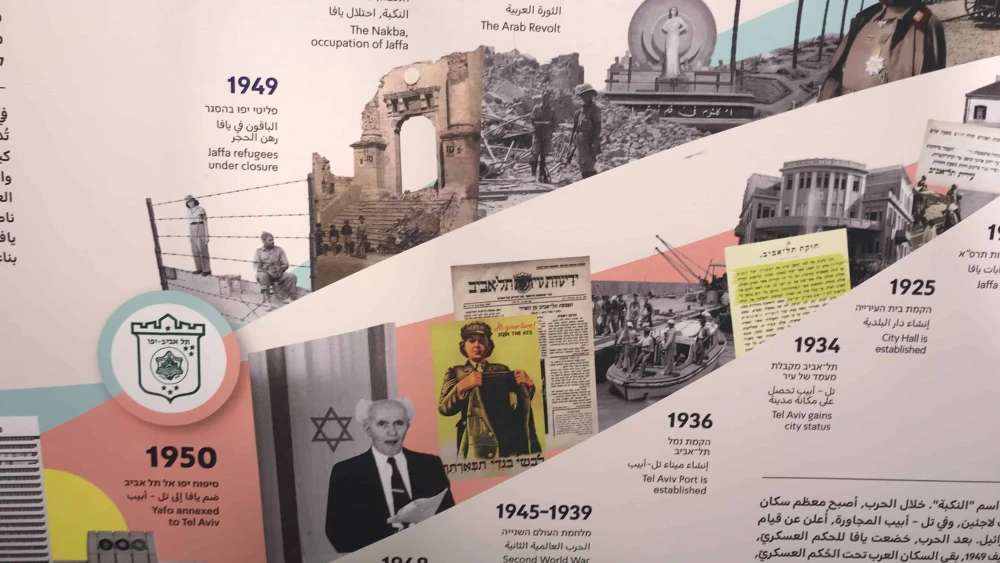
The reference to nakba appears at the new City Museum in central Tel Aviv in a timeline of the history of Tel Aviv and Jaffa. The museum, which opened its doors earlier this year at the site of the historic city hall building at Bialik Square, was established by the Tel Aviv Foundation in collaboration with the Tel Aviv-Jaffa Municipality.
The timeline, titled “Tel Aviv-Jaffa Time,” is one of the first exhibits visitors see on the walls at the entrance to the museum, and includes two parallel lines, one for the history of Jaffa and the other for the history of Tel Aviv, which merged in 1950, when both came under the municipality of Tel Aviv-Jaffa, as it is today.
The timeline for 1948, the year of Israel’s Independence, states, “The Nakba, occupation of Jaffa,” in Hebrew, Arabic and English with a picture of a bombed-out government compound building in Jaffa. On the lower line, the parallel timeline for the city of Tel Aviv reads, “Declaration of Independence” with a photo of Israel’s founding father and first prime minister David Ben-Gurion.
After citing the nakba, the timeline for Jaffa continues with “Jaffa refugees under closure” in 1949 with a photo of barbed wire, and “Yafo annexed to Tel Aviv” in 1950, using the Hebrew word for Jaffa, with a symbol of the municipality.
The other exhibitions on the main level of the museum, which are geared towards city residents, school groups and visitors from abroad, deal with lighter subjects, including “Legends in the Sand,” “Is Tel Aviv a Global City?” “Local and International,” and “Between Sacred and Secular.”
A lower-level exhibition encompasses an interactive city stories exhibition, a video of historic shots of Tel Aviv, and fun in the sun at the city’s beaches. It also has a stand for “What can only happen in this city,” allowing visitors to affix Post-It notes. Many, in a sign of the times, read: “Bring them home,” referring to the more than 120 Israelis still held hostage by Hamas in Gaza.
The Tel Aviv Foundation referred a JNS query about the Palestinian terminology used in the timeline exhibition to the Tel Aviv Municipality.
In a written response, the municipality said: “The City Museum tells the story of Tel Aviv-Jaffa, a story that begins before the establishment of the city of Tel Aviv, which originated as a neighborhood that was born out of Jaffa.”
The city statement then endorsed the museum’s usage of the terminology nakba. “The timeline represents two perspectives of history, Jewish and Arab. By the nature of things, the Arab residents of Jaffa viewed the War of Independence and its results as a nakba (‘catastrophe’) for them.”



