


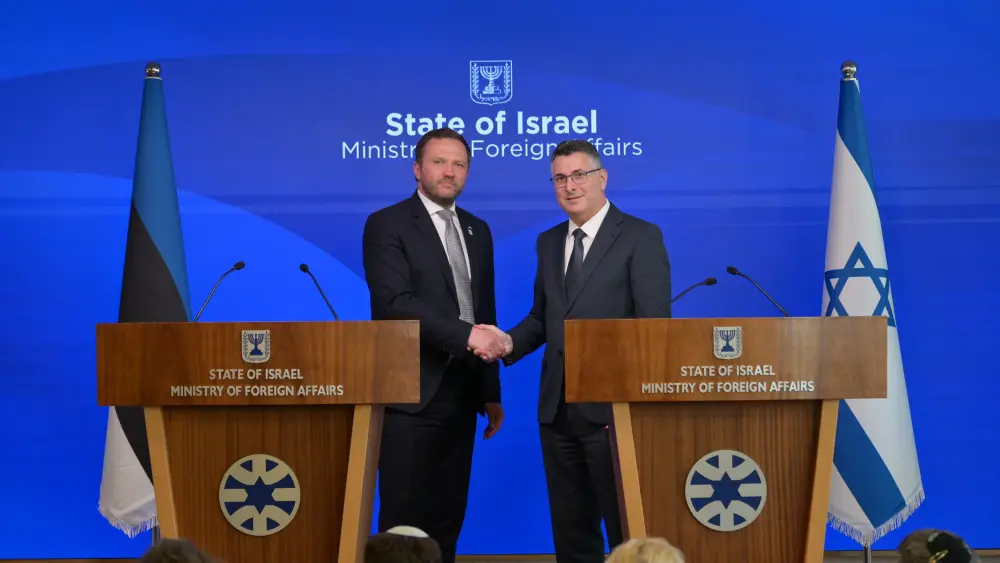
Israeli Foreign Minister Gideon Sa’ar welcomed his Estonian counterpart, Margus Tsahkna, to Jerusalem on Tuesday for a solidarity visit, thanking Estonia for designating Hezbollah “in its entirety” a terrorist organization and expressing hope that the European Union would follow suit.
Estonia blacklisted Hezbollah in October 2020. Several other European countries have taken similar steps. However, the E.U. designates only Hezbollah’s “military wing” as a terrorist organization, distinguishing it from the group’s “political wing.”
Hezbollah joined the current war against Israel on behalf of its patron, Iran, on March 2, launching an “unbelievable” 2,000 missiles and drones in just two weeks, Sa’ar said.
“Many more attacks have been launched from Lebanese territory than from Iran,” he said, noting that northern communities close to the source of the fire do not always have sufficient time to reach shelters.
Those same residents were forced to evacuate their homes for more than a year when Hezbollah began firing rockets and drones at Israel on Oct. 8, 2023, the day after Hamas carried out its massacre.
“The story of their suffering is not being told. The international media only reports on what happens on the Lebanese side of the border,” Sa’ar said, adding that Israel will continue to defend its citizens and communities.
Sa’ar highlighted the strong and growing bilateral ties between Israel and Estonia, noting that 2025 marked a milestone year in their relations, including the opening of Israel’s embassy in Estonia’s capital, Tallinn. He expressed optimism that the momentum would continue into 2026.
Sa’ar praised Estonia’s strengths in innovation and digital services, expressing confidence in future cooperation. (Estonia is a global leader in e-governance, having digitized everything from tax filing and medical prescriptions to voting.)
Sa’ar devoted most of his remarks to the war with Iran, praising the elimination of Ali Larijani, a senior figure in Tehran’s power structure.
The IDF also killed Basij Commander Gholamreza Soleimani, who was responsible for the recent mass killing of protesters opposing the regime.
Ali Larijani had a $10 million prize on his head. We did it for free. pic.twitter.com/KgiOscLCby
— Gideon Sa'ar | גדעון סער (@gidonsaar) March 17, 2026
“Soleimani was under U.S. and E.U. sanctions for his role in repressing Iranians. Larijani was also under U.S. sanctions, for the same reason, with a $10 million prize on his head. We did it for free,” Sa’ar said.
Iran is a threat to the West and the world, he said. “The regime exports its fanatic interpretation of Islam around the world. The regime is anti-Western and seeks to destroy our Western lifestyle.”
Israel and the United States are systematically targeting Iran’s nuclear program, which it had hoped to move deep underground to make impervious to future strikes, he added.
The combined U.S.-Israel alliance is also taking out Iran’s ballistic missile program. “These don’t just threaten Israel, but also other countries in the Middle East and Europe. This will directly impact European security for the better,” Sa’ar said.
He noted that Iran has supported Moscow in its war against Ukraine, a conflict that poses a particular concern for Estonia, which shares a border with Russia.
Referring to Iran’s attempts to close the Strait of Hormuz, a key passageway for the world’s oil supply, Sa’ar said the international community faces “modern piracy” by terrorist states. The Houthis, an Iranian proxy in Yemen, have similarly disrupted freedom of navigation in the Red Sea.
“This isn’t simply an American or Israeli issue; it’s a global problem,” he said.
If these acts go unchecked, other regimes will follow suit elsewhere. “It could become a problem in the Baltic, Black, or Mediterranean seas,” Sa’ar warned. “If Iranian piracy in the Strait of Hormuz isn’t stopped, this form of terror will spread worldwide.”



