


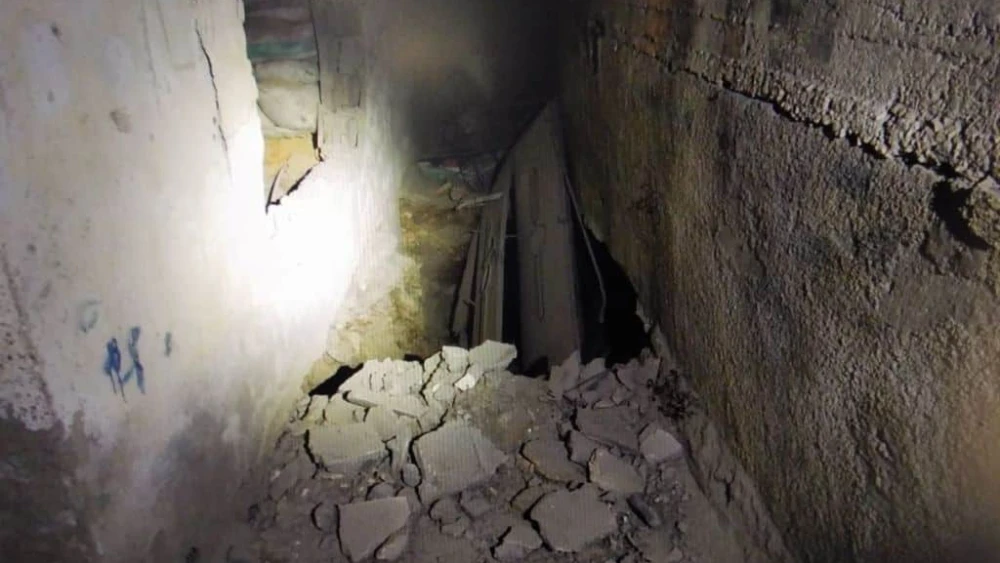
The mosque in the Jenin refugee camp where Palestinian terrorists barricaded themselves contained a tunnel leading to a nearby kindergarten, the IDF announced on Tuesday.
Soldiers working with the Israel Security Agency (Shin Bet) in the camp’s al-Ansar mosque using technological tools discovered the tunnel, traced its route and “neutralized” it. A map released by the army shows one tunnel opening into an adjacent kindergarten.
Lt. Col. M., who was involved in the mission, said that “the excavations carried out in the mosque turned it into a fortified target.”
On Monday, the IDF released photos of pits found in the mosque containing weapons, explosives and military gear.
Israeli forces operating in the refugee camp since Monday morning have uncovered bomb-making laboratories, a homemade rocket launcher, explosives, weapons and military gear.
The Israel Defense Forces said its forces killed 10 Palestinians, adding that “all the dead were involved in combat” and that 120 wanted terrorism suspects have been arrested since Monday morning. The IDF is still searching for 350 terrorists in Jenin, of whom 160 the IDF believes are still in the camp.
IDF Spokesperson R. Adm. Daniel Hagari said that water and electricity in the camp were disrupted by fighting and that the army’s liaison to the Palestinians was working to repair the damage in coordination with the Palestinian Authority.
“This happened mainly because of where we damaged roads where there were hidden explosives,” Hagari said.
Some 3,000 of the camp’s 18,000 residents fled the camp on Monday. They were sheltering in local homes and schools.
Established in 1953, the U.N.-administered camp is often referred to by Palestinians as the “Martyr’s Capital.” Between 2000 and 2003, during the Second Intifada, at least 28 suicide bombers came from the Jenin camp.
The incursion was widely anticipated by Israelis and Palestinians alike as Palestinian terrorism mounted in northern Samaria. Since the beginning of 2023, terrorists have killed 28 people. The Palestinian Authority has little authority in northern Samaria.
In mid-June, an unusually large bomb buried beneath a road wounding seven soldiers was followed by the launch of the first rocket from Jenin. The IDF carried out a targeted killing of three terrorists in Samaria with an aerial drone, a tactic not seen in Judea and Samaria in 20 years.


