Newsletter
Newsletter Support JNS

Kushner to provide update on Mideast peace plan at Warsaw conference

“The Ministerial Conference to Promote a Future of Peace and Security in the Middle East” will include U.S. and Israeli officials, as well as the foreign ministers of Saudi Arabia, Jordan, the United Arab Emirates, Oman and Bahrain.

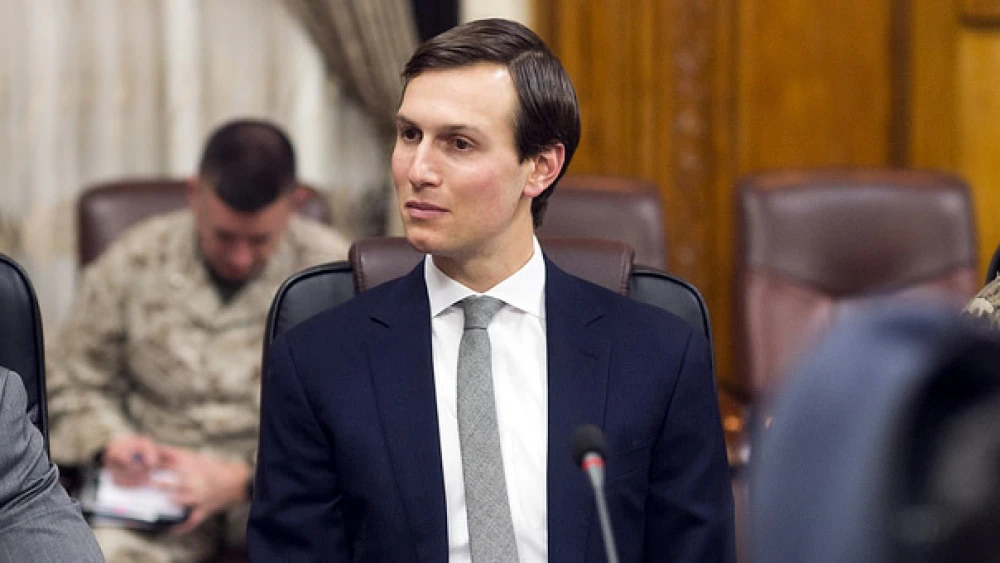
Jared Kushner, senior adviser to U.S. President Donald Trump, sits in on a meeting with Marine Corps Gen. Joseph F. Dunford Jr., chairman of the Joint Chiefs of Staff, at the Ministry of Defense in Baghdad, Iraq, on April 3, 2017. Credit: Dominique A. Pineiro/U.S. Department of Defense.

White House senior adviser Jared Kushner will reportedly give an update on the Trump administration’s peace proposal between the Israelis and the Palestinians at next week’s Warsaw conference on the Middle East.

A White House official told Axios that Kushner, also the president’s son-in-law, will be part of a discussion at the conference on Feb. 13-14, hosted by former Norwegian Foreign Minister Børge Brende regarding attempts to end the conflict.

U.S. Secretary of State Mike Pompeo, who is expected to be at the event, said the peace plan will be released after the April 9 Israeli elections.

Also scheduled to be in attendance in Warsaw are U.S. Vice President Mike Pence; Israeli Prime Minister Benjamin Netanyahu; and the foreign ministers of Saudi Arabia, Jordan, the United Arab Emirates, Oman and Bahrain.

These nations, which have more positive relations with America and Israel, not only look to a constructive Mideast peace plan but efforts to combat a growing threat from Iran.

Neither the Palestinians nor representation from Iran was invited to the conference.

Initially, the conference was advertised as forum to combat the Iranian threat. Due to backlash from several U.S. allies and Iranian pressure on Poland, it was rebranded as “The Ministerial Conference to Promote a Future of Peace and Security in the Middle East.”

Washington “must first remove operational obstacles, including the blockade,” as a condition for “resolving issues,” Iran’s President Masoud Pezeshkian says.
A panel of judges led by the court’s Deputy President Noam Sohlberg set out a series of measures government bodies must adopt.
Israel’s head of state has faced pressure to grant a pardon from U.S. President Trump.
Tzipi Hotovely will be filling a position that has been vacant for two years.
Mohammad Bagher Ghalibaf was reportedly forced to resign after seeking to include the nuclear issue in the talks.
The exiled Iranian opposition leader said they failed to address Tehran’s human rights violations.