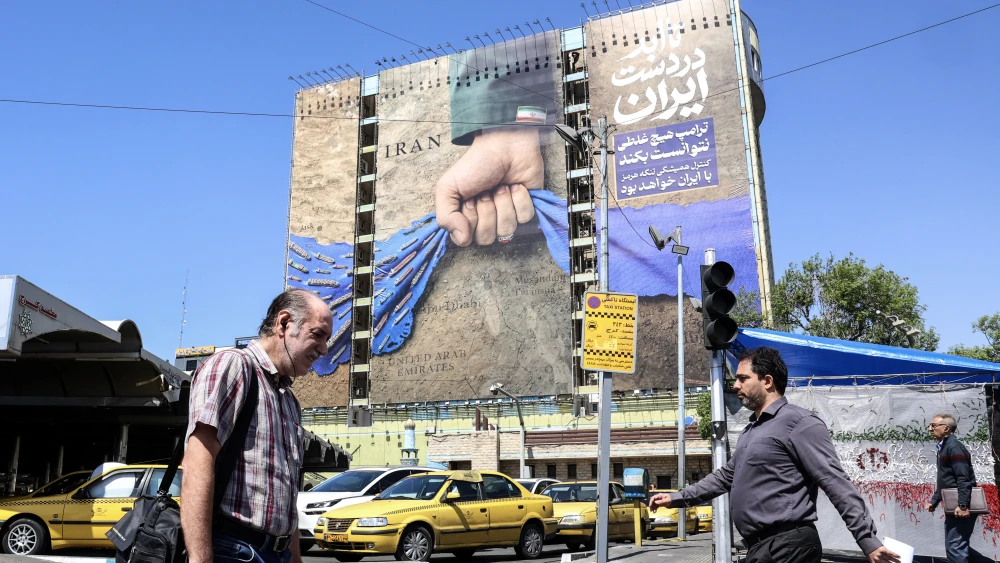
The Islamic Republic refuses to resume talks with the United States so long as the latter continues its blockade of the Strait of Hormuz, senior Iranian leadership said on Sunday.
Iranian President Masoud Pezeshkian told Pakistan’s Prime Minister Shehbaz Sharif in a call that the U.S. “must first remove operational obstacles, including the blockade,” as a condition for “resolving issues.”
The U.S. Navy has redirected 37 vessels since April 13, the day its blockade of Iranian ports went into effect. On Saturday, a U.S. Navy helicopter from the guided-missile destroyer USS Pinckney intercepted the M/V Sevan in the Arabian Sea. The Panama-flagged LPG (liquefied petroleum gas) tanker is among 19 “shadow fleet” vessels sanctioned by the U.S. Department of Treasury, U.S. Central Command said.
Pezeshkian said American maritime restrictions on Iran were a “clear breach of the ceasefire understandings.” Such measures, along with “threatening rhetoric” from the U.S. administration, have increased Iran’s doubts regarding America’s commitment to the diplomatic process, he said, according to Iran’s semi-official Mehr News Agency.
The U.S. put its blockade in place in response to Iran’s own blockade of the Strait of Hormuz. U.S. President Donald Trump explained on April 13: “We can’t let a country extort the world, because that’s what they’re doing.” He said the blockade would bring Tehran to the negotiating table.
Iran said it has no intention of lifting its blockade as long as the American blockade remained in place. On April 22, Iran fired on three ships in the strait. The attacks were carried out by the Islamic Revolutionary Guard Corps, according to Iranian media, AP reported.
On Sunday, Iranian Foreign Minister Abbas Araghchi met with Sultan of Oman Haytham bin Tariq, where he discussed security in the Strait of Hormuz and the stalled talks between the U.S. and Tehran.
Before visiting Oman, Araghchi met with Pakistan’s leadership in Islamabad. However, he departed on Saturday without meeting the U.S. delegation as had been expected.
Shortly afterward, Trump canceled the trip to Pakistan of U.S. envoys Steve Witkoff and Jared Kushner, given Araghchi had already left Pakistan.
In canceling their trip, Trump said that there was confusion within Iran’s top ranks. “Nobody knows who is in charge, including them. ... There is tremendous infighting and confusion within their ‘leadership,’” he posted to Truth Social on Saturday.
Also on Saturday, Trump told media, referring to Iran’s negotiating positions: “They gave us a paper that should have been better and—interestingly—immediately when I canceled it [the talks], within 10 minutes, we got a new paper that was much better.”
On Sunday, after his visit to Oman, Araghchi returned to Islamabad. He is expected to again meet with Pakistan’s top leadership.