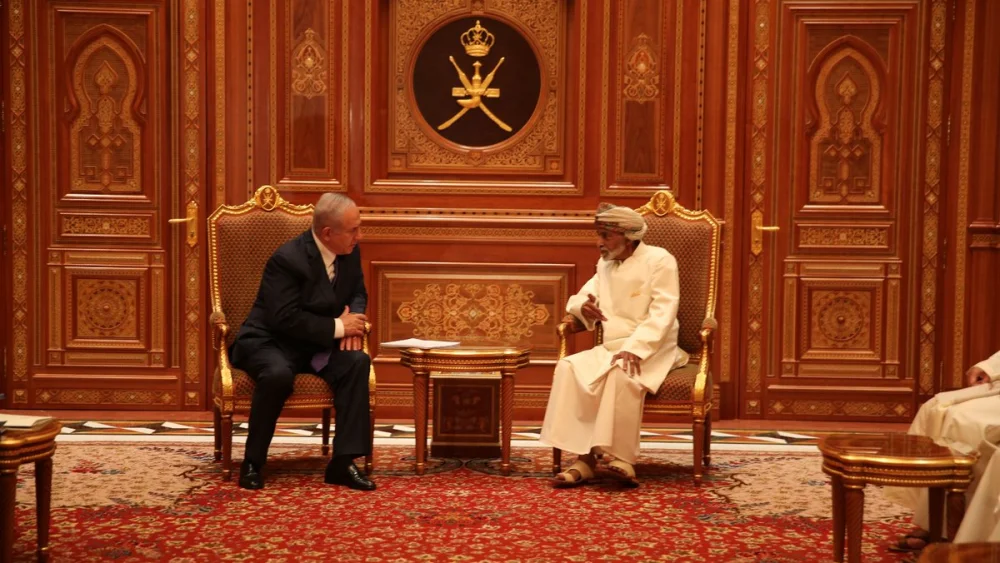
Israeli Prime Minister Benjamin Netanyahu made a secret one-day trip to Oman on Friday, where he met with the ruler, Sultan Qaboos bin Said, who has led his country for nearly 50 years.
It is the first trip made by an Israeli prime minister since Shimon Peres in 1996.
Accompanying Netanyahu and his wife, Sara, were National Security Adviser and National Security Council Director Meir Ben-Shabbat; Mossad director Yossi Cohen; the head of the Prime Minister’s staff, Yoav Horowitz; the director of the Foreign Ministry, Yuval Rotem; and Brig.-Gen. Avi Bluth, the Prime Minister’s Military Secretary.
Among the issues discussed were how to advance the Middle East peace process, along with several matters of common interest, according to the prime minister’s office.
The visit is a crucial step in expanding relationships with the region’s players while “leveraging Israel’s advantages in security, technology and economic matters,” according to Netanyahu’s office.
“We always thought that if we solved the Palestinian problem, it would open up the doors to peace with the broader Arab world. And that’s certainly true, if you could do it,” said Netanyahu.
“But it may mean that equally true and perhaps even truer is that if you open up to the Arab world and you normalize relations with them,” he continued, “it will open the door for an eventual reconciliation and peace with the Palestinians.”
A 14th-generation descendant of the founder of the Al Bu Sa’id dynasty, the sultan came to power in a palace coup in 1970, making him the longest-serving Arab leader to date.