


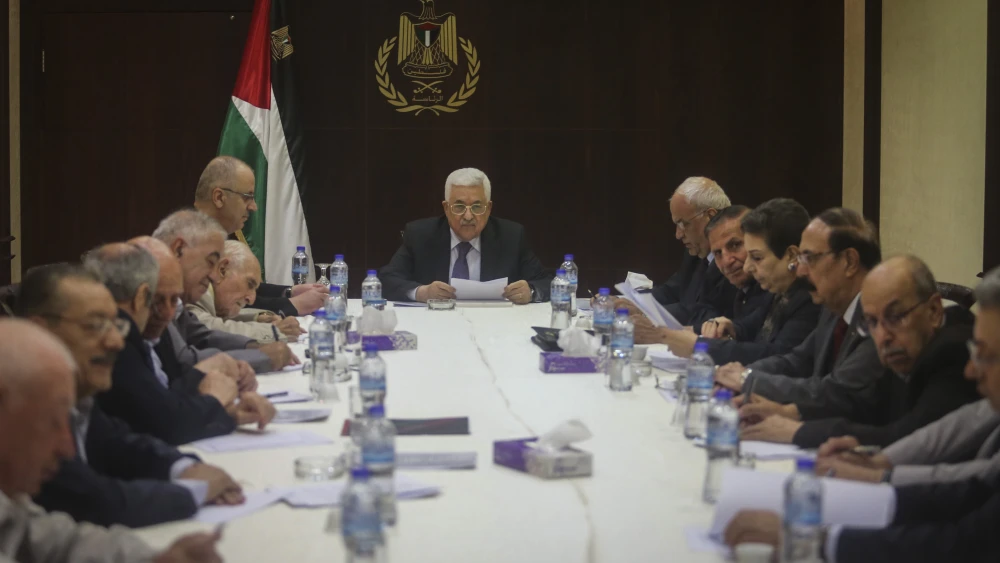
Palestinian Authority leader Mahmoud Abbas announced during a government meeting in Ramallah on Monday that he would refuse to accept any tax revenues collected by Israel as long as Israel deducted payments made to families of security prisoners and “martyrs.”
Now, the European Union will provide 22 million euros in additional humanitarian assistance to the P.A. on top of the 300 million euros it already provides each year. It will also reportedly ask the P.A. to accept the transfer of deducted tax funds from Israel until a solution to the financial crisis can be found.
This comes after Israeli Prime Minister Benjamin Netanyahu and Finance Minister Moshe Kahlon worked to deliver the money to the P.A. in an effort to preempt a possible looming Palestinian economic collapse.
But will the P.A. really continue to prioritize paying terrorist salaries over providing basic government services to its own people?
According to Yossi Kuperwasser, an Israeli intelligence and security expert and director of the Project on Regional Middle East Developments at the Jerusalem Center for Public Affairs, “The P.A. will not collapse. It was their most important achievement. Why would they let it collapse? They know that at any point, if they want, they can return to the status quo and keep taking the money,” he told JNS. “The option is there for them to take the money.”
“The Palestinians are trying to make a point by insisting on receiving all of the money,” he added.
Palestinian Media Watch founder Itamar Marcus, head of legal strategies Maurice Hirsch and analyst Nan Jacques Zilberdik wrote, “If Abbas follows through with his decision and the P.A. refuses to accept this money next month, it will conclusively confirm that Abbas and the P.A. prioritize rewarding terrorists and murderers rather than the best interests of the entire Palestinian population. Instead of accepting that Israel refuses to transfer $11.6 million/month for terror rewards, Abbas prefers to punish the entire Palestinian population by refusing $174.5 million of tax money, which would benefit all Palestinians.”
According to Kuperwasser’s assessment, the Palestinians believe that since Israel is so concerned that the Palestinians will not have enough money, it would rather give them the entire sum even if it means they will be able to pay salaries to terrorists and kill Israelis, “which is, of course, misreading the Israeli position.”
Israel has made clear that it will no longer allow the tax transfers to be used as a source of income for terrorists and their families.
Abbas’s refusal to accept any money whatsoever “just shows that what is important to the Palestinians is paying salaries to terrorists, which clearly paints the P.A. as a terror-sponsoring entity,” Kuperwasser added.
He referred to the recently released publication by the “PLO Committee for Interaction with Israeli Society,” in which the Palestinians reiterate their refusal to recognize the state of the Jewish nation or disavow terrorism. “This means the entire Oslo process was some sort of ploy, some sort of deceit. They never meant to change anything.”
Kuperwasser explained that their violent struggle against Israel as a Jewish state—not just the “occupation”—is misleading because the P.A. already controls the lives of most of the Palestinians in the West Bank.
“This is an effort to get legitimacy to continue paying salaries to terrorists,” he said. “Of course, Israel cannot accept it.”


