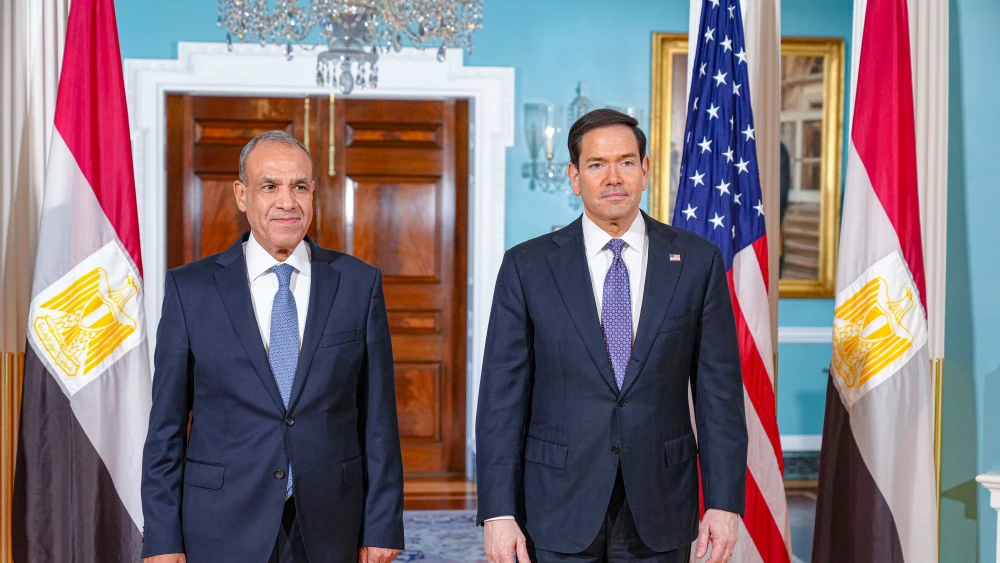
Egyptian Foreign Minister Badr Abdelatty defended his country’s peace agreement with Israel on Tuesday, saying the Camp David Accords continue to serve Cairo’s national interests nearly five decades after they were signed.
“No, not at all,” Abdelatty said when asked whether the accords had been a mistake, in an interview on the Abu Dhabi-based English-language newspaper The National’s “On The Record with Hadley Gamble” program.
The agreement was reached in a “completely different regional and international context,” he said, adding that it served Egypt’s national interests at the time and continues to do so.
“That’s why we are respecting fully our commitment,” he added.
Asked whether the agreement should now be revised, the foreign minister said Israel was respecting its commitments “to some extent.” Regarding the bilateral relationship and the treaty itself, he added: “So far, so good.”
The 1978 Camp David Accords, brokered by U.S. President Jimmy Carter and signed by Israeli Prime Minister Menachem Begin and Egyptian President Anwar Sadat, laid the groundwork for the Israel-Egypt peace treaty signed the following year.
This reporter pushes the Egyptian FM on Camp David, asking if he'd like to renegotiate it. He clamly explains that "of course" Camp David was good for Egypt, continues to serve Egyptian interests, and Cairo and Jerusalem maintain multiple channels to deconflict. A must watch 👇 pic.twitter.com/eMdu0XGuT7
— Mariam Wahba (@themariamwahba) August 25, 2026
Abdelatty warned that any transfer of Palestinians from the Gaza Strip into Egypt’s Sinai Peninsula remained a red line for Cairo.
“We will not allow this to happen,” he said, arguing that such a move would mean “the liquidation of the Palestinian cause.”
Egypt communicates that position to Israel through military, intelligence and political channels, as well as to Washington, he said. Asked whether Cairo could respond militarily, Abdelatty declined to elaborate, saying: “They understand our red lines.”
He criticized Israel over the lack of progress in implementing a U.S.-brokered Gaza peace plan, while saying Hamas and other Palestinian factions had agreed to surrender their heavy and light weapons and allow a Palestinian National Committee to temporarily administer the Strip.
Abdelatty also addressed efforts to end the U.S.-Iran conflict, describing negotiations as being at a “deadlock” and suggesting that key decisions in Tehran were now being handled by the Islamic Revolutionary Guard Corps rather than Iranian diplomats.
He said the Gaza war, disruption in the Strait of Hormuz and attacks by Iranian-backed Houthi terrorists on Red Sea shipping had created a “perfect storm” for Egypt’s economy, costing the country about $11 billion in lost Suez Canal revenue.
Egypt has played a central role in mediation efforts since the Hamas massacre of Oct. 7, 2023. In October 2025, Israeli Prime Minister Benjamin Netanyahu met in Jerusalem with Egyptian intelligence chief Hassan Rashad to discuss advancing U.S. President Donald Trump’s peace plan and strengthening Israel-Egypt relations.
Meanwhile, economic ties between the two countries have expanded. In December, Israel approved its largest-ever natural-gas export agreement, a 112-billion-shekel ($34.9 billion) deal to supply Egypt through 2040. Netanyahu said at the time that the agreement strengthened Israel’s position as a regional energy power and contributed to regional stability.