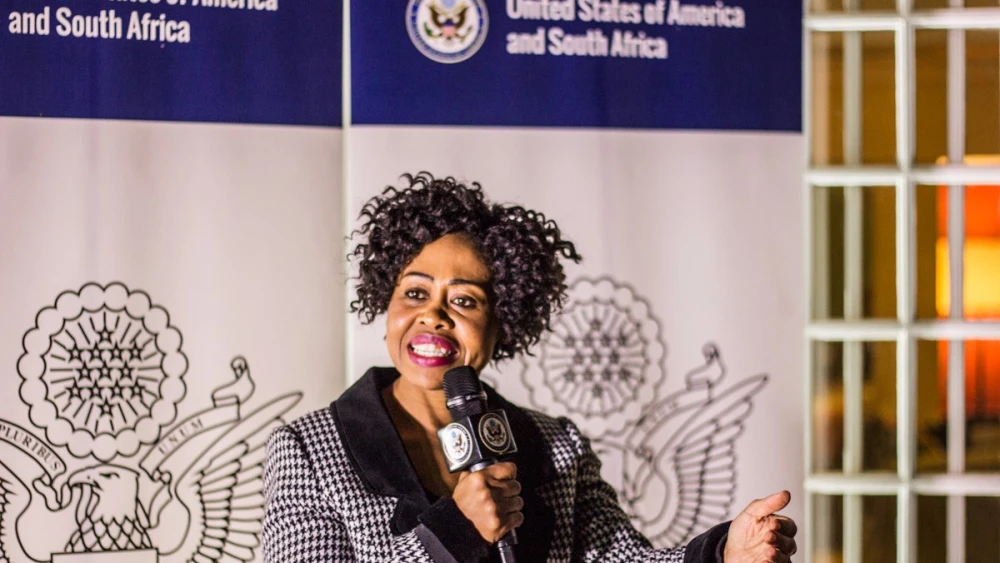

Redi Tlhabi is one of South Africa’s most recognized broadcasters. She presented a daily talk show on Johannesburg’s Radio 702 for more than a decade, won the country’s principal award for nonfiction and now presents UpFront for Al Jazeera English—a network owned by the government of Qatar—from Washington, D.C. As many as 700,000 people follow her on X.
On March 28, an X user replying to Tlhabi offered her advice about her critics, saying she could not debate intellectually with “these indoctrinated genocidal maniacs” who “are God’s ‘chosen people’ who are free to commit genocide, steal, rape, pillage with blessings of the Almighty.” They added, “me thinks they liars [sic].”
Tlhabi reposted the response and added: “I agree with you.”
These four words, posted from Washington, D.C., form the basis of a case against Tlhabi for hate speech, antisemitism and abuse of the First Amendment. They carry legal consequences. Among them should be deportation from the United States.
The International Holocaust Remembrance Alliance (IHRA) provides a series of examples in its working definition of antisemitism. The second example is making stereotypical allegations against Jews. The third is holding Jews collectively responsible for the actions of individuals. The IHRA has gained significant global recognition as a widely accepted reference standard for identifying antisemitism. The United States is a member of the IHRA and adopted the definition in 2016. Tlhabi’s four-word endorsement on March 28 clearly aligns with these IHRA criteria.
Her endorsement was no slip of the tongue. Indeed, this was hardly the first time Tlhabi engaged in such hate.
On Aug. 9, 2025, the chief executive of the Anti-Defamation League expressed concern about rising rates of intermarriage among American Jews. Tlhabi responded, “Sounds like another version of the despicable Hitler’s ‘pure race’ theory, which, as we know, wasn’t just about racial identity. It shaped Nazi Germany’s foreign policy, militarism and the genocidal projects that followed. Special/chosen people ALWAYS consider others inferior & this progresses into war, subjugation, and Lebensraum! Just as we see happening today!”
This clearly constitutes antisemitism under the IHRA definition’s second example by falsely conflating the Jewish understanding of covenant, driven by Jewish concerns about intermarriage and the preservation of Jewish identity, with the racial ideology of the Third Reich.
Tlhabi has engaged in this libel with monotonous regularity: On Nov. 5, 2025, regarding the monitoring of New York’s incoming Mayor Zohran Mamdani for antisemitism, she said, “Nobody should acquiesce to this. ‘God’s chosen people?’ Please!” On Nov. 12, 2025, she said, “Even more ludicrous is the idea that these are good, chosen people, and detractors are the baddies!” On Dec. 12, 2025, commenting on the deterioration in relations between Washington and Pretoria after South Africa brought genocide proceedings against Israel at the International Court of Justice, Tlhabi stated, “South Africa is on the agenda because it dared take on the chosen people.”
The sixth IHRA example concerns the accusation that Jews are more loyal to Israel than to the countries in which they live. Of Warren Goldstein, the chief rabbi of South Africa, Tlhabi has written that his “lens is ONLY Israel and his Jewish identity” and that he is a “divisive, hateful man.”
Goldstein, the religious leader of a small minority community, had voiced a reasonable fear for that community’s safety in a country where Jewish schools and synagogues require guards at their entrances. Moreover, at an Aug. 2 rally in Cape Town, Haroon Orrie, national coordinator of PAGAD—a U.S.-designated terrorist organization—told supporters of Zionism that they had “better find yourself a rock to hide under.”
The second IHRA example also covers allegations about “the power of Jews as a collective,” citing the myth of Jewish control of media, economy and government.
An alien is deportable if the Secretary of State believes their presence would have foreign-policy consequences.
On March 21, Tlhabi wrote, “So can we say the Israeli lobby uses money and power to control the United States and its lawmakers? Or is that antisemitic? Multiple lawmakers, including Bernie Sanders, say so. So, can we say so? I think we must.” On June 4, quoting a claim that Jews “control the whole world” and “manage social media,” she wrote, “I thought this was an antisemitic trope.” In other words, Tlhabi acknowledged that the libel is a lie but asserted it anyway. She knows precisely what she’s doing.
On July 28, over 300 relatives of 9/11 victims requested that Mamdani refrain from attending the 25th anniversary commemoration of the attacks at Ground Zero. Tlhabi’s response was to ask, “What is the race or religion of the over 300 family members making this demand? I want to see something.” She did not write the word “Jew” and did not need to. The innuendo was clear.
The U.S. authorities are alert to the destructive conduct of foreign commentators in the United States. On Sept. 11, 2025, the day after conservative activist Charlie Kirk was assassinated, Deputy Secretary of State Christopher Landau wrote that “foreigners who glorify violence and hatred are not welcome visitors to our country.” He added that he had “directed our consular officials to undertake appropriate action” and invited the public to bring relevant statements to his attention.
The post has been seen 7.8 million times. Within hours, a reply identified Tlhabi as a “South African woman who works in D.C. and is in your country on a visa,” attached screenshots and asserted that there was “no reason this woman should be in the U.S., let alone in D.C.” The Deputy Secretary of State answered with the seal of the United States above two words: EL QUITAVISAS —“the visa remover.”
Landau had good reason, because Tlhabi had slandered Kirk shortly after his murder. To a reader asking where her empathy was, she wrote, “For his wife and children … none for him. He believed gun-related deaths were acceptable and a small price to pay for gun ownerships. His position was that some would be shot and killed, and it’s a small price to pay. I imagine he is proud now. Argue with the wall.” Obviously, Tlhabi’s position was that Kirk’s politics had earned him his death. He deserved to be assassinated.
Five weeks later, the Department of State revoked Nhlamulo Baloyi’s visa. A South African music executive, Baloyi had written that Kirk “won’t be remembered as a hero.” However, no such consequences followed for Tlhabi. Indeed, in July 2026 she moderated a forum in New York headlined by Mamdani, attended commemorations at the United Nations and returned to Washington. She has escaped scrutiny.
But American law is not as protective as Tlhabi’s defenders suppose. The First Amendment restrains the government from punishing her for her speech, but there are limitations on visa-holding foreigners. A visa is a privilege, revocable at the Secretary of State’s discretion. It is not a right.
The U.S. Supreme Court has held for more than half a century that the same rules as American citizens do not govern such foreigners. In Kleindienst v. Mandel, the court considered the exclusion of a Belgian Marxist journalist invited to lecture in the United States and held that when the executive acts “on the basis of a facially legitimate and bona fide reason, the courts will neither look behind the exercise of that discretion nor test it by balancing its justification against the First Amendment interests.”
The statute in question is section 237(a)(4)(C) of the Immigration and Nationality Act. It states that an alien is deportable where the Secretary of State has reasonable grounds to believe that his or her presence or activities would have serious adverse foreign policy consequences.
There is a caveat, however. The foreign national in question cannot be deported for beliefs, statements, or associations that would be lawful within the United States, unless the Secretary of State personally determines that the alien’s presence would compromise a compelling United States foreign-policy interest.
Congress has assigned that discretion to the Secretary of State personally, and the incumbent has announced his stance on the issue. Addressing the Israeli Ministerial Conference on Combating Antisemitism on May 28, 2025, U.S. Secretary of State Marco Rubio said, “We have implemented a vigorous new visa policy that will prevent foreign nationals from coming to the United States to foment hatred against our Jewish community.”
The only remaining question is whether this policy will be applied to a South African broadcaster in Washington who told 700,000 people that she agrees with the claim that Jews are maniacs who steal and rape because they see themselves as a chosen people.
Tlhabi’s position has not changed since 2017, when she wrote in News24, South Africa’s largest news site, that criticizing Israel earns her the label of “antisemite,” and she could live with the title. Asked last month by the South African Jewish Report to answer the charge, she replied: “You DO NOT get to ask ME anything.”
Despite Tlhabi’s arrogant statement, we are entitled to ask whether her strident, unapologetic and clear IHRA violations are consistent with the interests of the United States or within the parameters of tolerable speech by visa holders. They clearly are not. All that remains is for the Secretary of State to take the appropriate action.