Newsletter
Newsletter Support JNS

Israel approves $35 billion natural-gas deal with Egypt

Jerusalem signs its largest-ever gas export deal with Chevron and partners, solidifying its role as a regional energy hub.

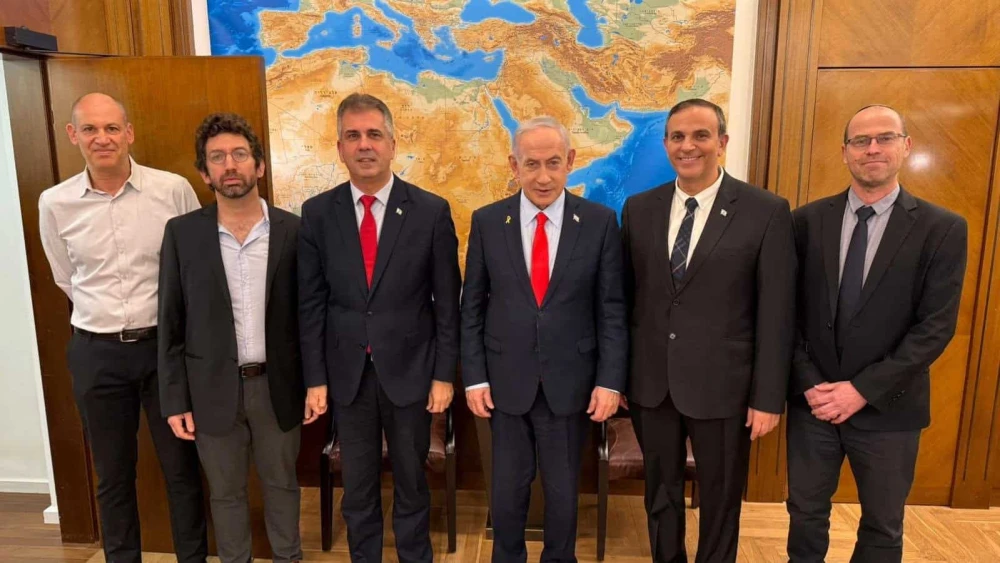
Israeli Prime Minister Benjamin Netanyahu and Energy and Infrastructure Minister Eli Cohen (third from left) announce a record $34 billion natural gas export deal with Egypt in Jerusalem, Dec. 17, 2025. Credit: Prime Minister’s Spokesperson's Office.
Israeli Prime Minister Benjamin Netanyahu and Energy and Infrastructure Minister Eli Cohen (third from left) announce a record $34 billion natural gas export deal with Egypt in Jerusalem, Dec. 17, 2025. Credit: Prime Minister’s Spokesperson’s Office.

Israeli Prime Minister Benjamin Netanyahu announced Wednesday the approval of the country’s largest-ever natural gas export agreement—a deal worth 112 billion shekels ($34.9 billion) that will send fuel to Egypt through 2040.

The agreement with U.S. energy company Chevron and Israeli partners is expected to generate about 58 billion shekels ($17.9 billion) in state revenue through taxes and royalties, with funds designated for education, health, infrastructure and security. The deal also includes more than 16 billion shekels ($4.9 billion) in direct infrastructure investment.

“This deal greatly strengthens Israel’s status as a regional energy power and contributes to stability in our region. It encourages other companies to invest in gas exploration in Israel’s economic waters,” Netanyahu said alongside Energy and Infrastructure Minister Eli Cohen following the approval. “More gas will be found, but first and foremost, this deal obligates the companies to sell gas at a good price to you—the citizens of Israel.”

Revenue will start modestly, at about half a billion shekels ($154 million) annually during the first four years as companies expand pipeline infrastructure, then rise to about 6 billion shekels ($1.9 billion) per year, according to Netanyahu’s office.

Cohen called the agreement a historic moment that establishes Israel as a regional energy power. The approval includes mechanisms to prioritize supply and improve gas pricing for the local market.

“Natural gas is a strategic asset for the state. Prime Minister, you resolutely led the Gas Framework exactly a decade ago, and today we are reaping the fruits,” Cohen said. “We will continue to work toward bringing in additional local and international companies to invest in Israel to increase reserves for the local market and export.”

The Associated Press called the race early for the Jewish Democrat, whom the mayor has backed.
Marc Bloch, who was also a veteran and resistance fighter whom the Nazis tortured and killed in 1944, is now interred alongside Voltaire, Alexandre Dumas, Émile Zola and other national French heroes.
The report is “an embarrassment to the United Nations and a disservice to genuine human rights accountability,” Dina Rovner, of U.N. Watch, told JNS.
Four Republicans joined with nearly every Democrat to direct U.S. President Donald Trump to remove American military forces from the conflict with Iran in a non-binding resolution.
“Despite his statements, it is not Israel, America or the Republican Party that has changed but Carlson himself,” Rabbi Yaakov Menken, executive vice president of the Coalition for Jewish Values, told JNS.
“Antisemitic language does not become acceptable simply because it appears within boycott messaging or political advocacy,” tech nonprofit CyberWell stated.
Benny Gantz, JNS editor-in-chief Jonathan S. Tobin, Gilad Erdan, Mosab Hassan Yousef, Nissim Black and leading voices in security, diplomacy, media, law and Jewish communal affairs headline the summit’s third day in Jerusalem.