


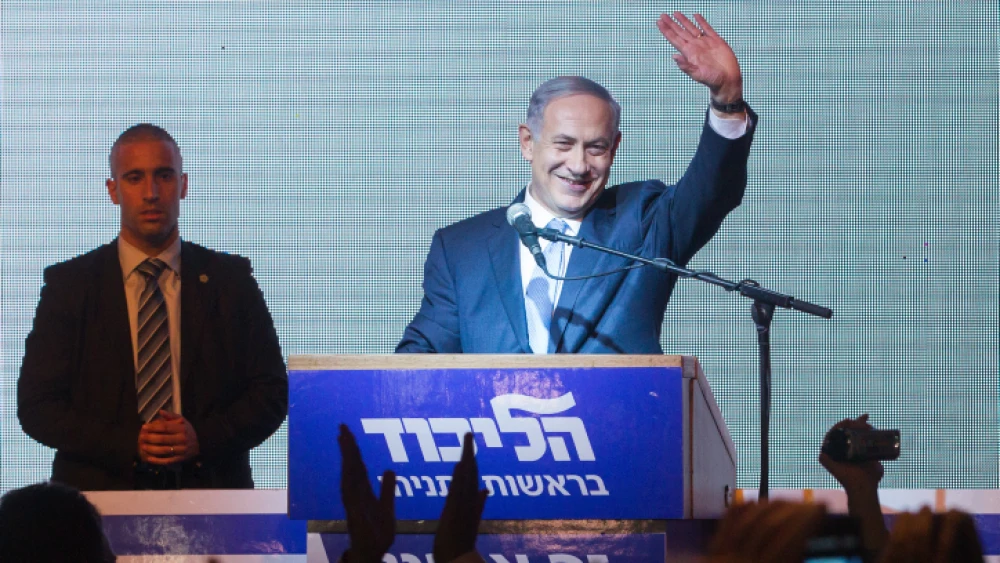
According to poll conducted last week, Netanyahu on easy path to win a fifth term should elections be called, with governing party projected a plurality of 34 seats in Knesset • Zionist Union, currently the second-largest party, drops to only 10 seats.
Despite new developments in ongoing corruption investigations against Prime Minister Benjamin Netanyahu and his colleagues, his political standing is improving. A new poll suggests that in the event of an early election, he would lead his Likud party to victory and stay on as prime minister.
A new poll suggests that if early elections were to be called, Likud is projected to win 34 seats, up from 30 seats in the current Knesset, and would likely be successful in assembling a coalition.
Yesh Atid, led by former Finance Minister Yair Lapid, is projected to become the second-largest party with 24 seats (up from its current 11 seats).
The Zionist Union, currently the second-largest faction in the Knesset, is expected to garner only 10 seats, down from 24.
The poll was commissioned by Israel Hayom and conducted by the Maagar Mochot polling institute last week with 517 respondents comprising a representative sample of Israelis 18 and over. The statistical margin of error is 4.3 percentage points.
According to the poll, the Sephardi ultra-Orthodox party Shas is projected to continue to lose support. The poll predicts that Shas will not win enough votes to cross the electoral threshold. (A party must win at least 3.25% of the valid votes in order to enter the Knesset.) This could explain why Shas leader Aryeh Deri has made every effort to avoid early elections by calling on all parties to resolve the ongoing coalition crisis over ultra-Orthodox service in the military.
The Ashkenazi ultra-Orthodox party United Torah Judaism has been at the center of the coalition crisis, with its leaders threatening to withhold support for the 2019 state budget bill unless the Knesset passes new legislation to cement the de facto military exemptions for haredi yeshiva students. It has refused to back down despite the threat of an early election. According to the poll, it is expected to get eight seats (up from the current six).
The left-wing Meretz party is projected to win seven seats (up from five).
The national religious party Habayit Hayehudi is projected to win 14 seats (up from eight) and the Joint Arab List – a faction made up of predominantly Arab parties – is expected to garner 10 seats.
Kulanu, which is led by Finance Minister Moshe Kahlon, gets six mandates (down from 10), according to the poll, whereas Yisrael Beytenu, led by Defense Minister Avigdor Lieberman, is expected to get five. (It got six seats in 2015, but one of its MKs later formed a new faction.)
The poll shows that Netanyahu would be able to assemble a 67-member coalition in the Knesset that would include the current coalition partners, with the exception of Shas.



